
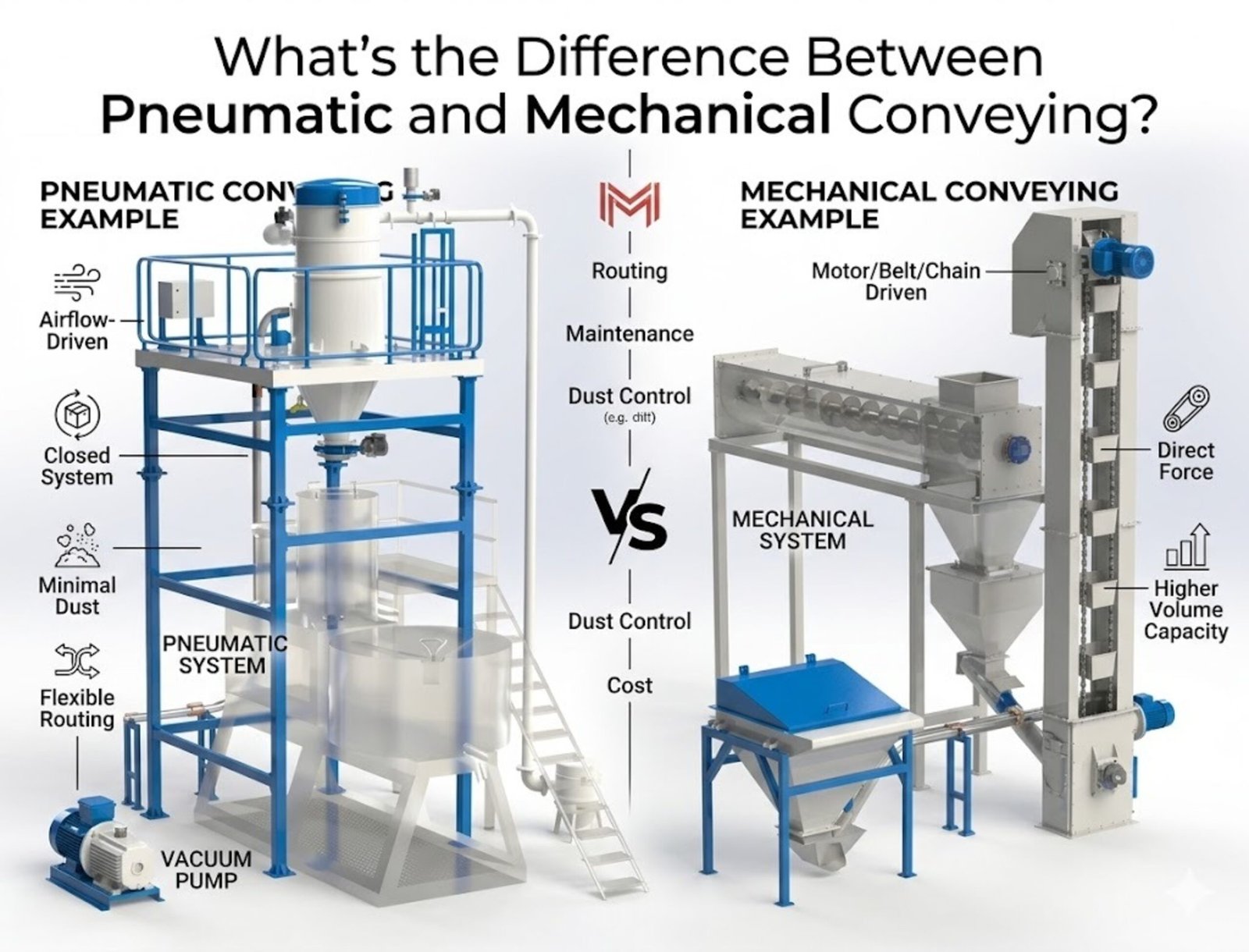
When it comes to bulk material handling, selecting the right type of conveying system is essential for efficient transportation of products. In many cases, companies will ask themselves “Should we use Pneumatic Conveying or Mechanical Conveying?” At Margo Industries we offer innovative solutions for modern industrial applications using Advanced Pneumatic Conveying Solutions.
In this article we will define the differences between both Pneumatic and Mechanical Conveying Solutions while providing practical examples. This will help you decide which system best suits your business requirements.
Understanding Pneumatic Conveying
Pneumatic transport of solids refers to using air or vacuum pressure to move bulk materials through pipe systems. Pneumatic tube systems utilize the airflow to convey bulk powders and light bulk materials from point to point in addition to other methods of carrying bulk materials like belts or screws.
Best Industry Applications for Pneumatic Transport:
Many industries with a high emphasis on cleanliness & efficiency, including food & beverage processing, pharmaceuticals, and chemical manufacturing, rely heavily on pneumatic transport.
Pneumatic transport uses air (gas) to convey bulk material through a pipe system instead of belts or screws. It uses airflow (not mechanical liners) to move bulk materials.
Highlights of Pneumatic Transport Systems:
Use of air or gas as a transportation medium
Complete enclosed pipeline system
Ideal for powder, fine, and lightweight bulk materials
Flexible routing (horizontal or vertical).
Applications for Pneumatic Transport:
Food and beverage processing, pharmaceuticals, chemicals, and cement industries use Pneumatic Conveying Solutions because they are clean and efficient.
Where Pneumatic Transport of Solids Work the Best!
Many industries depend on pneumatic systems for their processes, such as food processing, pharmaceuticals, cement and chemicals, because they require cleanliness and efficiency.
Pneumatic transport of solids is a method of moving material through pipelines using air pressure or a vacuum. Unlike conveyors or screw conveyors, pneumatic transport uses air flow to transport bulk materials from one location to another.
Key Features:
uses air or gas as the conveying medium
uses a fully enclosed piping system
is well suited for powders, fine particles, and lighter weight material
is able to be routed in flexible ways (horizontal + vertical)
Where it Works best:
Pneumatic conveying solutions are an essential component of the food processing, pharmaceutical, cement and chemical industries due to their cleanliness and efficiency.
Mechanical Conveying: Movement of Items Using Equipment
Mechanical Conveying System is the movement of material(s) from one place to another using mechanically driven systems such as:
- Belt conveyors
- Screw conveyors
- Bucket elevators
Each of these systems uses mechanical parts to MOVE material to a FIXED location.
Advantages of Mechanical Conveying:
1- Direct Contact with Material (BULK).
2- Appropriate to haul both HEAVY AND BULKY materials.
3- Simple and MORE ECONOMICAL for SHORT DISTANCES.
4- Greater Maintenance Due to Moving Parts.
Here are some of the most important differences between pneumatic and mechanical conveying methods:
- Working Principle
Pneumatic (vacuum) conveying uses either air pressure or a vacuum to move material.
Mechanically conveying uses mechanical means (e.g., belts and screws) to do so.
- Material Handling
While pneumatic transport of solids is perfect for materials that are lightweight, like powder and the fragile, mechanical systems can handle heavier and larger material.
- Cleanliness & Hygiene
Pneumatic transfer systems are completely enclosed (thus eliminating contamination risks), whereas mechanical systems are more likely to be dusted and leak.
- Flexibility
Pneumatic conveying systems have extremely flexible piping configurations allowing for complex routing of product flow; whereas, mechanical conveyors can only operate along fixed, straight-run, track routes.
- Maintenance
Pneumatic conveying systems tend to have much lower maintenance costs due to fewer moving parts; whereas, mechanical conveying systems require regular servicing.
- Cost Consideration
Initial investment for pneumatic systems is noted to be higher; whereas, mechanical systems offer lower up-front cost but generally incur higher costs in future upkeep as a result of additional maintenance required.
What Should You Decide?
Your application determines what you should use.
Use Pneumatic Conveying Solutions when
– You need a no-dust environment
– You are moving fine powders or other fine products
– You require flexibility of layout for your operations
Use Mechanical Conveying Solutions when
– You are transporting heavy product in bulk
– Your facility has a simple footprint or layout
– You have to be most fiscally responsible with your budget
Margo Industries specializes in providing solutions to your Pneumatic Transport of Solids (PTS) needs by designing cutting-edge systems that offer high levels of efficiency and markedly reduced waste while providing ultimate product quality.
What Makes Us Different?
Custom-built Pneumatic Conveying Solutions – we develop customized materials handling solutions to meet each customer’s unique needs.
Advances in Engineering and Technology – Our team employs the latest technologies and methods to create the highest quality systems.
Reliability, Ease of Maintenance – Our systems are designed for high reliability and ease of maintenance.
Multiple Industries – Our company has a long-standing reputation among many different industries.
Final Thoughts
Both pneumatic and mechanical conveying systems offer benefits to the user. With the ever-increasing push towards automation, cleanliness, and efficiency, Pneumatic Transport of Solids is rapidly becoming the preferred method of material movement in today’s marketplace.
Margo Industries can assist you in selecting and procuring the most reliable and efficient Pneumatic Conveying Solution for your needs.