How to Choose the Right Food Processing Machinery for Your Industry

The Food Industry keeps growing quickly. As more and more people want food and there are more companies selling food, it is increasingly important for every company to think carefully about the kind of equipment they need to buy from a trusted provider like Margo Industries.

Many business owners make the same mistake—they buy their food equipment before fully understanding what their actual needs are. This can lead to lower productivity, higher operating costs, and wasted materials, which Margo Industries helps businesses avoid with expert guidance and customized solutions.

This blog will help you choose the right kind of Equipment that you need in the Food Processing Equipment Industry and help you to get better results from your Food Processing Equipment.

1. Make Sure You Have A Good Understanding Of What You Need

Before choosing any type of equipment, you should have a clear understanding of what you are looking for with guidance from Margo Industries.

What kind of products do you want to make? (Powder, liquid, or granule)
How much product will you be producing?
Will your operation be running manually or automated?

If you do not have clarity, you could make the wrong decision when choosing food processing equipment, and as a result, affect your whole production process. Margo Industries helps you make the right choice with expert support and customized solutions.

 2. Choose the Right Level of Automation

Automation is enabling businesses today to move from a manual mode of production to using computers to manufacture goods. Some examples of businesses using automation processes are:

  • Manual machinery
  •  Automatic food processing machines

Benefits of Automation

  •  Increased speed of production

  •  Reduced reliance on labor

  • Greater accuracy and consistency in products

Companies like Margo Industries provide advanced Food Processing Efficiency Solutions that help businesses streamline operations and boost productivity.

 3. Focus on Material Handling Systems

Efficiently managing your materials is a significant challenge within the food industry.

Typical operations within food processing include:

  • Transferring powder
  • Mixing ingredients
  • Weighing batches

When there isn’t an appropriate system in place, you run the risk of:

  • Losing materials
  • Compromising hygiene

Using systems, such as pneumatic conveying systems, batch weighing, and bulk material handling, is essential to maximize efficiency.

4. Give Priority to Efficiency/Production

You should regularly check all food processing equipment for each of these areas: 

  • Speed at which production takes place 
  • Energy consumed 
  • Maintenance and repairs 

The right equipment will: 

  • Increase production rate. 
  • Lower waste. 
  • Provide cost savings over time. 

5. Don’t Only Look for Lowest Price — Look for Total Value

While a lower purchase price may value itself over time, there are many additional costs you may incur in the future.
Important things to consider: 

Length of time the product can be used (durable). 

How well will it perform; service after sale;  reliability of the manufacturer (Margo Industries).

6. Search for Available Customizable Choices

Various industries have different needs including:

  • Food processing
  • Pharmaceuticals
  • Chemicals

An all-in-one solution doesn’t always fit!

Custom Food Processing Equipment Produces:

  • Increased Equipment Productivity
  • Improved Production Efficiency
  • Continuous Production Flow

7. Verify That Your Equipment Meets Food Preparation and Equipment Safety & Sanitation Standards

Sanitation is very important in food preparation!

Confirm your equipment possesses;

  • Stainless Steel Construction
  • Easy to Clean
  • No Dust-in-the-Air While Operating

These three items will assist you in achieving high quality products as well as complying with Margo industry requirements.

8. Choose the Right Manufacturer:

Selecting the proper manufacturer is equally significant to selecting the appropriate type of machinery. Find a supplier with

  • 1) Industry experience
  • 2) An entire industrial solution presence
  • 3) Ongoing support

Margo Industries is a reputable name in providing advanced automation and Food Processing Efficiency Solutions designed specifically for your company’s requests.

When making an investment in equipment, you need to think about how many different ways to meet your specific needs, how much to produce, and what type of equipment is available to you. You also need to develop a strong working relationship with a trustworthy vendor like Margo Industries, who has expertise in the food processing industry. These three factors are critical to increasing production, decreasing costs, and providing superior quality food products for your customers.

Suggestion: 

If you are looking  into setting up or upgrading a portion of your Food Processing Machinery, you need to consult with an industry insider who has experience in navigating this area in order to successfully implement your project.

Margo Industries has a huge selection of customized Food Processing Equipment, paired with a big line of automation products that will allow you to become more productive and to ensure your long-term growth.

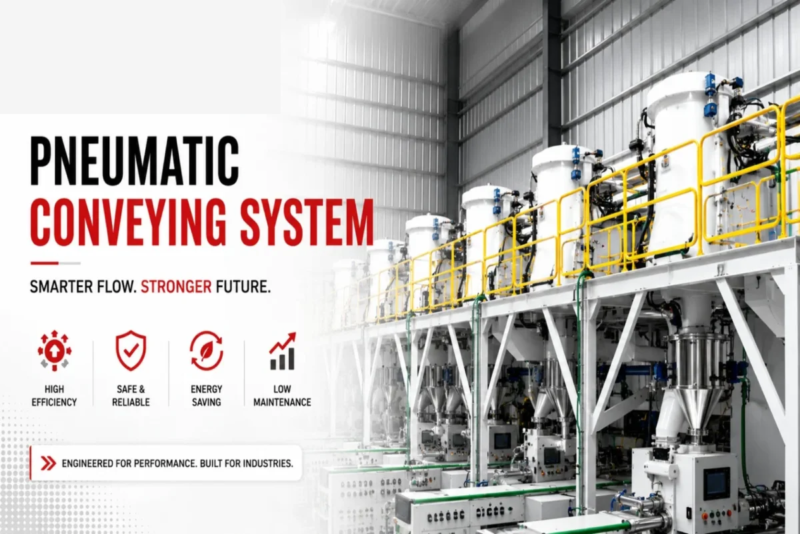
What’s the Difference Between Pneumatic and Mechanical Conveying?

When it comes to bulk material handling, selecting the right type of conveying system is essential for efficient transportation of products. In many cases, companies will ask themselves “Should we use Pneumatic Conveying or Mechanical Conveying?” At Margo Industries we offer innovative solutions for modern industrial applications using Advanced Pneumatic Conveying Solutions.

In this article we will define the differences between both Pneumatic and Mechanical Conveying Solutions while providing practical examples. This will help you decide which system best suits your business requirements.

Understanding Pneumatic Conveying

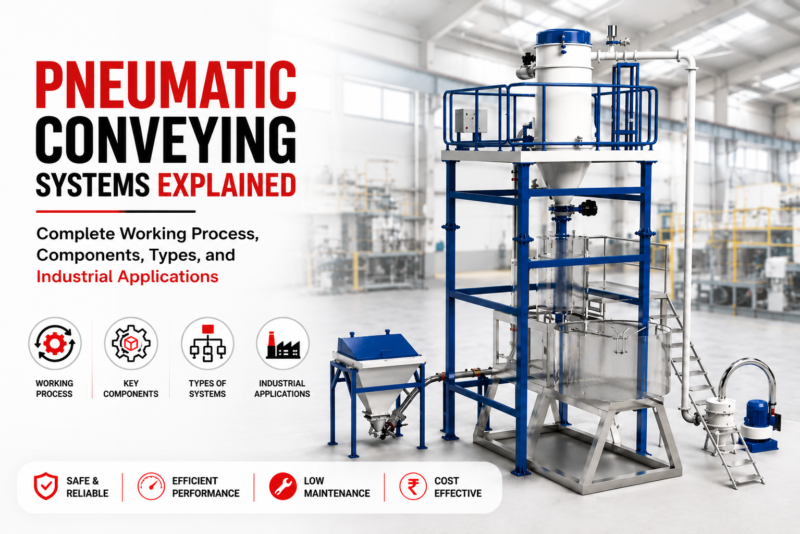
Pneumatic transport of solids refers to using air or vacuum pressure to move bulk materials through pipe systems. Pneumatic tube systems utilize the airflow to convey bulk powders and light bulk materials from point to point in addition to other methods of carrying bulk materials like belts or screws.

Best Industry Applications for Pneumatic Transport:

Many industries with a high emphasis on cleanliness & efficiency, including food & beverage processing, pharmaceuticals, and chemical manufacturing, rely heavily on pneumatic transport.

Pneumatic transport uses air (gas) to convey bulk material through a pipe system instead of belts or screws. It uses airflow (not mechanical liners) to move bulk materials.

Highlights of Pneumatic Transport Systems:

Use of air or gas as a transportation medium

Complete enclosed pipeline system

Ideal for powder, fine, and lightweight bulk materials

Flexible routing (horizontal or vertical).

Applications for Pneumatic Transport:

Food and beverage processing, pharmaceuticals, chemicals, and cement industries use Pneumatic Conveying Solutions because they are clean and efficient.

Where Pneumatic Transport of Solids Work the Best!

Many industries depend on pneumatic systems for their processes, such as food processing, pharmaceuticals, cement and chemicals, because they require cleanliness and efficiency.  

Pneumatic transport of solids is a method of moving material through pipelines using air pressure or a vacuum. Unlike conveyors or screw conveyors, pneumatic transport uses air flow to transport bulk materials from one location to another.  

Key Features:  

uses air or gas as the conveying medium  

uses a fully enclosed piping system  

is well suited for powders, fine particles, and lighter weight material  

is able to be routed in flexible ways (horizontal + vertical)  

Where it Works best: 

Pneumatic conveying solutions are an essential component of the food processing, pharmaceutical, cement and chemical industries due to their cleanliness and efficiency.

Mechanical Conveying: Movement of Items Using Equipment

Mechanical Conveying System is the movement of material(s) from one place to another using mechanically driven systems such as:

  • Belt conveyors
  • Screw conveyors
  • Bucket elevators

Each of these systems uses mechanical parts to MOVE material to a FIXED location.

Advantages of Mechanical Conveying:

1- Direct Contact with Material (BULK).

2- Appropriate to haul both HEAVY AND BULKY materials.

3- Simple and MORE ECONOMICAL for SHORT DISTANCES.

4- Greater Maintenance Due to Moving Parts.

Here are some of the most important differences between pneumatic and mechanical conveying methods:

  1. Working Principle

Pneumatic (vacuum) conveying uses either air pressure or a vacuum to move material.

Mechanically conveying uses mechanical means (e.g., belts and screws) to do so.

  1. Material Handling

While pneumatic transport of solids is perfect for materials that are lightweight, like powder and the fragile, mechanical systems can handle heavier and larger material.

  1. Cleanliness & Hygiene

Pneumatic transfer systems are completely enclosed (thus eliminating contamination risks), whereas mechanical systems are more likely to be dusted and leak.

  1. Flexibility

Pneumatic conveying systems have extremely flexible piping configurations allowing for complex routing of product flow; whereas, mechanical conveyors can only operate along fixed, straight-run, track routes.

  1. Maintenance

Pneumatic conveying systems tend to have much lower maintenance costs due to fewer moving parts; whereas, mechanical conveying systems require regular servicing.

  1. Cost Consideration

Initial investment for pneumatic systems is noted to be higher; whereas, mechanical systems offer lower up-front cost but generally incur higher costs in future upkeep as a result of additional maintenance required.

What Should You Decide?

Your application determines what you should use.

Use Pneumatic Conveying Solutions when

– You need a no-dust environment

– You are moving fine powders or other fine products

– You require flexibility of layout for your operations

Use Mechanical Conveying Solutions when

– You are transporting heavy product in bulk

– Your facility has a simple footprint or layout

– You have to be most fiscally responsible with your budget

Margo Industries specializes in providing solutions to your Pneumatic Transport of Solids (PTS) needs by designing cutting-edge systems that offer high levels of efficiency and markedly reduced waste while providing ultimate product quality.

What Makes Us Different?

Custom-built Pneumatic Conveying  Solutions – we develop customized materials handling solutions to meet each customer’s unique needs.

Advances in Engineering and Technology – Our team employs the latest technologies and methods to create the highest quality systems.

Reliability, Ease of Maintenance – Our systems are designed for high reliability and ease of maintenance.

Multiple Industries – Our company has a long-standing reputation among many different industries.

Final Thoughts

Both pneumatic and mechanical conveying systems offer benefits to the user. With the ever-increasing push towards automation, cleanliness, and efficiency, Pneumatic Transport of Solids is rapidly becoming the preferred method of material movement in today’s marketplace.

Margo Industries can assist you in selecting and procuring the most reliable and efficient Pneumatic Conveying Solution for your needs.

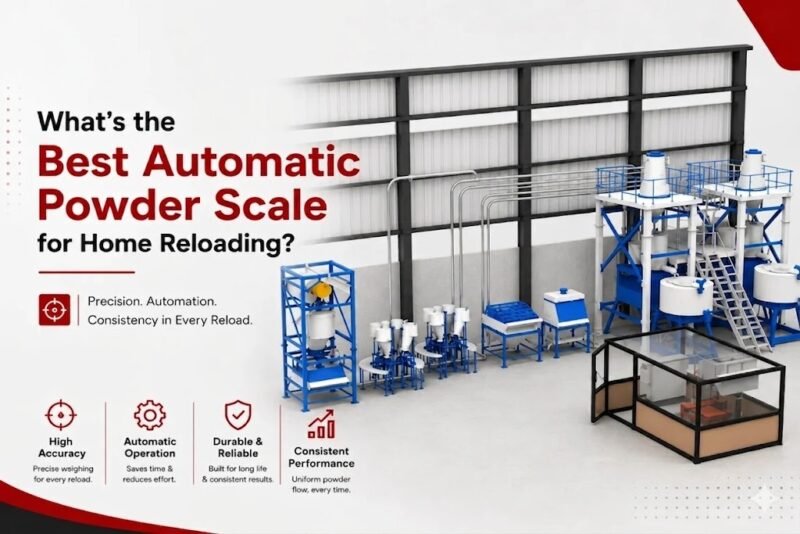
What’s the Best Automatic Powder Scale for Home Reloading?

Reloading your own ammo can be tough, especially if you are not very good at accurately measuring your powder. No matter how great of a powder you use, you are going to need to measure each and every time that you need to reload, if you want to ensure that each of your reloads is using equal amounts of powder. For the majority of individuals, there is no chance of measuring their powder out using manual methods without spending an extraordinary amount of time doing so—and it’s a lot of hard work to do that as well!!

This is one of the primary reasons why more and more people are utilizing automatic powder scales as well as automatic batch weighing systems from Margo Industries for their powder handling requirements. It is the equivalent of having a more efficient means of handling your powder, but also faster, easier, and more reliable than measuring your powder by hand!

Issues with Reloading Solutions

Let us face it; reloading at home is primarily a manual weighing process to produce your finished product. Although you can produce consistent weights of product; the manual process will result in having some negative consequences in relation to measuring the material. However, using an Automatic Batch Weighing System from Margo Industries can help eliminate these common issues and improve overall efficiency.

The negative consequences of measuring materials manually include:

  • Inconsistent weight due to small variances
  • Excessive time to measure your material
  • Repetitive use of your body to measure
  • Increased human error due to the possibility of making a mistake.

If you continually make any  of these small errors for a long period of time it will become a major problem when attempting to reproduce the same result on a regular basis. This is where an Automatic Batch Weighing System by Margo Industries becomes a reliable and efficient solution for consistent and accurate results.

The Intelligent Approach: Automatic Powder Scale + Automatic Batch Weighing System

You enter the target weight into the device and it will automatically display and deliver the precise quantity of powdered product for you – without needing any calculations or further adjustments.

This is how an Automatic Powder Scale plus Automatic Batch Weighing System work together.

Margo Industries has the latest, most reliable equipment and systems to make this entire process of measuring and dispensing powdered product as easy as possible.

How This System Actually Helps You

Using our system not only provides automation benefits, but it will also help you improve your process’s efficiency and accuracy.

– Perfectly Accurate Every Time

You can achieve identical measurements for every batch, with no variation or compromise whatsoever.

– Significantly Reduced Cycle Times

Cycle times for each batch have been dramatically reduced from multiple minutes down to only seconds!

– Less Labor Required

No longer do you need to continuously check and adjust; simply input your desired parameters and let the automated system perform its job.

– Products Are Returned Consistently from Reloads

Every material that is refilled will come back out of the refill process with the exact same measurement.

– Safe Operations

By creating a process that accurately doses your materials by controlling every single factor, you will significantly reduce your risk of making a mistake when working with your material.

Key Features You Should Look For

Individuals considering upgrading their system need to look at the capabilities of new systems, such as an Automatic Batch Weighing System from Margo Industries, in order to determine their compatibility and appropriateness in fulfilling their desired project specifications:

  • High-performance sensors give accurate weight measurements
    • Automated dosing systems minimize manual handling
    • High-speed dispensing will increase productivity
    • Systems with easy to use interfaces will provide a smooth operating experience
    • Systems with strong construction will last for many years

All of Margo Industries manufactured systems, including the Automatic Batch Weighing System, have all of these characteristics which is excellent for both customers now using Margo products and for those considering using Margo products in the future.

Why Margo Industries is a Smart Choice

Selecting proper equipment is very important—Margo Industries has been able to excel in that area through years of experience providing customers with the best solutions within the areas of material handling and weighing systems; these systems will provide the following benefits:

  1. Integrate cutting-edge automation technologies
  2. Provide high-accuracy and repeatability
  3. Meet small and industrial applications (full-scale)
  4. Deliver reliability over time as noted above.

Whether it’s an upgraded home reloading system, or a large commercial operation managing bulk powder, the Margo Industries Automatic Batch Weighing System has been designed and built to provide you with trustworthy results.

Where This System Can Be Used

For home reloading, this is a great option; and this same system is also used extensively in the following areas:

  • The chemical industry
  • Food processing facilities
  • Pharmaceutical production
  • Bulk material handling

This indicates that your investment in this system will provide not only effective results but also an expandable solution.

FAQs

1. What is an Automatic Batch Weighing System?

An Automatic Batch System is an advanced solution that automatically measures and dispenses a precise amount of powder or material, ensuring accuracy and consistency in every batch.

2. Is an automatic powder scale suitable for home reloading?

Yes, it is perfect for home reloading. It reduces manual effort, improves accuracy, and ensures consistent results, making the process safer and more efficient.

3. How does an Automatic Batch Weighing System improve accuracy?

It uses high-precision sensors and automation to eliminate human error, ensuring each measurement is exact and repeatable.

4. Can this system be used in industries other than reloading?

Absolutely. It is widely used in food processing, pharmaceuticals, chemicals, and bulk material handling industries.

5. Why should I choose Margo Industries?

Margo Industries offers reliable, high-quality, and customized weighing solutions backed by years of expertise, ensuring performance, durability, and precision.

Conclusion

By making the switch to an Automatic Powder Scale and Automatic Batch Weighing System by Margo Industries, you can enhance your precision, reduce your labor demands and efficiently reload.

Rather than relying on old-fashioned and unreliable methods, you will have an automated, accurate, and 100% optimized system that will consistently provide you with precision.

If you want to transform your setup for the better process, there are advanced options available! Start today on your journey to achieve faster, safer, and more accurate powder handling! Contact Margo Industries today to determine the best solution for your needs!

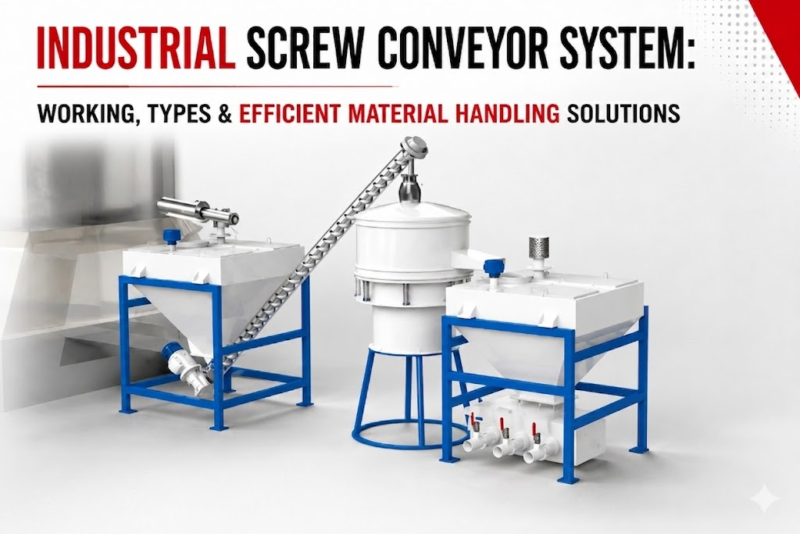
Industrial Screw Conveyor System: Working, Types & Efficient Material Handling Solutions

Efficient Material Handling has become essential for maintaining productivity and reducing operating costs in the rapidly changing production environment of today. Because of their ability to withstand extreme conditions, provide efficient transport of bulk materials, and be useful across various applications, Industrial screw conveyor systems are one of the most commonly used and reliable methods of transportation of bulk materials in modern industries.

Margo Industries understands the significance of efficient material handling; therefore, we have designed our screw conveyor solutions to yield the highest degree of performance, even in the most difficult situations.

What is an Industrial Screw Conveyor System?

An Industrial Screw Conveyor System is a mechanical device designed to transport bulk materials. A rotating spiral screw blade (or flighting) moves bulk material on a continuous basis that moves along an enclosed tube or open trough. This type of conveyor system is typically found in the cement, food processing, chemical, and agricultural industries.

Screw Conveyor Systems are highly effective when transporting powders, granules, and semi-solid materials. They enable users to handle materials quickly and effectively while minimizing spillage.

Working Principle of Screw Conveyor System

A screw conveyor system allows the movement of product through an entire system (from head to tail) by using a rotating screw which turns at different speeds and in various directions based on the amount of time the screw rotates.

As with any piece of industrial machinery, failure can occur from many reasons including operator or maintenance error; therefore, Margo Industries wants to reduce mechanical failure due to the use of faulty components on the assembly and maximise the life of the product it manufactures by only purchasing high-quality components for its Industrial Screw Conveyor Systems so that its products will have high durability and be energy efficient.

Types of Screw Conveyor Systems

There are many different configurations of screw conveyors depending on the specific needs of the material being conveyed. The majority of configurations can be broken down into four categories.

1) Horizontal Screw Conveyors are used for carrying the material short distances, and usually, make straight (linear) paths with the material.

2) Inclined Screw Conveyors are typically used to carry materials to an elevation above their original position, with the ability to retain material flow.

3) Vertical Screw Conveyors perform very well at elevating bulk materials vertically in a small footprint.

4) Shaftles Screw Conveyors are very effective at moving sticky or fibrous materials with a much lower potential to clog.

Here at Margo Industries, we provide systems for Industrial Screw Conveyors based on the needs of our customers.

Benefits of Using Industrial Screw Conveyor System

Picking the Suitable Screw Conveyor System will have a Positive Effect on Your Business. The following are Some of the Major Advantages of Using Screw Conveyors:

Continuous transport of materials with greater efficiency;

Less Maintenance and Operating Costs;

A small and flexible design will fit almost anywhere; 

Able to Handle Different Types of Materials From Different Industries;

Reduces Material Loss and Keeps Dust Under Control.

By Choosing Margo Industries, you are guaranteed to receive a Superior Product That Will be Durable and Reliable.

Applications Across Industries

The Industrial Screw Conveyor System is utilized in a variety of industries including:

-Cement & Concrete

-Food Processing

-Chemicals/Pharmaceuticals

-Agriculture/Grain Handling

-Waste Management Systems

Margo Industries manufactures a Screw Conveyor Machine that is designed to provide reliable, easy operation in a variety of applications.

Why Choose Margo Industries?

Margo Industries is among the top providers of innovative and high-quality material handling solutions focused on meeting their customers’ requirements through:

  1. Custom designed solutions (for every project),
  2. Use of high quality materials for long-lasting performance,
  3. Utilization of advanced engineering and technology during design/build,
  4. Timely support through the entire life of the product, and
  5. Delivery of Industrial Screw Conveyor Systems (ISCS) to the highest industry standards, while exceeding what customers expect.

Conclusion

The modern Industrial Screw Conveyor System is extremely important for efficiently delivering materials. Due to their simple construction, versatility, and low cost; this equipment is used extensively in factories and warehouses alike. For your screw conveyor system that delivers on quality, performance, and value, you can count on the experience of Margo Industries to support your ongoing operations.

Dense Phase Conveying System: Complete Guide to Material Handling, Benefits & Applications

Handling materials efficiently and without dust in the modern industrial setting is critical for productivity and safety. The Dense Phase Conveying System is one of the most developed solutions for handling basic materials across industries with the least amount of damage and the most efficiency. At Margo Industries we provide high-performing solutions for your conveying needs.

What is a Dense Phase Conveying System?

The way in which bulk materials are conveyed through a pneumatic conveying system at low velocities and high pressure is referred to as dense-phase conveying. In contrast to dilute-phase conveying systems, dense-phase systems are able to convey bulk materials through a controlled flow of material with minimal wear and tear on equipment.

Dense-phase bulk material handling is the optimal method for transporting fragile, abrasive, or very heavy bulk materials, as additional attention must be paid to the manner in which bulk materials are conveyed and how those materials are treated during transport.

How Does Dense Phase Material Handling Work?

Heavy bulk material can be transported using pneumatic Dense Phase Material Handling. Pneumatic dense phase transport consists of moving materials in a pneumatic manner through pneumatic tube line networks with the help of a supply of air, pressure vessels, compressors, and control valves. This method allows for the transportation of bulk materials slowly and with less velocity, because all of the motion is supplied by pneumatic pressure in a plug-style fashion throughout a transport system using tubes.

There are six major components required for the operation of a pneumatic dense phase transport system: an air source; a pressure vessel; a compressor; a tube line network that connects different locations; control valves; and a control panel/automated system.

Precision control of the bulk material transfer operations can be accomplished with the use of a pneumatic dense-phase transport system.

Benefits of Dense Phase Conveying System

1) Minimal Material Damage: The fragile materials’ conveyance via a Dense Phase Pneumatic Conveying at low velocities will not damage them as they are being conveyed.2) Dust Free Environment: Due to its closed-loop design, the system will perform flawlessly in a clean environment.

3) Lower Pipeline Erosion: While every material-handling operation will erode the pipeline to some degree, there is significantly less erosion than in any other material handling method.

4) Economic Energy Utilization: The Dense Phase Conveyor operates at high pressures, but because of their superior flow control system, they are more efficient than other material handling methods.

5) Minimal Maintenance Costs: The Dense Phase system will require very little maintenance, because of the limited wear and tear on the equipment, thus extending the life of the system.

Applications of Dense Phase Material Handling

There are lots of application examples of using a Dense Phase Conveyor System to move products in many different industries:

  • Cement
  • Food
  • Pharma
  • Chemical
  • Plastics and polymers

Margo Industries provides design engineers with the tools to design their systems based on the customer’s needs and maximize production throughput.

Why Choose Margo Industries?

Finding a trustworthy partner for every part of your Dense Phase Material Handling operation can be the key ingredient in making sure that your operations are successful. Margo Industries has many services to offer you in relation to your Dense Phase Material Handling needs.

  • Custom Conveyor Solutions
  • Advanced Automation Technology
  • Quality Fabrication
  • Complete Project Execution
  • Strong After Sales Support

You can depend on Margo’s large amount of experience and knowledge of Dense Phase Conveying System product lines to help provide you with operational reliability and consistency as well as an economical operation.

Conclusion

A Dense Phase Conveying System (DPC), is an efficient, reliable, and safe method of moving large quantities of material through several industries. DPC minimizes product wear and tear, increases productivity, reduces the amount of time required for maintenance, making it the preferred method of bulk material movement.

Margo Industries develops comprehensive systems for Dense Phase Bulk Material Handling. The resulting enhancements include increased productivity and improved performance of the finished product.

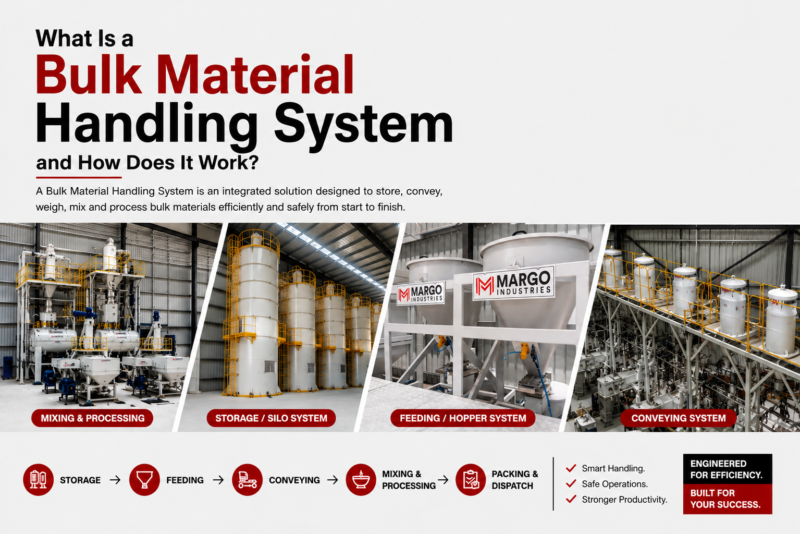
Bulk Material Handling Systems: How It Works, Best Equipment & Smart Solutions

In any industry where there is a high volume of daily material movement, storage, or processing, maintaining efficiency is critical. This is where Bulk Material Handling Systems play a vital role. At Margo Industries, these systems are designed to simplify complex operations by ensuring smooth handling of powders, granules, and heavy industrial materials. With the right setup, including advanced equipment like a bulk bag filler machine, businesses can streamline their workflow and significantly improve overall productivity.

Whether you are in manufacturing, food processing, pharmaceuticals, or chemicals, implementing reliable Bulk Material Handling Systems can reduce manual effort, minimize material wastage, and increase operational speed. Solutions offered by Margo Industries are built to deliver consistent performance while meeting industry-specific requirements.

What Are Bulk Material Handling Systems?

Systems for transporting bulk materials (such as powders, grains, or pellets) have been developed to enable the transport and management of materials in bulk form—helping to move, store, control, and protect them efficiently. With the use of  Bulk bag filler machine, materials can be smoothly transferred from one process to another without disruption. Many companies utilize automated Bulk Material Handling to move materials from one workstation to the next instead of manual handling, ensuring better consistency and efficiency throughout the manufacturing process.

How Bulk Material Handling Systems Work

All variety of bulk material handling systems function similarly; nevertheless, every Bulk bag filler machine  is uniquely designed to accommodate the types of bulk materials for which they were developed and the physical properties of those types of bulk materials. There are five primary functioning parts of a bulk material handling system, including:

  1. Feeding : Bulk materials enter into the bulk material handling system by way of feeding devices, e.g., hoppers, chutes, etc. 

  2. Conveying: Generic conveyance devices, such as; belt conveyors or chain conveyors transport the bulk materials through the bulk material handling system

  3. Processing: During the Bulk bag filler machine travel through the Bulk bag filler machine they may also be processed and/or combined with other bulk materials. 

  4. Storing: Bulk materials would eventually have to be stored in the appropriate devices, i.e., offline – Silo/Bin, or any amount of storage devices, i.e., Silos.  
  5. Discharging: The last portion of the bulk material handling system would, through either a packaging function or through the appropriate manufacturing process, provide the means of discharging the bulk materials. 

Manufacturers who implement automated systems will experience improved accuracy, productivity and/or safety throughout the bulk material handling system.

Best Equipment Used in Bulk Material Handling Systems

Choosing the right equipment to accomplish the required performance for any system is essential. The list below illustrates some commonly used applications for moving and holding material. 

  1. Conveyor Systems: Move material in the most effective manner from one point of production into the next. 
  2. Screw Conveyors: Designed to provide controlled flow for powder and semi-solid material through an industrial conveyor system. 
  3. Pneumatic Conveyors: Move material by utilizing compressed air to push the material through tubing (this type of conveyor is ideal when the goal is to produce a dust-free product). 
  4. Bulk Bag Fillers: provide a method of filling large volumes of material into bulk bags (jumbo bags or FIBCs) to ensure that the following four objectives are met:
  • Accurate filling
  • Minimize material being lost
  • Fa ster packaging times
  1. Silos and Hoppers: Provide safe storage of material until it is either further processed or shipped.

Smart Solutions for Modern Industries

Businesses of today must have more sophisticated operations that are also more efficient than in the past. Advanced bulk material handling systems provide numerous benefits to businesses that utilize them.

Some Benefits of Advanced Bulk Material Handling Systems Are:

− Automated Control System

− Real-time monitoring of system

− Dust-free and environmentally friendly operations

− Custom design options based on bulk material type

− Compatibility/integration with existing production lines

Margo Industries can create a tailored solution to fit your individual industrial requirements by focusing on delivering a seamless workflow and long-lasting performance.

Key Features of Bulk Material Handling Systems

  • High efficiency and speed
  • Durable and low maintenance design
  • Flexible configuration
  • Safe and dust-controlled operations
  • Suitable for different types of materials

Advantages of Bulk Material Handling Systems

A properly designed system provides numerous advantages including:

Increased Productivity – Automation of processes reduces the amount of manual work that needs to be completed and speeds up delivery of services.

Decreased Costs – Reduced labor costs and minimal loss or waste of raw materials.

Enhanced Safety – Reduces the risk of workplace injuries and reduces the exposure to potentially harmful materials in the workplace.

Consistent Quality – Provides the same method of handling and processing products.

Scalable Systems – Systems can be increased or decreased to grow or decrease as the business grows.

Why Choose Margo Industries?

Since 1998, Margo Industries has supplied successful and dependable bulk material handling equipment systems that possess the following features:

  1. Custom-made Solutions to Suit Your Specific Industry
  2. Superior Quality Equipment (e.g., Bulk Bag Fillers)
  3. Extensive Technical Expertise
  4. Solutions Designed for Performance and Long-lasting Durability
  5. Total Support from Design through Installation

Frequently Asked Questions (FAQs)

  1. Industries Where Bulk Materials Handling Systems Are Utilized?

Bulk material handling systems are extensively used in the following industries: food processing, pharmaceuticals, chemical, cement/construction, plastic, and agricultural.

  1. What Purpose Does A Bulk Bag Filling Machine Serve?

A Bulk bag filler machine serves to fill bulk bags in an accurate and efficient manner like there will be little manual handling of bags, and very little spillage.

  1. How Do You Determine which System is Right for Your Application?

When choosing a bulk material handling system you will need to consider your product, production capacity, available space, and degree of automation needed.

  1. Are Bulk Material Handling Systems Customizable?

All bulk material handling systems are capable of being customized to the specific needs of a given application.

  1. What Type of Maintenance is Required for Bulk Material Handling Systems?

Standard maintenance for a Material Handling System includes: routine service inspections, cleaning, and replacement of worn out parts to ensure long-term reliability of the system.

Conclusion

In today’s competitive market place, it is crucial to invest in the correct Bulk Material Handling System as it no longer remains an option, but rather something required for successful operations in today’s business world. Through properly integrating systems such as Bulk bag filler machine, standardizing processes and improved productivity through usage of all available resources is achieved by utilizing the selected collection of equipment to get maximum benefit of these investments.

Margo Industries provides a new level of technology to help businesses operate smoothly and to perform efficiently based on meeting today’s industry standards.

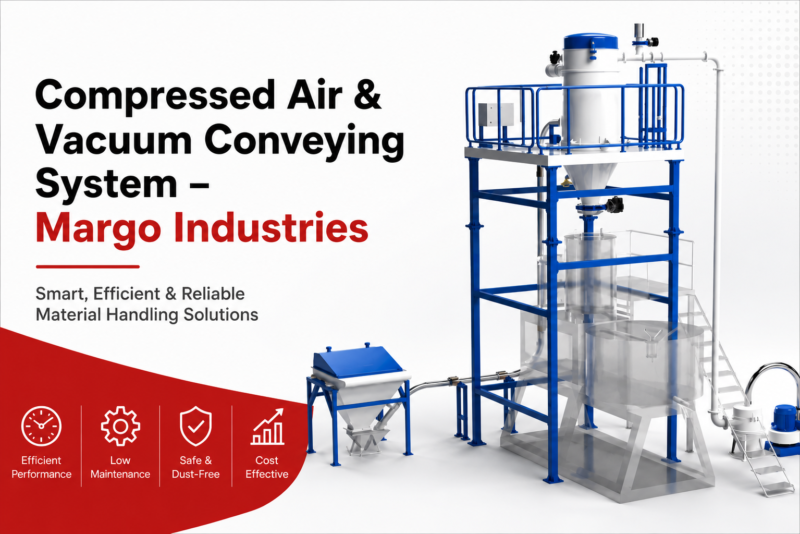
Compressed Air & Vacuum Conveying System- Margo Industries

Compressed Air Conveying System: Working Principle, Benefits & Applications | Margo Industries

The way bulk materials are handled in the manufacturing process is almost as significant as the production process itself. Companies want to convey their bulk powders, granules, or fine powders as quickly, cleanly and reliably as possible, that’s why so many manufacturing companies today are using  compressed air conveying system to convey their products. 

At Margo Industries, we realize that for a company to be successful, they need to be able to handle their products easily; so we created this guide to help our customers understand how compressed air conveying systems work, understand some of the reasons why more and more companies are choosing to use them and to provide them with enough information to help them decide whether they should choose a pneumatic conveying system versus a vacuum conveying system.

What is a Compressed Air Conveying System?

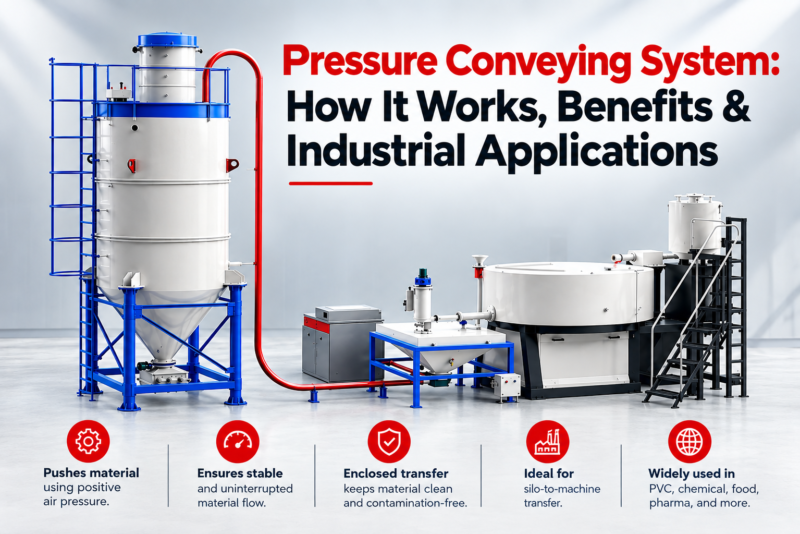
A compressed air conveying system is a method of transporting bulk materials using pressurized air through a pipeline. Instead of manual handling or mechanical conveyors, this system uses air pressure to move materials quickly and safely from one point to another.

It is widely used in industries like:

  • Food processing
  • Pharmaceuticals
  • Chemicals
  • Cement & construction   
  • Packaging industries

How Does a Compressed Air Conveying System Work?

Compressed air systems function on the principle of compressed air moving bulk material. The process is generally consistent and simple but highly effective:and at Margo Industries, these systems are designed to deliver maximum efficiency and reliability:

  1. Air compression: The air is compressed using a special type of equipment called a compressor.
  2. Materials fed into pipelines: Bulk materials are introduced into a pipeline.
  3. Air Conveying: Compressed air moves the bulk materials through the pipelines.
  4. Air and materials separated: At the receiving end, air and materials are separated by using filters or cyclones.

The entire process provides a continuous reliable flow of material with very little waste..

What is a Vacuum Conveying System?

A pneumatic conveying system uses blowers or compressors to move air into a chamber containing material. Engineered by Margo Industries. The material is fed through a tube, and vacuum pressure creates suction that pulls it into the system. Vacuum conveying systems are used where:

  • The material will be moved only short distances,
  • There is a desire to handle the material without dust,
  • The material is very delicate and/or light, and
  • The product to be conveyed will not lose its shape.

Both pneumatic conveyors and vacuum conveyors have their advantages; Margo Industries helps you choose right. and their disadvantages; when deciding which system is best for your operation, you will need to evaluate each application individually.

Compressed Air Conveying System vs Vacuum Conveying System       

Feature Compressed Gas Transport System (Helium) Vacuum Transfer System
Operation Push (Positive Air Pressure) Pull (Negative Air Pressure)
Distance Covered by System Long Distances Short Distances
Capacity of System High Capacity System Medium Capacity System
Installation Complexity Complicated to Install Easy to Install
Application of System Heavy Duty Industries Clean and Controlled Environment

Why Choose a Compressed Air Conveying System?

Modern-day  industries are looking for a compressed air conveying system, which can help them meet several obstacles at one time: 

  • Reduce manual labour 
  • Improve performance and speed 
  • Minimise material loss 
  • Clean and dust-free operation
  • Used for transporting materials over longer distances

Margo Industries has designed its systems to meet the durability and efficiency needs required for continuous industrial use.

Key Benefits of Compressed Air Conveying System

1) Higher Speed

The conventional methods of transporting materials on conveyor belts and in buckets are slower than pipeline systems.

2) Free of Contamination

Closed pipe systems will greatly reduce the amount of contamination that can enter and will leave you with a completely clean work area after the product has been moved through the pipeline system.

3) Lower Costs for Maintenance

The fewer moving components that pipeline systems have compared to traditional methods will reduce the number of people that will need to maintain them.

4) Versatility in Installation

The use of a pipeline system allows for installation throughout the facility, allowing for the flexibility to design the lighting and mechanical systems in your facility without any possibility of hindering the installation of the pipeline system.

5) Increased Safety and Reliability 

The reduction of the human being as a contact point for material handling will allow for increased safety and reliability in the handling of the products being transported through the pipeline system, thereby providing you with an efficient way to ship your produced goods.

Applications of Compressed Air Conveying System

Many companies utilize this piece of equipment for many different reasons. 

  • Companies include food companies (for grains and sugars),
  •  pharmaceutical businesses (correctly moving materials), 
  • chemical companies (moving hazardous materials)
  •  and packaging (moving products from bulk).

How to Choose the Right System for Your Industry?

When choosing between an air system or a vacuum convey system to products, you should consider the following: 

(1) how far the products will be conveyed, 

(2) whether the products are solids or powders, 

(3) how much will be conveyed (determining if it is a high volume application), 

(4) how clean the products must be after being conveyed, and 

(5) how much each system will cost/what are the installation space requirements for each system. 

If large quantities of products need to be conveyed at long distances, then a compressed air conveying system is best; if small amounts of products need to be moved at short distances with little to no dust formation or contamination caused by conveying products to other locations, then a vacuum system is best.

Frequently Asked Questions (FAQ)

  1. What materials can be transported through an Air Conveying System?

 Compressed  Air Conveying Systems are capable of transporting a wide variety of different materials including: powders, granules, cement, pharmaceuticals, foodstuff, and chemicals.

  1. Is a compressed air delivery system preferable to a vacuum delivery system?

This answer will depend on your required application.Compressed  Air Conveying Systems are often more efficient for transporting long distances and/or large volumes of materials.

  1. Is air conveying safe for the food and pharmaceutical industries?

Yes.  conveying Air Conveying Systems are designed to be sanitary and eliminate the risk of contamination to the transported products.

  1. Is there maintenance required for Air Conveying Systems?

There is little maintenance required for  conveying Air Conveying Systems due to the fact that they consist of a minimal number of mechanical components.

  1. Can an Air Conveying System be custom built?

Absolutely. Margo Industries will fabricate an Ordinaria Conveying System to fit your specific industrial application.

Conclusion

A compressed air conveying system is a highly effective method for modern industry to increase its efficiency and speed of transporting products. They provide high speeds of processing, minimal maintenance and downtime, and eliminate dust, making them an ideal conveyor in all industries.

The selection of the type of system and application that will work best for your business will depend on the particular needs of your business and the quantity of other work you need to do.

If you are planning to upgrade your materials handling conveying system, then buying quality systems from Margo Industries would be a valuable investment because these systems will help you achieve higher levels of productivity, decrease potential risk of accidents, and save you money in the long run.

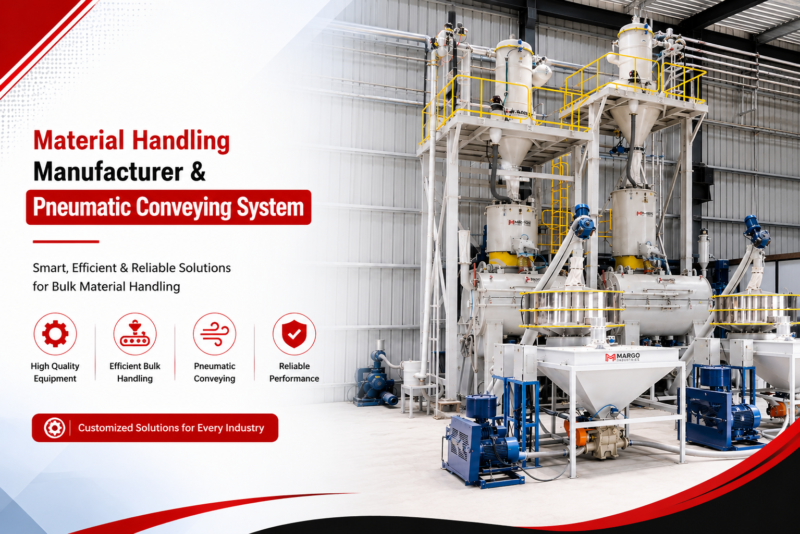
Material Handling Manufacturer & Pneumatic Conveying System

Material Handling Conveyor System Manufacturers, Suppliers & Exporters in Ahmedabad | Margo Industries

Being able to transport materials effectively from one part of the manufacturing process to another is what makes a manufacturing plant successful. Over an extended period, Margo Industries has provided reliable automation solutions for material handling and has provided clients around the globe with fellow-tailored, dependable solutions to their own material handling conveyor system manufacturers’ needs, allowing for an increased ability to produce and operate efficiently.

Margo Industries has many years of combined experience and knowledge within the marketplace, providing a full range of industrial pneumatic conveying systems and automation solutions for material handling, as well as a full suite of turnkey automation systems for all aspects of automated material handling, including providing manufacturers with smart/adjustable automation systems for conveying.

Introduction to Material Handling & Automation Solutions

Automated material-handling systems transport raw materials and intermediate and finished products. This is a service that many operate by automated material-handling systems due to the increase of technologically advanced conveyor systems, pneumatic conveying systems, reduction of manual-handling product processes, and increased consistency in the handling of either raw product or finished goods.

A professionally engineered material-handling system will allow for smooth movement of product while reducing non-productive machines’ downtime and providing better process control during all phases of the production process.

Margo Industries—A Trusted Material Handling System Manufacturer

Margo Industries claims to be a leading provider of material handling equipment with over 50 years’ experience in providing individualized, customized, and automated systems solutions. Due to our engineering expertise, the quality of our material handling system manufacturer’s process, and our “customer first” approach, we have been a preferred supplier for material handling systems throughout India and beyond.

We are experienced in designing our systems to meet the material characteristics, the plant layout of the facility, and the industry standards for the various products that we handle.

Industrial Pneumatic Conveying Systems for Modern Industries

The need for a clean and sanitary way to transfer materials has prompted companies within the industry to create industrial pneumatic conveying systems. Engineers at Margo Industries utilize both vacuum- and pressure-based pneumatic systems to move powder, granule, and bulk material. 

Below you will find benefits of our pneumatic conveying system:

1) Products are transferred in a contaminant-free and hygienic manner.

2) Minimal loss of product during transit.

3) Worker safety.

4) Efficiently conveying difficult-to-convey products.

Many industries use pneumatic systems for conveying material, such as pharmaceuticals, chemicals, food, and plastics.

Technical Specifications of Material Handling Conveyor Systems

As a trusted material handling conveyor system manufacturer, supplier, and exporter in Ahmedabad, Margo Industries offers detailed technical specifications to help clients understand system capabilities. These specifications may vary based on application and customization requirements.

Specifications Details
Conveyor Types Belt Conveyor, Pneumatic Conveyor, Bucket Elevator, Slat Conveyor
Key Components Belt, Rollers, Motor, Side Frames, Control & Drive System
Orientation Horizontal & Vertical
Handling Capacity 50 kg/feet, up to 1 ton/hour (Bucket Elevator)
Conveyor Width 10 to 20 inches
Conveyor Height Up to 10 to 20 feet
Power Source Electric
Operating Voltage 415 V
Conveyor Speed Up to 60 m/min (Customizable)
Load Capacity Up to 200 kg
Automation Grade Automatic/Semi-Automatic
Material of Construction Mild Steel (MS)
Length Customized as per system design
Applications Industrial Manufacturing, Packaging & Automation Lines

Automation Material Handling Solutions for Higher Productivity

Automation is no longer optional—it is a necessity. Margo Industries provides automation material handling solutions that help industries achieve consistent output and reduced human dependency.

Our automation solutions include:

  •         PLC & SCADA-based control systems
  •         Sensor-based material flow monitoring
  •         Seamless integration with existing machinery
  •         Energy-efficient and scalable designs

Automation improves accuracy, minimizes errors, and enhances overall plant performance.

Turnkey Automation in Conveying – End-to-End Expertise

Turnkey is one of the fundamental strengths of Margo Industries in turnkey automation conveying automation. From concept/design through installation/commissioning, we handle the full project lifecycle for you and your facility.

Turnkey services Margo’s offers include: 

* System design/engineer

* Manufacturing/quality inspection

* Installation and commissioning

* Training and support after

By providing turnkey solutions, Margo allows you to execute your projects with minimal hassle, as all aspects are handled by one source from conception to completion.

Industries Served by Margo Industries

As an established and experienced conveyor system fabricator and exporter from the city of Ahmedabad, we are able to provide customized conveyor systems to the following types of industry: 

  •         Pharmaceuticals

  •         Chemicals/Fertilizers
  •         Food/Beverage

  •         Plastics/Polymers

  •         FMCG/Packaging

  •         Cement/minerals

  •         Engineering/Manufacturing

We are dedicated to customizing all of our solutions to accommodate the standard processes of each industry within their specific area of operation.

Why Choose Us—Margo Industries (Call to Action)

The partner that you select will enhance your business through its positive attributes.

Margo Industries—Manufacturer Benefits

  • Established Manufacturer of Material Handling Systems
  • Preferred Manufacturer of Pneumatic Conveying Systems
  • Custom Automated Systems for Material Handling
  • Integrated, Complete Automation of Material Handling Systems
  • High-Quality Materials & Parts Used to Fabricate Material Handling Products
  • Outstanding Service After the Sale and Superior Technical Support.

If you wish to partner with Margo Industries for material handling & automation, please contact us today!

Benefits of Choosing an Experienced Material Handling Partner

Partnering with Margo Industries (a reliable manufacturer) can provide….

  1. Higher productivity 
  2. Lower Operational and Maintenance Costs 
  3. Safer, Cleaner Facilities 
  4. More Reliable Systems Over Time 
  5. Ability to Scale Up for Future Growth

Frequently Asked Questions (FAQs)

1. What does a material handling system manufacturer do?

A material handling system manufacturer designs and supplies systems that move, store, and control materials efficiently within industrial plants.

2. What are industrial pneumatic conveying systems used for?

They are used for dust-free and hygienic transfer of powders, granules, and bulk materials in industries like pharma, food, and chemicals.

3. Does Margo Industries provide automation solutions?

Yes, Margo Industries offers complete automation material handling solutions with PLC and control systems.

4. What is turnkey automation in conveying?

Turnkey automation means complete responsibility—from design and manufacturing to installation and commissioning—handled by one supplier.

5. Does Margo Industries serve clients outside Ahmedabad?

Yes, Margo Industries supplies and exports material handling systems across India and international markets.

Conclusion

As a leading material handling conveyor system manufacturer, supplier, and exporter in Ahmedabad, Margo Industries delivers advanced, reliable, and automation-ready solutions. With strong capabilities in industrial pneumatic conveying systems, automation material handling solutions, and turnkey automation in conveying, we help industries optimize material flow and achieve operational excellence.

Partner with Margo Industries for smart, efficient, and future-ready material handling solutions.