
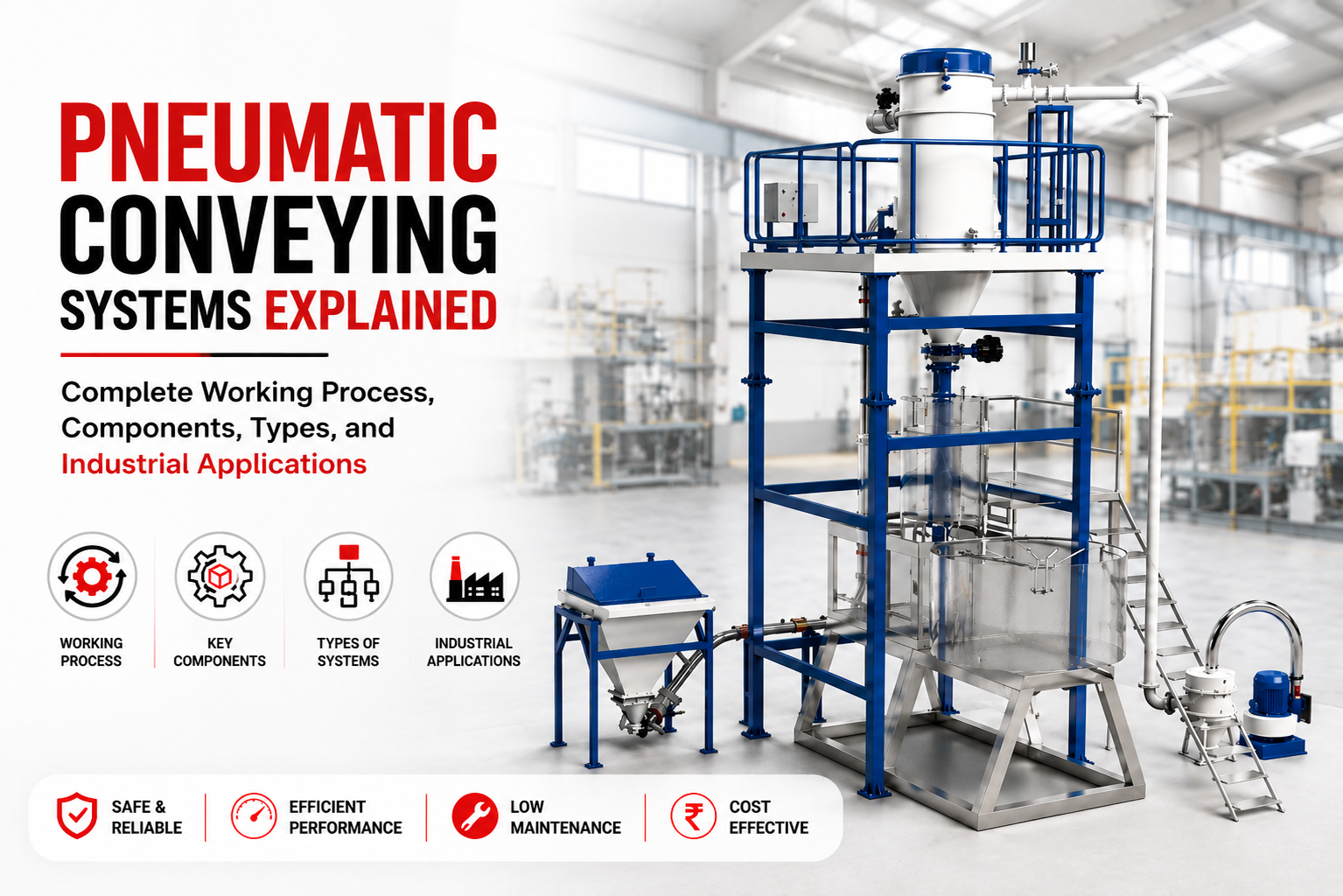
In industries that handle powders, granules, pellets, and bulk materials, efficient material transfer is critical for productivity and product quality. Traditional conveying methods can create dust, material loss, contamination, and higher maintenance costs. This is why many manufacturers are switching to Pneumatic Conveying Systems.
A pneumatic conveying system uses air pressure or vacuum to move dry bulk materials through enclosed pipelines. This method provides clean, safe, and efficient material handling while reducing manual labor and improving plant automation.
From PVC compounds and plastic processing to food, chemicals, pharmaceuticals, and minerals, pneumatic conveying systems have become an essential part of modern manufacturing. In this guide, we will explain how pneumatic conveying systems work, their types, benefits, applications, and how to choose the right solution for your industry.
What is a Pneumatic Conveying System?
A Pneumatic Conveying System is a material handling system that transports powders, granules, pellets, and other dry bulk materials through pipelines using airflow.
Instead of using belts, buckets, or manual handling, materials are transferred inside a closed pipeline. This helps prevent dust generation, contamination, and material wastage.
Common Materials Handled
- PVC Resin
- PVC Compound
- Calcium Carbonate
- Cement
- Fly Ash
- Flour
- Sugar
- Starch
- Plastic Granules
- Carbon Black
- Silica Powder
- Pigments
- Chemical Powders
Why Industries Use Pneumatic Conveying Systems
Industries prefer Pneumatic Conveying Solution because it offers several operational advantages:
- Dust-free material transfer
- Reduced manpower requirement
- Improved workplace safety
- Better product quality
- Minimal material loss
- Easy plant automation
- Flexible installation layout
- Lower maintenance requirements
For industries handling fine powders or sensitive materials, pneumatic conveying provides a cleaner and more reliable solution compared to conventional conveying systems.
Working Principle of a Pneumatic Conveying System
The basic principle is simple. Airflow generated by a blower, compressor, or vacuum pump moves material through a closed pipeline from one location to another.
Step-by-Step Workflow
Step 1: Material Feeding
Material is stored in a hopper, silo, bag dumping station, or big bag unloading system.
Step 2: Controlled Material Entry
A rotary airlock valve or feeder regulates the material entering the conveying line.
Step 3: Air Generation
A blower, compressor, or vacuum pump creates airflow inside the pipeline.
Step 4: Material Conveying
The airflow carries the material through the pipeline to the destination.
Step 5: Material Separation
Cyclone separators or filter receivers separate material from the conveying air.
Step 6: Final Discharge
The material is discharged into mixers, storage bins, silos, packaging machines, or process equipment.
This entire process can be automated using PLC-based control systems, reducing operator involvement and improving efficiency.
Main Components of a Pneumatic Conveying System
Hopper
Stores material before conveying begins.
Rotary Airlock Valve
Controls material feeding while maintaining air pressure.
Roots Blower / Air Compressor
Generates airflow required for material transfer.
Vacuum Pump
Used in vacuum conveying systems to create suction.
Conveying Pipeline
Transfers material from source to destination.
Cyclone Separator
Separates conveyed material from airflow.
Dust Collector
Captures fine dust particles and keeps the environment clean.
PLC Control Panel
Controls and monitors the complete system automatically.
Types of Pneumatic Conveying Systems
1. Pressure Pneumatic Conveying System
A pressure conveying system uses positive air pressure to push material through the pipeline.
How It Works
Compressed air generated by a blower pushes material from the feeding point to the receiving point.
Best Applications
- PVC Compound Plants
- Plastic Processing Industries
- Chemical Industries
- Mineral Processing Plants
- Long-distance conveying
Advantages
- High conveying capacity
- Suitable for long distances
- Continuous operation
- Easy automation
2. Vacuum Pneumatic Conveying System
A vacuum conveying system uses negative pressure to pull material through the pipeline.
How It Works
A vacuum pump creates suction that draws material toward the receiver.
Best Applications
- Food Industry
- Pharmaceutical Industry
- Chemical Processing
- Dust-sensitive materials
Advantages
- Excellent cleanliness
- Reduced contamination risk
- Multiple pickup points
- Safer material handling
Dense Phase vs Dilute Phase Conveying
Many people think these are system types, but they are actually conveying methods.
Dilute Phase (Lean Phase) Conveying
In Lean phase conveying, material remains suspended in high-velocity airflow.
Best For
- Plastic Pellets
- PVC Resin
- Sugar
- Flour
- Light Powders
Benefits
- High conveying speed
- Lower installation cost
- Continuous operation
Dense Phase Conveying
In dense phase conveying, material moves at lower velocity and higher pressure in compact slugs.
Best For
- Cement
- Fly Ash
- Carbon Black
- Silica
- Abrasive Materials
Benefits
- Reduced product damage
- Lower pipeline wear
- Less dust generation
Dense Phase vs Dilute Phase Comparison
| Feature | Dense Phase | Dilute Phase |
| Velocity | Low | High |
| Pressure | High | Moderate |
| Product Damage | Very Low | Moderate |
| Pipeline Wear | Low | Higher |
| Best For | Heavy Materials | Light Materials |
| Initial Cost | Higher | Lower |
Industrial Applications of Pneumatic Conveying Systems
Pneumatic conveying systems are widely used across industries:
Plastic Industry
For conveying PVC resin, PVC compound, additives, and masterbatch.
Chemical Industry
For powders, pigments, minerals, and chemical ingredients.
Food Industry
For flour, sugar, starch, spices, and food powders.
Pharmaceutical Industry
For clean and contamination-free powder transfer.
Cement Industry
For cement, fly ash, and mineral powders.
Battery Industry
For lithium-based powders and specialty materials.
Mineral Processing
For calcium carbonate, silica, and industrial minerals.
Key Benefits of Pneumatic Conveying Systems
Cleaner Operation
Closed pipelines minimize dust and improve workplace hygiene.
Better Product Quality
The enclosed system reduces contamination risk.
Improved Safety
Less manual handling reduces workplace accidents.
Flexible Plant Layout
Pipelines can run horizontally and vertically, making installation easier.
Increased Productivity
Continuous material transfer improves production efficiency.
Automation Friendly
Easy integration with PLC and Industry 4.0 systems.
Lower Material Loss
Materials remain enclosed throughout the process.
How to Choose the Right Pneumatic Conveying System
Choosing the right system depends on:
- Material characteristics
- Bulk density
- Particle size
- Conveying distance
- Production capacity
- Available installation space
- Product sensitivity
For example:
- Light materials → Dilute Phase Conveying
- Heavy materials → Dense Phase Conveying
- Hygienic applications → Vacuum Conveying
- Long-distance conveying → Pressure Conveying
A proper system design ensures higher efficiency and lower operating costs.
Why Choose Margo Industries?
At Margo Industries, we specialize in designing and manufacturing customized Pneumatic Conveying Systems for various industrial applications.
Our solutions are designed to provide:
- High conveying efficiency
- Reliable performance
- Dust-free operation
- Energy-efficient design
- Low maintenance requirements
- Custom-built solutions
- Complete automation support
Whether you need a pressure conveying system, vacuum conveying system, dense phase conveying, or dilute phase conveying solution, Margo Industries can provide a system tailored to your production requirements.
Frequently Asked Questions (FAQs)
1. What is a Pneumatic Conveying System?
A pneumatic conveying system transports dry bulk materials through pipelines using air pressure or vacuum.
2. What materials can be conveyed pneumatically?
PVC resin, PVC compound, cement, fly ash, flour, sugar, starch, carbon black, silica, pigments, and chemical powders.
3. What is the difference between pressure and vacuum conveying?
Pressure conveying pushes material using compressed air, while vacuum conveying pulls material using suction.
4. What is Dilute Phase Conveying?
Dilute phase conveying moves material suspended in high-velocity airflow.
5. What is Dense Phase Conveying?
Dense phase conveying moves material at lower velocity and higher pressure, reducing product damage.
6. Which industries use pneumatic conveying systems?
Plastic, food, pharmaceutical, chemical, cement, mineral, and battery industries.
7. What are the main benefits of pneumatic conveying?
Dust-free transfer, improved safety, reduced contamination, automation, and higher productivity.
8. How do I select the right pneumatic conveying system?
The selection depends on material type, conveying distance, capacity, and process requirements.
Conclusion
A Pneumatic Conveying System is one of the most efficient solutions for transferring powders, granules, and bulk materials in modern industries. By using air pressure or vacuum, these systems provide clean, safe, and automated material handling while reducing contamination, material loss, and labor requirements.
Understanding the difference between pressure conveying, vacuum conveying, dense phase, and dilute phase conveying helps industries select the most suitable system for their application. With proper design and engineering, pneumatic conveying systems can significantly improve productivity, product quality, and operational efficiency.
For reliable and customized material handling solutions, Margo Industries offers advanced pneumatic conveying systems designed to meet the needs of modern manufacturing plants.