SCADA Automation System for Industrial Plant Monitoring & Control

Margo Industries provides customized SCADA Automation Systems for industrial plant monitoring, process control, material handling, batching, weighing, dosing, conveying and storage applications. Our PLC and SCADA-based automation solutions provide centralized process visualization, real-time monitoring, alarm management and operational data visibility.

From individual equipment automation to complete plant automation, our SCADA solutions are designed around your process requirements and can integrate with conveyors, silos, weighing systems, dosing systems, mixers, valves, sensors and other industrial equipment.

What is a SCADA Automation System?

SCADA (Supervisory Control and Data Acquisition) is an industrial automation system used to monitor, visualize and supervise manufacturing and process operations from a centralized interface.

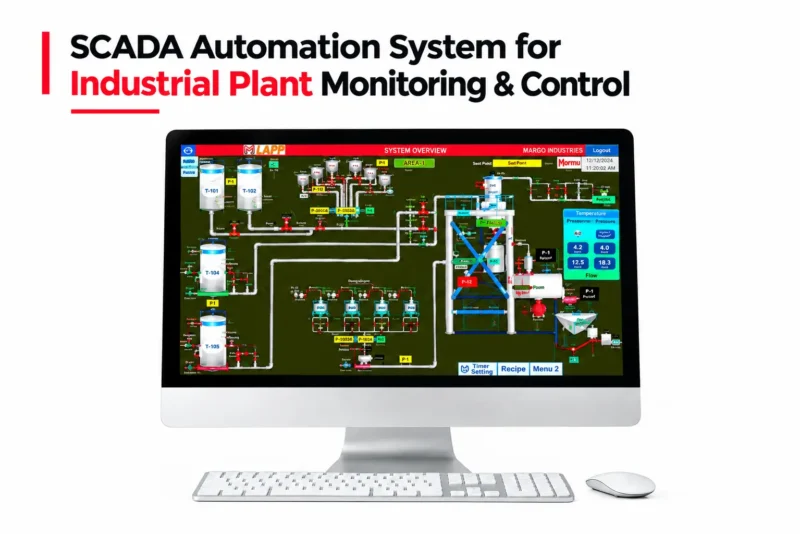
A SCADA Automation System collects information from sensors, instruments, machines and PLCs and presents the relevant process information through graphical screens.

Operators can use the SCADA interface to monitor:

  • Equipment status
  • Material flow
  • Pressure
  • Temperature
  • Weight
  • Silo levels
  • Dosing quantities
  • Batch status
  • Motor and valve status
  • Process alarms
  • Historical trends
  • Production information

In simple terms, PLC controls the equipment, while SCADA gives operators centralized visibility and supervisory control of the process.

Margo already uses PLC and SCADA integration across applications such as material handling, batching, dosing and compounding automation.

How Does SCADA Automation Work?

A typical SCADA automation system connects field devices, PLCs, communication networks and SCADA software.

1. Sensors Collect Process Data

Sensors and instruments collect information from the plant.

Examples include:

  • Pressure sensors
  • Level sensors
  • Temperature sensors
  • Load cells
  • Flow instruments
  • Proximity sensors
  • Equipment feedback signals

2. PLC Processes the Signals

The signals are transferred to the PLC (Programmable Logic Controller).

The PLC processes the input signals according to the programmed automation logic and controls the connected equipment.

3. Data is Communicated to SCADA

The PLC communicates relevant process information to the SCADA system through the plant’s industrial communication architecture.

4. SCADA Displays the Process

SCADA converts the information into graphical screens that allow operators to see the process in real time.

5. Operators Monitor & Supervise

Operators can monitor equipment status, process parameters, alarms and selected control functions from the centralized SCADA interface.

SCADA Automation System Architecture

A typical industrial SCADA system can be understood as:

Sensors & Instruments
↓
PLC / Control System
↓
Industrial Communication Network
↓
SCADA Software
↓
Operator / Control Room

Each level performs a different function.

Field Level

 Sensors, transmitters, motors, valves, drives and other equipment interact with the physical process.

Control Level

PLCs process signals and execute the programmed automation logic.

Communication Level

Industrial communication connects the control system with SCADA and other integrated devices.

Supervisory Level

SCADA provides visualization, alarms, trends, data monitoring and supervisory functions.

PLC and SCADA Integration

A PLC SCADA Automation System combines machine-level control with centralized supervisory monitoring.

The PLC handles real-time control logic, while SCADA provides a graphical interface for monitoring and managing the overall process.

For example, in an automated material handling plant:

Material Storage → Conveying → Weighing → Dosing → Mixing → Production

can be monitored through a centralized SCADA interface.

This type of integration is particularly useful where several machines or process stages need to operate in a coordinated sequence.

SCADA Automation for Material Handling

For Margo Industries, this is an important section because SCADA should connect directly with your core business instead of looking like a generic IT/software page.

SCADA can be integrated with automated material handling systems to provide centralized monitoring and control of:

1. Pneumatic Conveying Systems

Monitor conveying sequences, equipment status, pressure-related parameters, valves and process alarms.

2. Vacuum Conveying Systems

Monitor vacuum conveying cycles, equipment operation, material transfer and system status.

3. Pressure Conveying Systems

Monitor conveying parameters, valves, pressure conditions and equipment operation.

4. Automatic Batch Weighing Systems

Monitor material feeding, weighing values, batch sequences and recipe-related operations.

5. Liquid Dosing & Weighing Systems

Monitor dosing quantities, process parameters, equipment status and alarms.

6. Raw Material & Recipe Silos

Monitor material levels, silo status, feeding operations and connected equipment.

7. Automatic Mixer Feeding Systems

Monitor material feeding sequences, weighing information and mixer-related operations.

Margo’s existing automation portfolio includes these types of systems, including conveying, weighing, dosing, silo and PLC-SCADA-based compounding solutions.

Key Features of SCADA Automation

1. Real-Time Process Monitoring

View important plant parameters and equipment status through a centralized interface.

2. Graphical Process Visualization

Represent machines and processes through intuitive graphical screens so operators can understand plant conditions quickly.

3. Alarm Management

Configured alarms can notify operators when selected process conditions, equipment faults or abnormal events occur.

4. Historical Data & Trends

Selected process values can be recorded and displayed as historical trends for process analysis.

5. Batch & Recipe Monitoring

For suitable applications, batch and recipe information can be integrated into the automation interface.

6. Equipment Status Monitoring

Monitor motors, valves, conveyors, pumps and other connected equipment.

7. Centralized Control

Multiple automated process sections can be brought together within a centralized supervisory system.

8. Data Visibility

Relevant operational data can be made available for monitoring, reporting and process analysis.

9. Batch Report Generation

SCADA Automation Systems enable batch report generation by recording batch details, process parameters, material consumption, and production data. These reports help maintain production records, improve traceability, and support quality control and process analysis.

Benefits of SCADA Automation System

1. Better Process Visibility

SCADA provides a centralized view of connected plant operations.

2. Reduced Manual Monitoring

Operators can monitor multiple process parameters from a centralized interface instead of manually checking each equipment point.

3. Faster Identification of Abnormal Conditions

Alarm and status information helps operators identify configured faults and process deviations.

4. Improved Process Control

PLC and SCADA integration enables coordinated automation and supervisory monitoring.

5. Better Production Data

Historical process information can support production review and process analysis.

6. Improved Batch Consistency

For automated batching and dosing applications, SCADA can provide visibility into weighing, dosing and recipe-related operations.

7. Scalable Automation

The system can be designed around the required plant equipment and expanded as automation requirements change.

SCADA Automation Applications

Margo’s SCADA-based automation solutions can be applied to:

  • Plastic & PVC Industries
  • Polymer Compounding Plants
  • Chemical Industries
  • Pharmaceutical Industries
  • Food Processing Industries
  • Pigment Industries
  • Powder Processing Plants
  • Bulk Material Handling Plants
  • Batching & Weighing Applications
  • Dosing Applications
  • Silo & Storage Systems
  • Pneumatic Conveying Systems
  • Complete Plant Automation

Margo currently positions PLC/SCADA automation across industries including plastics, chemicals, pharmaceuticals and food processing.

Full Plant Automation with SCADA

For plants with multiple interconnected processes, SCADA can act as the supervisory layer for complete plant automation.

A typical automated plant may include:

Raw Material Storage
↓
Material Conveying
↓
Weighing & Dosing
↓
Batch Preparation
↓
Mixing / Processing

SCADA can provide a centralized view of these operations, while PLC-based automation manages the required control sequences.

Margo describes its full-plant SCADA solutions as integrating material handling, mixing, weighing, batching, conveying and storage into a unified monitoring and control system.

Why Choose Margo Industries for SCADA Automation?

50+ Years of Industrial Engineering Experience

Margo Industries has been working in industrial engineering, material handling and automation since 1969.

Material Handling + Automation Expertise

Instead of treating SCADA as a standalone software solution, Margo can connect automation with actual industrial equipment and material handling processes.

Customized Automation

SCADA screens, monitoring requirements, control logic and system integration can be designed around the project requirements.

Integrated Solutions

SCADA can be integrated with conveying, weighing, dosing, storage, feeding and other automation systems.

Turnkey Approach

Margo provides end-to-end industrial automation capabilities from engineering and manufacturing through installation and commissioning.

SCADA Automation System FAQs

1. What is SCADA Automation?

SCADA Automation is an industrial supervisory system used to monitor, visualize, collect data from and supervise automated processes.

2. What is the difference between PLC and SCADA?

A PLC primarily executes control logic and controls connected equipment, while SCADA provides centralized visualization, monitoring, alarms and supervisory functions.

3. Can SCADA be integrated with material handling systems?

Yes. SCADA can be integrated with pneumatic conveying, vacuum conveying, pressure conveying, batching, weighing, dosing, feeding and silo systems.

4. What can be monitored through SCADA?

Depending on the application, SCADA can monitor equipment status, pressure, temperature, weight, level, flow, alarms, batch information and other process parameters.

5. Can SCADA be customized for an industrial plant?

Yes. SCADA architecture, screens, parameters, alarms, data logging and integration can be configured according to the plant’s requirements.

6. Does Margo Industries provide SCADA Automation Solutions?

Yes. Margo Industries provides customized PLC and SCADA-based automation solutions for material handling, process automation, batching, dosing, weighing, conveying and complete plant automation.

Ready to Automate Your Plant?

Improve plant visibility with a customized SCADA Automation System from Margo Industries.

Whether you need SCADA for material handling, PLC-SCADA integration, batch automation, dosing automation, conveying control or complete plant automation, our team can develop a solution around your process requirements.

Request a Quote →
Talk to Our Automation Experts →
Pneumatic Conveying Systems Explained: Complete Working Process, Components, Types, and Industrial Applications

In industries that handle powders, granules, pellets, and bulk materials, efficient material transfer is critical for productivity and product quality. Traditional conveying methods can create dust, material loss, contamination, and higher maintenance costs. This is why many manufacturers are switching to Pneumatic Conveying Systems.

A pneumatic conveying system uses air pressure or vacuum to move dry bulk materials through enclosed pipelines. This method provides clean, safe, and efficient material handling while reducing manual labor and improving plant automation.

From PVC compounds and plastic processing to food, chemicals, pharmaceuticals, and minerals, pneumatic conveying systems have become an essential part of modern manufacturing. In this guide, we will explain how pneumatic conveying systems work, their types, benefits, applications, and how to choose the right solution for your industry.

What is a Pneumatic Conveying System?

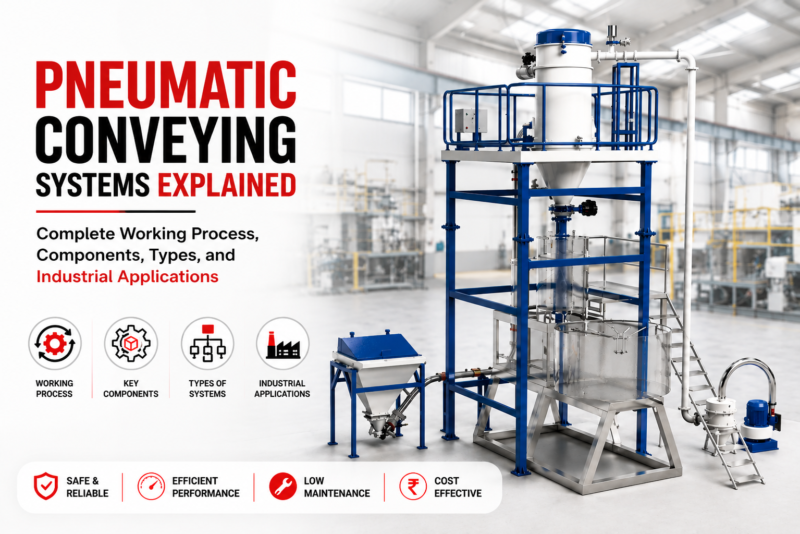
A Pneumatic Conveying System is a material handling system that transports powders, granules, pellets, and other dry bulk materials through pipelines using airflow.

Instead of using belts, buckets, or manual handling, materials are transferred inside a closed pipeline. This helps prevent dust generation, contamination, and material wastage.

Common Materials Handled

  • PVC Resin
  • PVC Compound
  • Calcium Carbonate
  • Cement
  • Fly Ash
  • Flour
  • Sugar
  • Starch
  • Plastic Granules
  • Carbon Black
  • Silica Powder
  • Pigments
  • Chemical Powders

Why Industries Use Pneumatic Conveying Systems

Industries prefer Pneumatic Conveying Solution  because it offers several operational advantages:

  • Dust-free material transfer
  • Reduced manpower requirement
  • Improved workplace safety
  • Better product quality
  • Minimal material loss
  • Easy plant automation
  • Flexible installation layout
  • Lower maintenance requirements

For industries handling fine powders or sensitive materials, pneumatic conveying provides a cleaner and more reliable solution compared to conventional conveying systems.

Working Principle of a Pneumatic Conveying System

The basic principle is simple. Airflow generated by a blower, compressor, or vacuum pump moves material through a closed pipeline from one location to another.

Step-by-Step Workflow

Step 1: Material Feeding

Material is stored in a hopper, silo, bag dumping station, or big bag unloading system.

Step 2: Controlled Material Entry

A rotary airlock valve or feeder regulates the material entering the conveying line.

Step 3: Air Generation

A blower, compressor, or vacuum pump creates airflow inside the pipeline.

Step 4: Material Conveying

The airflow carries the material through the pipeline to the destination.

Step 5: Material Separation

Cyclone separators or filter receivers separate material from the conveying air.

Step 6: Final Discharge

The material is discharged into mixers, storage bins, silos, packaging machines, or process equipment.

This entire process can be automated using PLC-based control systems, reducing operator involvement and improving efficiency.

Main Components of a Pneumatic Conveying System

Hopper

Stores material before conveying begins.

Rotary Airlock Valve

Controls material feeding while maintaining air pressure.

Roots Blower / Air Compressor

Generates airflow required for material transfer.

Vacuum Pump

Used in vacuum conveying systems to create suction.

Conveying Pipeline

Transfers material from source to destination.

Cyclone Separator

Separates conveyed material from airflow.

Dust Collector

Captures fine dust particles and keeps the environment clean.

PLC Control Panel

Controls and monitors the complete system automatically.

Types of Pneumatic Conveying Systems

1. Pressure Pneumatic Conveying System

A pressure conveying system uses positive air pressure to push material through the pipeline.

How It Works

Compressed air generated by a blower pushes material from the feeding point to the receiving point.

Best Applications

  • PVC Compound Plants
  • Plastic Processing Industries
  • Chemical Industries
  • Mineral Processing Plants
  • Long-distance conveying

Advantages

  • High conveying capacity
  • Suitable for long distances
  • Continuous operation
  • Easy automation

2. Vacuum Pneumatic Conveying System

A vacuum conveying system uses negative pressure to pull material through the pipeline.

How It Works

A vacuum pump creates suction that draws material toward the receiver.

Best Applications

  • Food Industry
  • Pharmaceutical Industry
  • Chemical Processing
  • Dust-sensitive materials

Advantages

  • Excellent cleanliness
  • Reduced contamination risk
  • Multiple pickup points
  • Safer material handling

Dense Phase vs Dilute Phase Conveying

Many people think these are system types, but they are actually conveying methods.

Dilute Phase (Lean Phase) Conveying

In Lean  phase conveying, material remains suspended in high-velocity airflow.

Best For

  • Plastic Pellets
  • PVC Resin
  • Sugar
  • Flour
  • Light Powders

Benefits

  • High conveying speed
  • Lower installation cost
  • Continuous operation

Dense Phase Conveying

In dense phase conveying, material moves at lower velocity and higher pressure in compact slugs.

Best For

  • Cement
  • Fly Ash
  • Carbon Black
  • Silica
  • Abrasive Materials

Benefits

  • Reduced product damage
  • Lower pipeline wear
  • Less dust generation

Dense Phase vs Dilute Phase Comparison

Feature Dense Phase Dilute Phase
Velocity Low High
Pressure High Moderate
Product Damage Very Low Moderate
Pipeline Wear Low Higher
Best For Heavy Materials Light Materials
Initial Cost Higher Lower

Industrial Applications of Pneumatic Conveying Systems

Pneumatic conveying systems are widely used across industries:

Plastic Industry

For conveying PVC resin, PVC compound, additives, and masterbatch.

Chemical Industry

For powders, pigments, minerals, and chemical ingredients.

Food Industry

For flour, sugar, starch, spices, and food powders.

Pharmaceutical Industry

For clean and contamination-free powder transfer.

Cement Industry

For cement, fly ash, and mineral powders.

Battery Industry

For lithium-based powders and specialty materials.

Mineral Processing

For calcium carbonate, silica, and industrial minerals.

Key Benefits of Pneumatic Conveying Systems

Cleaner Operation

Closed pipelines minimize dust and improve workplace hygiene.

Better Product Quality

The enclosed system reduces contamination risk.

Improved Safety

Less manual handling reduces workplace accidents.

Flexible Plant Layout

Pipelines can run horizontally and vertically, making installation easier.

Increased Productivity

Continuous material transfer improves production efficiency.

Automation Friendly

Easy integration with PLC and Industry 4.0 systems.

Lower Material Loss

Materials remain enclosed throughout the process.

How to Choose the Right Pneumatic Conveying System

Choosing the right system depends on:

  • Material characteristics
  • Bulk density
  • Particle size
  • Conveying distance
  • Production capacity
  • Available installation space
  • Product sensitivity

For example:

  • Light materials → Dilute Phase Conveying
  • Heavy materials → Dense Phase Conveying
  • Hygienic applications → Vacuum Conveying
  • Long-distance conveying → Pressure Conveying

A proper system design ensures higher efficiency and lower operating costs.

Why Choose Margo Industries?

At Margo Industries, we specialize in designing and manufacturing customized Pneumatic Conveying Systems for various industrial applications.

Our solutions are designed to provide:

  • High conveying efficiency
  • Reliable performance
  • Dust-free operation
  • Energy-efficient design
  • Low maintenance requirements
  • Custom-built solutions
  • Complete automation support

Whether you need a pressure conveying system, vacuum conveying system, dense phase conveying, or dilute phase conveying solution, Margo Industries can provide a system tailored to your production requirements.

Frequently Asked Questions (FAQs)

1. What is a Pneumatic Conveying System?

A pneumatic conveying system transports dry bulk materials through pipelines using air pressure or vacuum.

2. What materials can be conveyed pneumatically?

PVC resin, PVC compound, cement, fly ash, flour, sugar, starch, carbon black, silica, pigments, and chemical powders.

3. What is the difference between pressure and vacuum conveying?

Pressure conveying pushes material using compressed air, while vacuum conveying pulls material using suction.

4. What is Dilute Phase Conveying?

Dilute phase conveying moves material suspended in high-velocity airflow.

5. What is Dense Phase Conveying?

Dense phase conveying moves material at lower velocity and higher pressure, reducing product damage.

6. Which industries use pneumatic conveying systems?

Plastic, food, pharmaceutical, chemical, cement, mineral, and battery industries.

7. What are the main benefits of pneumatic conveying?

Dust-free transfer, improved safety, reduced contamination, automation, and higher productivity.

8. How do I select the right pneumatic conveying system?

The selection depends on material type, conveying distance, capacity, and process requirements.

Conclusion

A Pneumatic Conveying System is one of the most efficient solutions for transferring powders, granules, and bulk materials in modern industries. By using air pressure or vacuum, these systems provide clean, safe, and automated material handling while reducing contamination, material loss, and labor requirements.

Understanding the difference between pressure conveying, vacuum conveying, dense phase, and dilute phase conveying helps industries select the most suitable system for their application. With proper design and engineering, pneumatic conveying systems can significantly improve productivity, product quality, and operational efficiency.

For reliable and customized material handling solutions, Margo Industries offers advanced pneumatic conveying systems designed to meet the needs of modern manufacturing plants.

What Is a Vibro Siever? Working, Benefits & Industrial Applications

In today’s competitive manufacturing environment, maintaining consistent product quality is essential. Industries dealing with powders, granules, and bulk materials require efficient screening solutions to remove impurities, improve product consistency, and enhance production efficiency. A Vibro Siever is one of the most reliable machines used for material screening across various industries.

Whether in food processing, pharmaceuticals, chemicals, plastics, minerals, or specialty materials, Vibro Sievers help manufacturers achieve precise particle separation while maintaining high productivity.

At Margo Industries, we provide advanced material handling and screening solutions designed to improve operational efficiency and product quality for industries worldwide.

What Is a Vibro Siever?

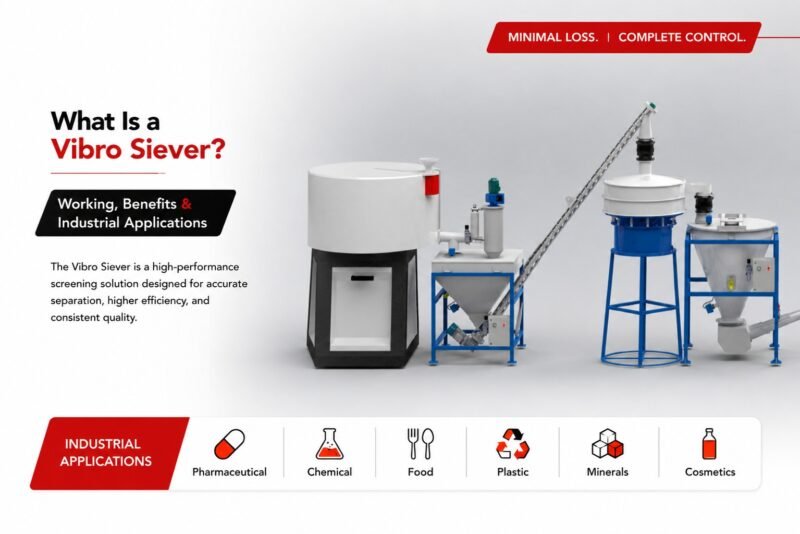
A Vibro Siever, also known as a Vibratory Sieving Machine, Vibro Sifter, or Vibrating Screen Separator, is a screening equipment that separates materials based on particle size using vibration.

The machine consists of a circular screen mounted on a vibrating motor. As the material enters the siever, vibrations cause particles to move across the screen surface. Fine particles pass through the mesh, while oversized particles remain on top and are discharged separately.

This process ensures accurate material classification and improved production quality across modern material handling systems.

How Does a Vibro Siever Work?

The working principle of a Vibro Siever is simple yet highly effective.

Step 1: Material Feeding

material is fed into the sieving chamber through a hopper or feeding system.

Step 2: Vibratory Motion

The vibratory motor generates multidirectional vibrations that move the material across the screen.

Step 3: Particle Separation

Particles smaller than the mesh opening pass through the screen, while larger particles remain above it.

Step 4: Product Collection

Different particle sizes are collected through separate discharge outlets.

This process ensures accurate material classification and improved production quality.

Key Components of a Vibro Siever

A high-quality Vibro Siever consists of:

  • Vibratory Motor
  • Screening Mesh
  • Feed Inlet
  • Outlet Ports
  • Stainless Steel Body
  • Anti-Vibration Mounts
  • Dust-Proof Cover

These components work together to deliver reliable and continuous screening performance.

Benefits of Using a Vibro Siever

1. Improved Product Quality

A Vibro Siever removes oversized particles, lumps, and contaminants, ensuring consistent product quality.

2. Higher Screening Efficiency

The high-frequency vibration enables faster and more accurate particle separation.

3. Reduced Product Waste

By achieving precise particle sizing, manufacturers can reduce material rejection and wastage.

4. Dust-Free Operation

Modern Vibro Sievers are designed to minimize dust generation, creating a cleaner working environment.

5. Increased Productivity

Continuous operation reduces manual labor and improves production throughput.

6. Low Maintenance

Industrial Vibro Sievers are designed for long service life with minimal maintenance requirements.

Industrial Applications of Vibro Sievers

  • Chemical Industry
  • Food Processing Industry
  • Pharmaceutical Industry
  • Plastic & Polymer Industry
  • Minerals Industry

Why Vibro Sievers Are Essential for Modern Manufacturing

Manufacturers today focus heavily on product consistency, process automation, and operational efficiency.

An Industrial Vibro Siever helps achieve:

  • Better Product Quality
  • Improved Process Reliability
  • Reduced Contamination Risk
  • Faster Material Processing
  • Compliance with Industry Standards

These advantages make Vibro Sievers an essential part of modern production facilities.

How to Choose the Right Vibro Siever

Before selecting a Vibro Siever Machine,  consider:

Material Characteristics

Understand particle size, density, and moisture content.

Required Capacity

Choose a machine capable of handling your production volume.

Number of Screening Decks

Multiple decks allow separation into several particle sizes simultaneously.

Material of Construction

Stainless Steel construction is preferred for food, pharmaceutical, and chemical industries.

Maintenance Requirements

Select equipment with easy screen replacement and cleaning features.

Why Choose Margo Industries?

At Margo Industries, we specialize in advanced material handling, screening, conveying, and process automation solutions.

Our screening systems are designed to deliver:

✔ High Screening Accuracy
✔ Reliable Performance
✔ Low Maintenance
✔ Industrial-Grade Construction
✔ Customized Solutions
✔ Global Export Support

With extensive experience serving industries worldwide, Margo Industries helps manufacturers improve productivity, product quality, and operational efficiency.

Frequently Asked Questions (FAQs)

  • What is a Vibro Siever used for?

A Vibro Siever is used for screening, grading, and separating powders, granules, and bulk materials based on particle size.

  • What industries use Vibro Sievers?

Food processing, pharmaceuticals, chemicals, plastics, minerals, and many other manufacturing industries use Vibro Sievers.

  • What is the difference between a Vibro Siever and a Vibrating Screen?

A Vibro Siever provides finer and more accurate particle separation, while vibrating screens are typically used for larger materials and higher capacities.

  • Can Vibro Sievers handle fine powders?

Yes, Vibro Sievers are specifically designed to process fine powders efficiently and accurately.

  • Why is a Vibro Siever important in manufacturing?

It improves product consistency, removes impurities, reduces waste, and enhances overall production efficiency.

Conclusion

A Vibro Siever Machine plays a critical role in ensuring efficient material screening, product quality, and process reliability. From chemicals and polymers to food and pharmaceutical applications, Vibro Sievers help manufacturers achieve precise particle separation while increasing productivity.

If you are looking for a reliable Industrial Vibro Siever, Vibro Sifter, or Vibratory Sieving Machine, Margo Industries offers customized solutions designed to meet the evolving needs of modern manufacturing industries worldwide.

Looking to improve your screening process? Contact Margo Industries today for high-performance Vibro Siever solutions tailored to your application.

What Is a Bulk Material Handling System and How Does It Work?

In modern industries, handling large quantities of raw materials efficiently is essential for maintaining productivity, reducing material loss, and ensuring smooth plant operations. This is where a Bulk Material Handling System plays a critical role.

Industries such as PVC, plastics, chemicals, food processing, pharmaceuticals, minerals, and agriculture rely heavily on automated material handling solutions to transfer, store, feed, and process bulk materials safely and efficiently.

At Margo Industries, we specialize in advanced Bulk Material Handling Systems, Vacuum Conveying Systems, and Pressure Conveying Systems designed for high-efficiency industrial automation.

What Is a Bulk Material Handling System?

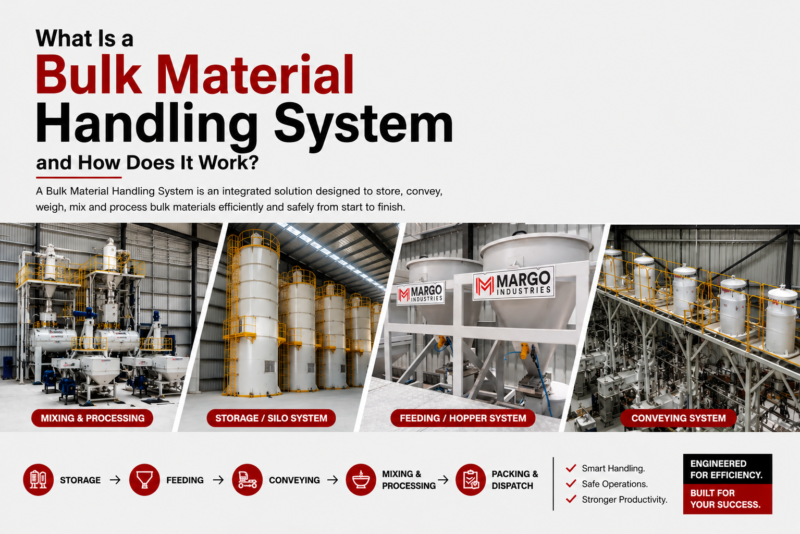
A Bulk Material Handling System is an industrial automated system that can be used to transport, store, control, feed, unload and process multiple types of bulk materials, such as:

  • Powder
  • Granules
  • Pellets
  • Flakes
  • Liquids
  • Semi-solid bulk materials

A bulk material handling system will automatically transport materials from one location to another with as little manual handling as possible. 

Reasons for implementing a bulk material handling system include:

✔ Reduce labor
✔ Increase productivity
✔ Minimize dust generation
✔ Reduce material loss
✔ Improve plant efficiency
✔ Ensure continuous material flow

How Does a Bulk Material Handling System Work?

A Bulk Material Handling System works through a combination of different equipment and automation technologies.

The process generally includes:

1. Raw Material Unloading

The process begins with unloading raw material from:

  • Bags
  • Jumbo bags
  • Tankers
  • Trucks
  • Containers

The material is transferred into receiving hoppers or storage silos.

Common Equipment Used:

  • Bag dumping stations
  • Jumbo bag unloaders
  • Tanker unloading systems

At Margo Industries, customized unloading systems are designed according to plant capacity and material type.

2. Material Conveying Process

After unloading, the material is transferred through a Pressure Conveying Systems or Vacuum Conveying System.

This is one of the most important stages in a Bulk Material Handling System.

Types of Conveying Systems

1)  Mechanical Conveying System

    A)  Screw Conveying
    B)   Belt Conveying

2)  Pneumatic Conveying System

    A)   Vacuum Conveying
    B)   Pressure conveying

Vacuum Conveying System

A Vacuum Conveying System uses negative pressure to transfer powder or granules through pipelines.

Benefits:

  •  High Productivity/Efficiency
  • Clean Operation
  •  Energy efficient
  • Ideal for powder handling
  • Safe material transfer
  • Reduced manpower dependency
  • Dust-free transfer
  • Reduced manpower dependency

Pressure Conveying System

A Pressure Conveying System uses positive air pressure to transfer powder or bulk materials through closed pipelines.

Benefits:

  • Long-distance conveying
    ● High-speed material transfer
    ● Dust-free operation
    ● Reduced material contamination
    ● Fully automated process
    ● Safe and efficient material handling
    ● Low maintenance requirement
    ● Suitable for continuous conveying

3. Material Storage in Silos

After conveying, the material is stored inside industrial silos or storage tanks.

Bulk Storage Silos Are Used For:

  •     Powder
  • ·  Granules
  • ·  Pellets
  • ·  Flakes
  • ·  Liquids
  • ·  Semi-solid bulk materials

Advantages of Silos:

✔ Large storage capacity
✔ Continuous material availability
✔ Reduced contamination
✔ Better inventory management

4. Feeding and Dosing Process

The stored material is then transferred to mixers, extruders, reactors, or processing machines using an automated feeding system.

Common Feeding Equipment:

  • Auto Batching System
  • Vacuum loaders
  • Minor Additives Weighing System
  • Liquid Weighing and Dosing System

This process ensures accurate material feeding and consistent production quality.

5. Process Automation

Modern Bulk Material Handling Systems include advanced automation and control panels.

  • Recipe management
  • PLC-SCADA integration
  • Batch tracking
  • Plant reporting systems

Automation helps industries:

✔ Monitor material flow
✔ Control feeding speed
✔ Reduce manpower
✔ Improve production accuracy
✔ Increase operational safety

At Margo Industries, advanced PLC and SCADA based automation systems are integrated for smart industrial operation.

Main Components of a Bulk Material Handling System

A complete Bulk Material Handling System generally includes:

  • Vacuum Conveying System
  • Pressure Conveying System
  • Storage Silos
  • Screw Conveyors
  • Control Panels
  • Pipeline Networks
  • Hopper Systems
  • Auto Batching/Weighing System
  • Mixing and Feeding Equipment

Industries Using Bulk Material Handling Systems

A Bulk Material Handling System is widely used in various industries.

  • PVC Industry

Used for PVC resin,Caco3,Reprocessed Material and other additives conveying, batching and centralized feeding.

  • Plastic Industry

Used for automatic raw material transfer.

  • Chemical Industry

Used for safe powder handling and chemical processing.

  • Pharma Industry

Used for contamination-free powder conveying.

  • Food Industry

Used for hygienic ingredient handling.

  • Minerals & Cement Industry

Used for heavy-duty bulk conveying applications.

Benefits of a Bulk Material Handling System

Installing a modern Bulk Material Handling System offers several industrial benefits.

1. Dust-Free Material Handling

One of the biggest advantages is clean and dust-free operation.

This improves:

  • Worker safety
  • Plant cleanliness
  • Product quality

2. Reduced Material Loss

Manual handling often causes:

  • Material wastage
  • Spillage
  • Contamination

Automated conveying systems significantly reduce these losses.

3. High Productivity

Automation ensures continuous material transfer without production interruption.

This increases:
✔ Plant efficiency
✔ Production speed
✔ Output capacity

4. Energy Efficient Operation

Modern Vacuum Conveying Systems and  Pressure Conveying  Systems are designed for low energy consumption.

This helps reduce operational costs.

5. Reduced Manpower Requirement

Automation minimizes manual handling and reduces labor dependency.

6. Better Process Control

Automated systems provide accurate control over:

  • Material feeding
  • Batch processing
  • Production flow

7. Improved Plant Safety

Dust-free conveying and automated handling reduce industrial hazards and improve workplace safety.

Why Choose Margo Industries for Bulk Material Handling Systems?

Margo Industries is a trusted manufacturer and exporter of industrial automation systems in India with decades of experience in bulk material handling solutions.

Our Expertise Includes:

  • Vibro Siever
  • Jumbo Bag Unloading System
  • 25/50 Kg  Bag Feeding System
  • Minor Additives Weighing System
  • Liquid Weighing and Dosing system
  • Raw Material Storage Silo
  •  Pressure/Vacuum Conveying System

Why Industries Prefer Margo Industries?

✔ Customized turnkey solutions
✔ Energy-efficient systems
✔ Export-quality engineering
✔ Dust-free material handling
✔ Advanced automation integration
✔ Reliable after-sales support

Future of Bulk Material Handling Automation

Industries are rapidly moving toward:

  • Smart automation
  • Industry 4.0
  • Energy-efficient plants
  • Dust-free processing systems

As industrial production increases, demand for advanced Bulk Material Handling Systems will continue to grow globally.

Automation is no longer optional — it has become essential for improving productivity and maintaining competitive industrial operations.

Conclusion

A Bulk Material Handling  System is an essential part of modern industrial automation. It helps industries transfer, store, and process bulk materials efficiently while reducing labor, material loss, and operational costs.

From Vacuum Conveying Systems to Pressure Conveying Systems, automated material handling improves productivity, safety, and process efficiency across industries.

If you are looking for a reliable and customized Bulk Material Handling System, Margo Industries provides advanced turnkey automation solutions for PVC, plastic, chemical, pharma, and food industries.