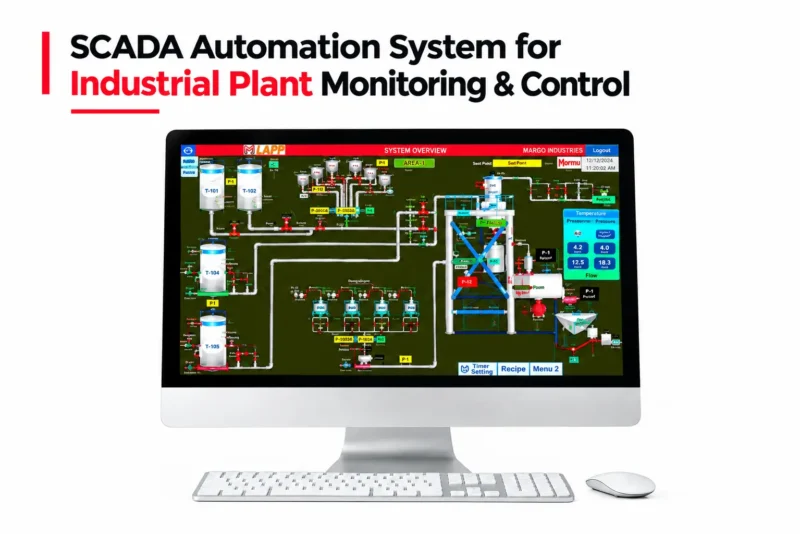
SCADA Automation System for Industrial Plant Monitoring & Control

Margo Industries provides customized SCADA Automation Systems for industrial plant monitoring, process control, material handling, batching, weighing, dosing, conveying and storage applications. Our PLC and SCADA-based automation solutions provide centralized process visualization, real-time monitoring, alarm management and operational data visibility.

From individual equipment automation to complete plant automation, our SCADA solutions are designed around your process requirements and can integrate with conveyors, silos, weighing systems, dosing systems, mixers, valves, sensors and other industrial equipment.

What is a SCADA Automation System?

SCADA (Supervisory Control and Data Acquisition) is an industrial automation system used to monitor, visualize and supervise manufacturing and process operations from a centralized interface.

A SCADA Automation System collects information from sensors, instruments, machines and PLCs and presents the relevant process information through graphical screens.

Operators can use the SCADA interface to monitor:

  • Equipment status
  • Material flow
  • Pressure
  • Temperature
  • Weight
  • Silo levels
  • Dosing quantities
  • Batch status
  • Motor and valve status
  • Process alarms
  • Historical trends
  • Production information

In simple terms, PLC controls the equipment, while SCADA gives operators centralized visibility and supervisory control of the process.

Margo already uses PLC and SCADA integration across applications such as material handling, batching, dosing and compounding automation.

How Does SCADA Automation Work?

A typical SCADA automation system connects field devices, PLCs, communication networks and SCADA software.

1. Sensors Collect Process Data

Sensors and instruments collect information from the plant.

Examples include:

  • Pressure sensors
  • Level sensors
  • Temperature sensors
  • Load cells
  • Flow instruments
  • Proximity sensors
  • Equipment feedback signals

2. PLC Processes the Signals

The signals are transferred to the PLC (Programmable Logic Controller).

The PLC processes the input signals according to the programmed automation logic and controls the connected equipment.

3. Data is Communicated to SCADA

The PLC communicates relevant process information to the SCADA system through the plant’s industrial communication architecture.

4. SCADA Displays the Process

SCADA converts the information into graphical screens that allow operators to see the process in real time.

5. Operators Monitor & Supervise

Operators can monitor equipment status, process parameters, alarms and selected control functions from the centralized SCADA interface.

SCADA Automation System Architecture

A typical industrial SCADA system can be understood as:

Sensors & Instruments
↓
PLC / Control System
↓
Industrial Communication Network
↓
SCADA Software
↓
Operator / Control Room

Each level performs a different function.

Field Level

 Sensors, transmitters, motors, valves, drives and other equipment interact with the physical process.

Control Level

PLCs process signals and execute the programmed automation logic.

Communication Level

Industrial communication connects the control system with SCADA and other integrated devices.

Supervisory Level

SCADA provides visualization, alarms, trends, data monitoring and supervisory functions.

PLC and SCADA Integration

A PLC SCADA Automation System combines machine-level control with centralized supervisory monitoring.

The PLC handles real-time control logic, while SCADA provides a graphical interface for monitoring and managing the overall process.

For example, in an automated material handling plant:

Material Storage → Conveying → Weighing → Dosing → Mixing → Production

can be monitored through a centralized SCADA interface.

This type of integration is particularly useful where several machines or process stages need to operate in a coordinated sequence.

SCADA Automation for Material Handling

For Margo Industries, this is an important section because SCADA should connect directly with your core business instead of looking like a generic IT/software page.

SCADA can be integrated with automated material handling systems to provide centralized monitoring and control of:

1. Pneumatic Conveying Systems

Monitor conveying sequences, equipment status, pressure-related parameters, valves and process alarms.

2. Vacuum Conveying Systems

Monitor vacuum conveying cycles, equipment operation, material transfer and system status.

3. Pressure Conveying Systems

Monitor conveying parameters, valves, pressure conditions and equipment operation.

4. Automatic Batch Weighing Systems

Monitor material feeding, weighing values, batch sequences and recipe-related operations.

5. Liquid Dosing & Weighing Systems

Monitor dosing quantities, process parameters, equipment status and alarms.

6. Raw Material & Recipe Silos

Monitor material levels, silo status, feeding operations and connected equipment.

7. Automatic Mixer Feeding Systems

Monitor material feeding sequences, weighing information and mixer-related operations.

Margo’s existing automation portfolio includes these types of systems, including conveying, weighing, dosing, silo and PLC-SCADA-based compounding solutions.

Key Features of SCADA Automation

1. Real-Time Process Monitoring

View important plant parameters and equipment status through a centralized interface.

2. Graphical Process Visualization

Represent machines and processes through intuitive graphical screens so operators can understand plant conditions quickly.

3. Alarm Management

Configured alarms can notify operators when selected process conditions, equipment faults or abnormal events occur.

4. Historical Data & Trends

Selected process values can be recorded and displayed as historical trends for process analysis.

5. Batch & Recipe Monitoring

For suitable applications, batch and recipe information can be integrated into the automation interface.

6. Equipment Status Monitoring

Monitor motors, valves, conveyors, pumps and other connected equipment.

7. Centralized Control

Multiple automated process sections can be brought together within a centralized supervisory system.

8. Data Visibility

Relevant operational data can be made available for monitoring, reporting and process analysis.

9. Batch Report Generation

SCADA Automation Systems enable batch report generation by recording batch details, process parameters, material consumption, and production data. These reports help maintain production records, improve traceability, and support quality control and process analysis.

Benefits of SCADA Automation System

1. Better Process Visibility

SCADA provides a centralized view of connected plant operations.

2. Reduced Manual Monitoring

Operators can monitor multiple process parameters from a centralized interface instead of manually checking each equipment point.

3. Faster Identification of Abnormal Conditions

Alarm and status information helps operators identify configured faults and process deviations.

4. Improved Process Control

PLC and SCADA integration enables coordinated automation and supervisory monitoring.

5. Better Production Data

Historical process information can support production review and process analysis.

6. Improved Batch Consistency

For automated batching and dosing applications, SCADA can provide visibility into weighing, dosing and recipe-related operations.

7. Scalable Automation

The system can be designed around the required plant equipment and expanded as automation requirements change.

SCADA Automation Applications

Margo’s SCADA-based automation solutions can be applied to:

  • Plastic & PVC Industries
  • Polymer Compounding Plants
  • Chemical Industries
  • Pharmaceutical Industries
  • Food Processing Industries
  • Pigment Industries
  • Powder Processing Plants
  • Bulk Material Handling Plants
  • Batching & Weighing Applications
  • Dosing Applications
  • Silo & Storage Systems
  • Pneumatic Conveying Systems
  • Complete Plant Automation

Margo currently positions PLC/SCADA automation across industries including plastics, chemicals, pharmaceuticals and food processing.

Full Plant Automation with SCADA

For plants with multiple interconnected processes, SCADA can act as the supervisory layer for complete plant automation.

A typical automated plant may include:

Raw Material Storage
↓
Material Conveying
↓
Weighing & Dosing
↓
Batch Preparation
↓
Mixing / Processing

SCADA can provide a centralized view of these operations, while PLC-based automation manages the required control sequences.

Margo describes its full-plant SCADA solutions as integrating material handling, mixing, weighing, batching, conveying and storage into a unified monitoring and control system.

Why Choose Margo Industries for SCADA Automation?

50+ Years of Industrial Engineering Experience

Margo Industries has been working in industrial engineering, material handling and automation since 1969.

Material Handling + Automation Expertise

Instead of treating SCADA as a standalone software solution, Margo can connect automation with actual industrial equipment and material handling processes.

Customized Automation

SCADA screens, monitoring requirements, control logic and system integration can be designed around the project requirements.

Integrated Solutions

SCADA can be integrated with conveying, weighing, dosing, storage, feeding and other automation systems.

  • Turnkey Approach

Margo provides end-to-end industrial automation capabilities from engineering and manufacturing through installation and commissioning.

SCADA Automation System FAQs

1. What is SCADA Automation?

SCADA Automation is an industrial supervisory system used to monitor, visualize, collect data from and supervise automated processes.

2. What is the difference between PLC and SCADA?

A PLC primarily executes control logic and controls connected equipment, while SCADA provides centralized visualization, monitoring, alarms and supervisory functions.

3. Can SCADA be integrated with material handling systems?

Yes. SCADA can be integrated with pneumatic conveying, vacuum conveying, pressure conveying, batching, weighing, dosing, feeding and silo systems.

4. What can be monitored through SCADA?

Depending on the application, SCADA can monitor equipment status, pressure, temperature, weight, level, flow, alarms, batch information and other process parameters.

5. Can SCADA be customized for an industrial plant?

Yes. SCADA architecture, screens, parameters, alarms, data logging and integration can be configured according to the plant’s requirements.

6. Does Margo Industries provide SCADA Automation Solutions?

Yes. Margo Industries provides customized PLC and SCADA-based automation solutions for material handling, process automation, batching, dosing, weighing, conveying and complete plant automation.

Ready to Automate Your Plant?

Improve plant visibility with a customized SCADA Automation System from Margo Industries.

Whether you need SCADA for material handling, PLC-SCADA integration, batch automation, dosing automation, conveying control or complete plant automation, our team can develop a solution around your process requirements.

Request a Quote →
Talk to Our Automation Experts →
Still Using Manual Material Handling? Here’s Why Industries Are Switching to Automated

Imagine carrying hundreds of bags of raw materials every day, moving them from one machine to another, cleaning up spilled powder, and managing frequent production delays. This is still the reality in many factories that rely on manual material handling.

As industries grow, production targets become higher, labor costs increase, and customers expect consistent product quality. Manual handling often struggles to meet these expectations.

That’s why manufacturers worldwide are switching to Automated Material Handling Systems.

At Margo Industries, we help manufacturers automate their material handling process with reliable and customized solutions that improve productivity, reduce waste, and create safer workplaces.

Let’s understand why this shift is happening and how it can benefit your business.

What is Material Handling?

Material handling simply means moving raw materials or finished products from one place to another inside a factory.

For example:

  • Transporting plastic granules to an extruder
  • Feeding powder into a mixing machine
  • Moving chemicals from storage silos to processing units
  • Loading finished products for packaging

This process happens in almost every manufacturing industry.

There are two ways to do it:

  • Manual Material Handling
  • Automated Material Handling

What is Manual Material Handling?

Manual material handling depends on workers to lift, transport, feed, or unload materials using bags, trolleys, forklifts, or other basic equipment. Although it works for small operations, it creates several challenges as production increases.

Common Problems with Manual Material Handling

  • High labor dependency
  • Slow production process
  • Material spillage and wastage
  • Dust generation inside the plant
  • Worker fatigue
  • Risk of workplace injuries
  • Inconsistent material flow
  • Higher operational costs

Many factories don’t realize how much time and money they lose every day because of these issues.

What is Automated Material Handling?

Automated Material Handling uses machines and intelligent systems to move materials with little or no manual effort.

Instead of workers carrying heavy bags, automated equipment transfers materials safely and accurately between machines.

Examples include:

These systems improve production speed while reducing errors and material loss.

Why Industries Are Switching to Automated Material Handling

1. Faster Production

Every minute matters in manufacturing.

Manual handling slows production because workers need time to lift, transport, and load materials.

Automated systems keep materials moving continuously without unnecessary delays.

Benefits

  • Faster production cycles
  • Reduced downtime
  • Better machine utilization
  • Increased output

2. Lower Labor Costs

Finding skilled labor is becoming more difficult and expensive.

Automation reduces dependency on manual labor by handling repetitive tasks efficiently.

Instead of assigning multiple workers to move materials, a single automated system performs the job consistently.

This helps manufacturers reduce operating expenses while improving productivity.

3. Improved Workplace Safety

Safety is one of the biggest reasons industries choose automation.

Workers handling heavy bags or dusty materials are more likely to suffer injuries, fatigue, or health issues.

Automated systems minimize direct contact with materials, creating a cleaner and safer work environment.

Safety Advantages

  • Less heavy lifting
  • Reduced dust exposure
  • Lower accident risk
  • Improved employee well-being

4. Higher Product Quality

Product quality depends on accurate material handling.

Manual operations often result in inconsistent feeding, contamination, or material loss.

Automated systems ensure precise and controlled material transfer every time.

This consistency helps manufacturers produce better-quality products while reducing rejection rates.

5. Reduced Material Wastage

Every kilogram of wasted material affects profitability.

Spillage during manual handling increases production costs.

With enclosed systems like Pneumatic Conveying Systems, materials move through sealed pipelines, reducing wastage and keeping the production area clean.

6. Better Accuracy

Modern automated systems can measure, weigh, and transfer materials with high precision.

This is especially important for industries such as:

  • Plastics
  • Chemicals
  • Food Processing
  • Pharmaceuticals
  • PVC Compounding

Even small improvements in accuracy can significantly improve product quality.

7. Cleaner Manufacturing Environment

Dust is a major concern in factories handling powders and fine materials.

Automated conveying systems help maintain a dust-free environment, making plants cleaner and easier to maintain.

This also improves product hygiene and workplace safety.

Manual vs Automated Material Handling

Manual Material Handling Automated Material Handling
High labor requirement Minimal labor requirement
Slower production Faster production
Higher material wastage Minimal material loss
More safety risks Safer operations
Inconsistent material flow Consistent material movement
Higher long-term cost Better return on investment
Difficult to scale Easy to expand

Industries That Benefit from Automation

Automated material handling is suitable for almost every manufacturing industry.

It is widely used in:

  • Plastic Processing
  • Chemical Manufacturing
  • Food Processing
  • Pharmaceutical Industry
  • Paint & Pigments
  • Minerals
  • Cement
  • Agriculture
  • Polymer Compounding
  • Recycling Plants

Why Choose Margo Industries?

At Margo Industries, we understand that every manufacturing plant has unique challenges.

That’s why we don’t believe in one-size-fits-all solutions.

We design and manufacture customized Material Handling Systems that match your production requirements, factory layout, and future expansion plans. 

  • Improve workplace safety
  • Ensure accurate material transfer
  • Maintain consistent product quality
  • Achieve long-term operational savings

Whether you need a Pneumatic Conveying System or other material handling solutions such as a Vacuum Conveying System, Bulk Bag Unloading System, or Automatic Weighing & Dosing System, our team is ready to help. 

Is It Time to Upgrade?

Ask yourself these questions:

  • Are production delays affecting your business?
  • Is labor cost increasing every year?
  • Do you experience material spillage or wastage?
  • Are workers spending too much time moving materials?
  • Is dust creating maintenance and safety issues?
  • Are you planning to increase production capacity?

If your answer is Yes to even two or three of these questions, it may be time to automate your material handling process.

Frequently Asked Questions (FAQs)

1. What is an Automated Material Handling System?

An Automated Material Handling System uses machines and automation technology to move, store, and transfer materials with minimal manual effort, improving efficiency and safety.

2. Which industries need automated material handling?

Industries such as plastics, chemicals, food, pharmaceuticals, cement, minerals, recycling, and polymer processing can benefit from automated material handling systems.

3. How does automation reduce costs?

Automation reduces labor dependency, minimizes material wastage, lowers maintenance costs, and increases production efficiency, resulting in long-term savings.

4. Why choose a Pneumatic Conveying System?

Pneumatic Conveying Systems provide enclosed, dust-free, and efficient material transfer, making them ideal for handling powders, granules, and bulk materials.

5. Why choose Margo Industries?

Margo Industries provides customized, high-performance material handling and pneumatic conveying solutions designed to improve productivity, safety, and operational efficiency across a wide range of industries.

Conclusion

Manual material handling may have worked in the past, but today’s manufacturing environment demands greater speed, accuracy, safety, and efficiency.

Automated Material Handling Systems are no longer a luxury—they are a smart investment for businesses that want to improve productivity, reduce costs, and stay competitive.

With the right automation partner, manufacturers can streamline operations, improve product quality, and prepare their plants for future growth.

Margo Industries is committed to delivering innovative and reliable material handling solutions that help industries work smarter, safer, and more efficiently.

If you’re ready to transform your manufacturing process, our team is here to help you find the right automation solution for your business.

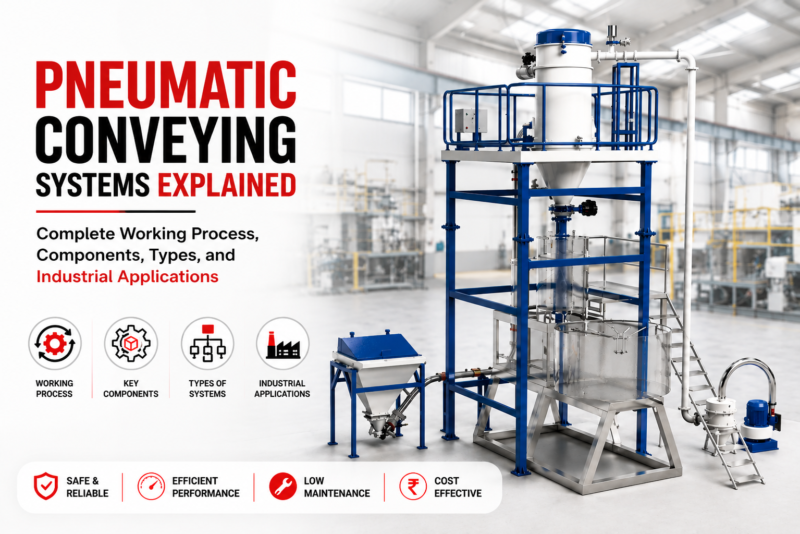
Pneumatic Conveying Systems Explained: Complete Working Process, Components, Types, and Industrial Applications

In industries that handle powders, granules, pellets, and bulk materials, efficient material transfer is critical for productivity and product quality. Traditional conveying methods can create dust, material loss, contamination, and higher maintenance costs. This is why many manufacturers are switching to Pneumatic Conveying Systems.

A pneumatic conveying system uses air pressure or vacuum to move dry bulk materials through enclosed pipelines. This method provides clean, safe, and efficient material handling while reducing manual labor and improving plant automation.

From PVC compounds and plastic processing to food, chemicals, pharmaceuticals, and minerals, pneumatic conveying systems have become an essential part of modern manufacturing. In this guide, we will explain how pneumatic conveying systems work, their types, benefits, applications, and how to choose the right solution for your industry.

What is a Pneumatic Conveying System?

A Pneumatic Conveying System is a material handling system that transports powders, granules, pellets, and other dry bulk materials through pipelines using airflow.

Instead of using belts, buckets, or manual handling, materials are transferred inside a closed pipeline. This helps prevent dust generation, contamination, and material wastage.

Common Materials Handled

  • PVC Resin
  • PVC Compound
  • Calcium Carbonate
  • Cement
  • Fly Ash
  • Flour
  • Sugar
  • Starch
  • Plastic Granules
  • Carbon Black
  • Silica Powder
  • Pigments
  • Chemical Powders

Why Industries Use Pneumatic Conveying Systems

Industries prefer Pneumatic Conveying Solution  because it offers several operational advantages:

  • Dust-free material transfer
  • Reduced manpower requirement
  • Improved workplace safety
  • Better product quality
  • Minimal material loss
  • Easy plant automation
  • Flexible installation layout
  • Lower maintenance requirements

For industries handling fine powders or sensitive materials, pneumatic conveying provides a cleaner and more reliable solution compared to conventional conveying systems.

Working Principle of a Pneumatic Conveying System

The basic principle is simple. Airflow generated by a blower, compressor, or vacuum pump moves material through a closed pipeline from one location to another.

Step-by-Step Workflow

Step 1: Material Feeding

Material is stored in a hopper, silo, bag dumping station, or big bag unloading system.

Step 2: Controlled Material Entry

A rotary airlock valve or feeder regulates the material entering the conveying line.

Step 3: Air Generation

A blower, compressor, or vacuum pump creates airflow inside the pipeline.

Step 4: Material Conveying

The airflow carries the material through the pipeline to the destination.

Step 5: Material Separation

Cyclone separators or filter receivers separate material from the conveying air.

Step 6: Final Discharge

The material is discharged into mixers, storage bins, silos, packaging machines, or process equipment.

This entire process can be automated using PLC-based control systems, reducing operator involvement and improving efficiency.

Main Components of a Pneumatic Conveying System

Hopper

Stores material before conveying begins.

Rotary Airlock Valve

Controls material feeding while maintaining air pressure.

Roots Blower / Air Compressor

Generates airflow required for material transfer.

Vacuum Pump

Used in vacuum conveying systems to create suction.

Conveying Pipeline

Transfers material from source to destination.

Cyclone Separator

Separates conveyed material from airflow.

Dust Collector

Captures fine dust particles and keeps the environment clean.

PLC Control Panel

Controls and monitors the complete system automatically.

Types of Pneumatic Conveying Systems

1. Pressure Pneumatic Conveying System

A pressure conveying system uses positive air pressure to push material through the pipeline.

How It Works

Compressed air generated by a blower pushes material from the feeding point to the receiving point.

Best Applications

  • PVC Compound Plants
  • Plastic Processing Industries
  • Chemical Industries
  • Mineral Processing Plants
  • Long-distance conveying

Advantages

  • High conveying capacity
  • Suitable for long distances
  • Continuous operation
  • Easy automation

2. Vacuum Pneumatic Conveying System

A vacuum conveying system uses negative pressure to pull material through the pipeline.

How It Works

A vacuum pump creates suction that draws material toward the receiver.

Best Applications

  • Food Industry
  • Pharmaceutical Industry
  • Chemical Processing
  • Dust-sensitive materials

Advantages

  • Excellent cleanliness
  • Reduced contamination risk
  • Multiple pickup points
  • Safer material handling

Dense Phase vs Dilute Phase Conveying

Many people think these are system types, but they are actually conveying methods.

Dilute Phase (Lean Phase) Conveying

In Lean  phase conveying, material remains suspended in high-velocity airflow.

Best For

  • Plastic Pellets
  • PVC Resin
  • Sugar
  • Flour
  • Light Powders

Benefits

  • High conveying speed
  • Lower installation cost
  • Continuous operation

Dense Phase Conveying

In dense phase conveying, material moves at lower velocity and higher pressure in compact slugs.

Best For

  • Cement
  • Fly Ash
  • Carbon Black
  • Silica
  • Abrasive Materials

Benefits

  • Reduced product damage
  • Lower pipeline wear
  • Less dust generation

Dense Phase vs Dilute Phase Comparison

Feature Dense Phase Dilute Phase
Velocity Low High
Pressure High Moderate
Product Damage Very Low Moderate
Pipeline Wear Low Higher
Best For Heavy Materials Light Materials
Initial Cost Higher Lower

Industrial Applications of Pneumatic Conveying Systems

Pneumatic conveying systems are widely used across industries:

Plastic Industry

For conveying PVC resin, PVC compound, additives, and masterbatch.

Chemical Industry

For powders, pigments, minerals, and chemical ingredients.

Food Industry

For flour, sugar, starch, spices, and food powders.

Pharmaceutical Industry

For clean and contamination-free powder transfer.

Cement Industry

For cement, fly ash, and mineral powders.

Battery Industry

For lithium-based powders and specialty materials.

Mineral Processing

For calcium carbonate, silica, and industrial minerals.

Key Benefits of Pneumatic Conveying Systems

Cleaner Operation

Closed pipelines minimize dust and improve workplace hygiene.

Better Product Quality

The enclosed system reduces contamination risk.

Improved Safety

Less manual handling reduces workplace accidents.

Flexible Plant Layout

Pipelines can run horizontally and vertically, making installation easier.

Increased Productivity

Continuous material transfer improves production efficiency.

Automation Friendly

Easy integration with PLC and Industry 4.0 systems.

Lower Material Loss

Materials remain enclosed throughout the process.

How to Choose the Right Pneumatic Conveying System

Choosing the right system depends on:

  • Material characteristics
  • Bulk density
  • Particle size
  • Conveying distance
  • Production capacity
  • Available installation space
  • Product sensitivity

For example:

  • Light materials → Dilute Phase Conveying
  • Heavy materials → Dense Phase Conveying
  • Hygienic applications → Vacuum Conveying
  • Long-distance conveying → Pressure Conveying

A proper system design ensures higher efficiency and lower operating costs.

Why Choose Margo Industries?

At Margo Industries, we specialize in designing and manufacturing customized Pneumatic Conveying Systems for various industrial applications.

Our solutions are designed to provide:

  • High conveying efficiency
  • Reliable performance
  • Dust-free operation
  • Energy-efficient design
  • Low maintenance requirements
  • Custom-built solutions
  • Complete automation support

Whether you need a pressure conveying system, vacuum conveying system, dense phase conveying, or dilute phase conveying solution, Margo Industries can provide a system tailored to your production requirements.

Frequently Asked Questions (FAQs)

1. What is a Pneumatic Conveying System?

A pneumatic conveying system transports dry bulk materials through pipelines using air pressure or vacuum.

2. What materials can be conveyed pneumatically?

PVC resin, PVC compound, cement, fly ash, flour, sugar, starch, carbon black, silica, pigments, and chemical powders.

3. What is the difference between pressure and vacuum conveying?

Pressure conveying pushes material using compressed air, while vacuum conveying pulls material using suction.

4. What is Dilute Phase Conveying?

Dilute phase conveying moves material suspended in high-velocity airflow.

5. What is Dense Phase Conveying?

Dense phase conveying moves material at lower velocity and higher pressure, reducing product damage.

6. Which industries use pneumatic conveying systems?

Plastic, food, pharmaceutical, chemical, cement, mineral, and battery industries.

7. What are the main benefits of pneumatic conveying?

Dust-free transfer, improved safety, reduced contamination, automation, and higher productivity.

8. How do I select the right pneumatic conveying system?

The selection depends on material type, conveying distance, capacity, and process requirements.

Conclusion

A Pneumatic Conveying System is one of the most efficient solutions for transferring powders, granules, and bulk materials in modern industries. By using air pressure or vacuum, these systems provide clean, safe, and automated material handling while reducing contamination, material loss, and labor requirements.

Understanding the difference between pressure conveying, vacuum conveying, dense phase, and dilute phase conveying helps industries select the most suitable system for their application. With proper design and engineering, pneumatic conveying systems can significantly improve productivity, product quality, and operational efficiency.

For reliable and customized material handling solutions, Margo Industries offers advanced pneumatic conveying systems designed to meet the needs of modern manufacturing plants.