
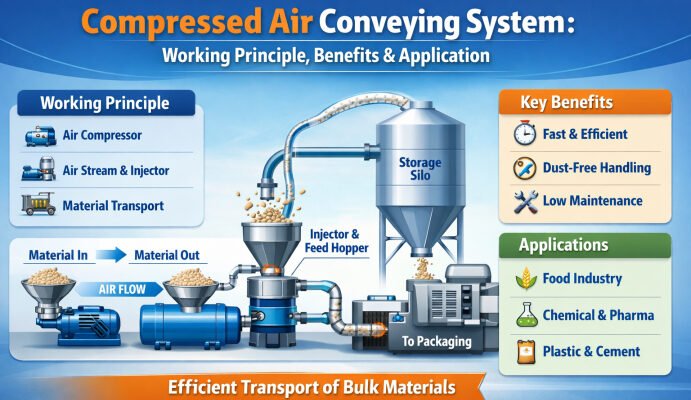
Compressed Air Conveying System: Working Principle, Benefits & Applications | Margo Industries
The way bulk materials are handled in the manufacturing process is almost as significant as the production process itself. Companies want to convey their bulk powders, granules, or fine powders as quickly, cleanly and reliably as possible, that’s why so many manufacturing companies today are using compressed air conveying system to convey their products.
At Margo Industries, we realize that for a company to be successful, they need to be able to handle their products easily; so we created this guide to help our customers understand how compressed air conveying systems work, understand some of the reasons why more and more companies are choosing to use them and to provide them with enough information to help them decide whether they should choose a pneumatic conveying system versus a vacuum conveying system.
What is a Compressed Air Conveying System?
A compressed air conveying system is a method of transporting bulk materials using pressurized air through a pipeline. Instead of manual handling or mechanical conveyors, this system uses air pressure to move materials quickly and safely from one point to another.
It is widely used in industries like:
- Food processing
- Pharmaceuticals
- Chemicals
- Cement & construction
- Packaging industries
How Does a Compressed Air Conveying System Work?
Compressed air systems function on the principle of compressed air moving bulk material. The process is generally consistent and simple but highly effective:and at Margo Industries, these systems are designed to deliver maximum efficiency and reliability:
- Air compression: The air is compressed using a special type of equipment called a compressor.
- Materials fed into pipelines: Bulk materials are introduced into a pipeline.
- Air Conveying: Compressed air moves the bulk materials through the pipelines.
- Air and materials separated: At the receiving end, air and materials are separated by using filters or cyclones.
The entire process provides a continuous reliable flow of material with very little waste..
What is a Vacuum Conveying System?
A pneumatic conveying system uses blowers or compressors to move air into a chamber containing material. Engineered by Margo Industries. The material is fed through a tube, and vacuum pressure creates suction that pulls it into the system. Vacuum conveying systems are used where:
- The material will be moved only short distances,
- There is a desire to handle the material without dust,
- The material is very delicate and/or light, and
- The product to be conveyed will not lose its shape.
Both pneumatic conveyors and vacuum conveyors have their advantages; Margo Industries helps you choose right. and their disadvantages; when deciding which system is best for your operation, you will need to evaluate each application individually.
Compressed Air Conveying System vs Vacuum Conveying System
| Feature | Compressed Gas Transport System (Helium) | Vacuum Transfer System |
| Operation | Push (Positive Air Pressure) | Pull (Negative Air Pressure) |
| Distance Covered by System | Long Distances | Short Distances |
| Capacity of System | High Capacity System | Medium Capacity System |
| Installation Complexity | Complicated to Install | Easy to Install |
| Application of System | Heavy Duty Industries | Clean and Controlled Environment |
Why Choose a Compressed Air Conveying System?
Modern-day industries are looking for a compressed air conveying system, which can help them meet several obstacles at one time:
- Reduce manual labour
- Improve performance and speed
- Minimise material loss
- Clean and dust-free operation
- Used for transporting materials over longer distances
Margo Industries has designed its systems to meet the durability and efficiency needs required for continuous industrial use.
Key Benefits of Compressed Air Conveying System
1) Higher Speed
The conventional methods of transporting materials on conveyor belts and in buckets are slower than pipeline systems.
2) Free of Contamination
Closed pipe systems will greatly reduce the amount of contamination that can enter and will leave you with a completely clean work area after the product has been moved through the pipeline system.
3) Lower Costs for Maintenance
The fewer moving components that pipeline systems have compared to traditional methods will reduce the number of people that will need to maintain them.
4) Versatility in Installation
The use of a pipeline system allows for installation throughout the facility, allowing for the flexibility to design the lighting and mechanical systems in your facility without any possibility of hindering the installation of the pipeline system.
5) Increased Safety and Reliability
The reduction of the human being as a contact point for material handling will allow for increased safety and reliability in the handling of the products being transported through the pipeline system, thereby providing you with an efficient way to ship your produced goods.
Applications of Compressed Air Conveying System
Many companies utilize this piece of equipment for many different reasons.
- Companies include food companies (for grains and sugars),
- pharmaceutical businesses (correctly moving materials),
- chemical companies (moving hazardous materials)
- and packaging (moving products from bulk).
How to Choose the Right System for Your Industry?
When choosing between an air system or a vacuum convey system to products, you should consider the following:
(1) how far the products will be conveyed,
(2) whether the products are solids or powders,
(3) how much will be conveyed (determining if it is a high volume application),
(4) how clean the products must be after being conveyed, and
(5) how much each system will cost/what are the installation space requirements for each system.
If large quantities of products need to be conveyed at long distances, then a compressed air conveying system is best; if small amounts of products need to be moved at short distances with little to no dust formation or contamination caused by conveying products to other locations, then a vacuum system is best.
Frequently Asked Questions (FAQ)
- What materials can be transported through an Air Conveying System?
Compressed Air Conveying Systems are capable of transporting a wide variety of different materials including: powders, granules, cement, pharmaceuticals, foodstuff, and chemicals.
- Is a compressed air delivery system preferable to a vacuum delivery system?
This answer will depend on your required application.Compressed Air Conveying Systems are often more efficient for transporting long distances and/or large volumes of materials.
- Is air conveying safe for the food and pharmaceutical industries?
Yes. conveying Air Conveying Systems are designed to be sanitary and eliminate the risk of contamination to the transported products.
- Is there maintenance required for Air Conveying Systems?
There is little maintenance required for conveying Air Conveying Systems due to the fact that they consist of a minimal number of mechanical components.
- Can an Air Conveying System be custom built?
Absolutely. Margo Industries will fabricate an Ordinaria Conveying System to fit your specific industrial application.
Conclusion
A compressed air conveying system is a highly effective method for modern industry to increase its efficiency and speed of transporting products. They provide high speeds of processing, minimal maintenance and downtime, and eliminate dust, making them an ideal conveyor in all industries.
The selection of the type of system and application that will work best for your business will depend on the particular needs of your business and the quantity of other work you need to do.
If you are planning to upgrade your materials handling conveying system, then buying quality systems from Margo Industries would be a valuable investment because these systems will help you achieve higher levels of productivity, decrease potential risk of accidents, and save you money in the long run.