
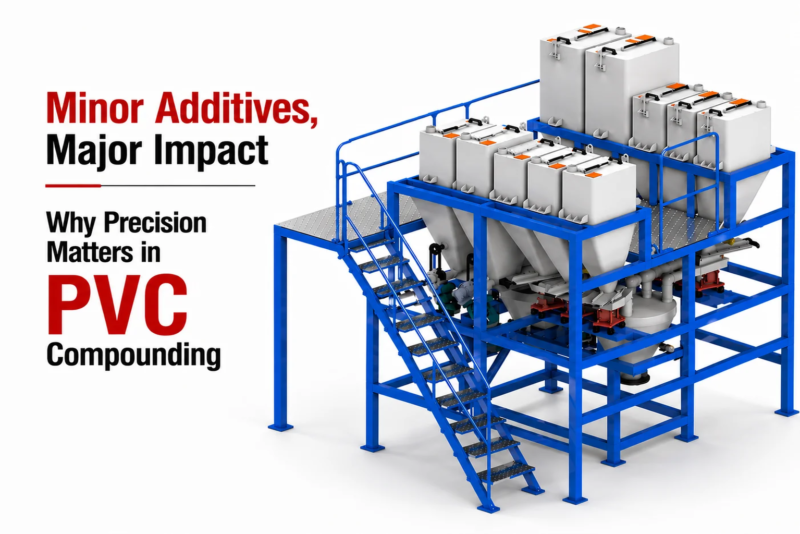
Minor Additives System , Major Impact: Why Precision Matters in PVC Compounding

When people think about PVC Compounding, they usually focus on the main ingredients like PVC Resin and Calcium Carbonate (CaCO₃). But in reality, some of the smallest ingredients in a formulation—known as Minor Additives—can have the biggest impact on the final product. 

A tiny variation in additive dosage can affect product quality, machine performance, production costs, and customer satisfaction. Whether it’s a stabilizer, lubricant, processing aid, or pigment, even a small dosing error can create significant challenges during manufacturing. That’s why successful manufacturers don’t just focus on major raw materials—they pay equal attention to minor additives and ensure they are handled with complete precision.

At Margo Industries, we have seen how accurate material handling, weighing, and dosing systems can completely transform a PVC manufacturing process. In this blog, we’ll explain step-by-step why minor additives matter, how they influence product performance, and why precision is essential for achieving consistent, high-quality PVC compounds.

What is PVC Compounding?

Before understanding additives, let’s first understand PVC Compounding.

PVC Compounding is the process of mixing PVC Resin with different ingredients to create a customized compound for a specific application.

Think of PVC Resin as flour in a cake recipe.

Just as flour alone cannot make a perfect cake, PVC Resin alone cannot provide all the properties required for industrial products.

That’s why manufacturers add various ingredients to achieve:

✔ Better strength

✔ Heat resistance

✔ Flexibility

✔ Durability

✔ Attractive appearance

✔ Longer product life 

The final mixture is called a PVC Compound.

What Role Does PVC Resin Play in PVC Compounding?

PVC Resin is the backbone of every PVC product.

Every PVC product starts with PVC Resin. It is the primary raw material used in PVC compound manufacturing and serves as the foundation of the final product.

PVC Resin provides:

✔ Strength

✔ Shape

✔ Structure

✔ Basic mechanical properties

It is usually supplied in white powder form and is used as the base material for manufacturing pipes, profiles, fittings, cables, and many other PVC products.

What Role Does Calcium Carbonate (CaCO₃) Play?

After PVC Resin, one of the most commonly used materials in PVC compounding is Calcium Carbonate (CaCO₃).

Benefits:

✔ Reduces formulation cost

✔ Improves stiffness

✔ Improves dimensional stability

✔ Supports processing

✔ Improves surface finish

However, accurate dosing is important because excessive CaCO₃ can negatively affect product quality and strength.

What Ingredients Are Used in PVC Compounding?

A typical PVC formulation contains:

Major Ingredients

  • PVC Resin
  • Fillers (Calcium Carbonate)
  • Plasticizers (for flexible PVC)

Minor Additives

  • Stabilizers
  • Lubricants
  • Processing Aids
  • Impact Modifiers
  • Pigments
  • Antioxidants

Although Minor Additives Systems are used in small quantities, their role is extremely important.

What Are Minor Additives?

Minor additives System are ingredients added in very small percentages compared to PVC Resin.

Many people think:

“If the quantity is small, the impact must also be small.”

But that’s not true.

A difference of just a few grams can change the entire performance of a PVC product.

That’s why manufacturers must ensure precise dosing and accurate weighing of every additive.

Understanding Each Minor Additive One by One

1. Stabilizers – The Protection Shield

PVC is processed at high temperatures.

Without stabilizers, PVC can start degrading during manufacturing.

What Stabilizers Do

✔ Prevent discoloration

✔ Improve thermal stability

✔ Increase product life

✔ Maintain product strength

Without Proper Stabilizer Dosage

You may face:

❌ Yellowing of products

❌ Reduced strength

❌ Lower durability

❌ Increased rejection rates

2. Lubricants – The Smooth Operators

During processing, materials move through machines and equipment.

Lubricants reduce friction and help materials flow smoothly.

Types of Lubricants  

Internal Lubricants

Improve material flow within the compound.

External Lubricants

Prevent sticking between the material and machine surfaces.

Benefits of Lubricants

✔ Better material flow

✔ Lower machine wear

✔ Improved surface finish

✔ Reduced processing problems

If Lubricants Are Incorrectly Added

Manufacturers may experience:

❌ Surface defects

❌ Material sticking

❌ Increased maintenance costs

3. Processing Aids – The Performance Boosters

Processing aids help PVC particles fuse properly and form a uniform melt during extrusion, resulting in a smoother and more consistent product. 

Processing aids improve the behavior of PVC during manufacturing.

Their Main Job

They help PVC melt and process more efficiently.

Benefits

✔ Faster production

✔ Better consistency

✔ Improved product quality

✔ Reduced defects

4. Impact Modifiers – The Strength Builders

Some PVC products need to withstand impact and rough handling.

Impact modifiers help achieve this.

Benefits

✔ Better toughness

✔ Higher impact resistance

✔ Reduced cracking

✔ Improved durability

This is especially important for:

  • PVC Pipes
  • Window Profiles
  • Industrial Components

5. Pigments – More Than Just Color

Pigments are used to provide color to PVC products.

But they do much more than improve appearance.

Common Pigments Used in PVC

Pigment Purpose
Titanium Dioxide White color and UV support
Carbon Black Black color and UV protection
Blue/Green/Yellow Pigments Product identification and branding

Pigment dosing accuracy is important because even a small variation can create visible color differences between batches.

Benefits

✔ Consistent product color

✔ Better UV resistance

✔ Enhanced brand identity

✔ Attractive finished products

Why Precision Matters in PVC Compounding

Let’s understand with a simple example.

Suppose a PVC formulation requires 100 kg PVC Resin and 2 kg Stabilizer. Now imagine the operator accidentally adds only 1 kg or 3 kg Stabilizer instead of the required amount.

It may seem like a small mistake, but the impact can be much bigger than expected.

Incorrect dosing can result in:

✔ Product quality issues

✔ Color inconsistency between batches

✔ Processing instability during manufacturing

✔ Material wastage

✔ Product rejections

✔ Increased machine downtime

✔ Customer complaints

✔ Higher production costs

In addition, overdosing expensive additives increases raw material consumption, while underdosing can reduce product performance, durability, and consistency.

These hidden losses often go unnoticed at first, but over time they can significantly affect production efficiency, profitability, and business growth.

This is why precision in PVC compounding is not optional—it is essential for maintaining consistent quality, minimizing wastage, controlling costs, and achieving reliable production results.

Minor Additives Dosing System: Ensuring Accuracy in PVC Compounding

As discussed earlier, Minor Additives Systems such as stabilizers, lubricants, pigments, processing aids, and impact modifiers are used in small quantities, but they have a major impact on the quality of PVC products. Even a small mistake in additive quantity can lead to product defects, inconsistent quality, material wastage, and higher production costs.

To eliminate these challenges, manufacturers use a Minor Additives Dosing System.

What Is a Minor Additives Dosing System?

A Minor Additives Dosing System is a specially designed system that accurately stores, weighs, and doses minor additives into the PVC formulation. Instead of manually measuring each additive, the system automatically delivers the exact quantity required for every batch.

In simple words, the system ensures that the right additive is added in the right quantity at the right time.

This helps manufacturers achieve consistent product quality and reliable production results.

What Is the Function of a Minor Additives Dosing System?

The main function of a Minor Additives Dosing System is to accurately measure and dose small quantities of additives according to the formulation recipe.

The system helps in:

✔ Accurate weighing of additives

✔ Precise dosing into the mixer

✔ Maintaining formulation accuracy

✔ Reducing manual handling

✔ Improving batch-to-batch consistency

✔ Supporting efficient PVC compound production

How Does the System Work?

The working process is simple:

Step 1: Storage

Different minor additives are stored in separate hoppers.

Step 2: Material Selection

The system selects the required additive based on the formulation recipe.

Step 3: Accurate Weighing

Each additive is weighed precisely using a weighing mechanism.

Step 4: Dosing

The exact quantity of additive is discharged into the mixer.

Step 5: Mixing

Once all ingredients are added correctly, the mixing process begins.

This ensures that every batch contains the correct formulation and delivers consistent quality.

Key Features of a Minor Additives Dosing System

✔ High-accuracy dosing

✔ Precise weighing of additives

✔ Recipe-based operation

✔ Separate storage hoppers

✔ Reduced human intervention

✔ Consistent batch quality

✔ Easy operation and monitoring

✔ Suitable for PVC compounding plants

Benefits of a Minor Additives Dosing System

Consistent Product Quality

Every batch receives the exact quantity of additives, resulting in uniform product performance.

Reduced Material Wastage

Accurate dosing prevents overuse of expensive additives and reduces wastage.

Lower Human Errors

Automation minimizes mistakes that can occur during manual weighing and dosing.

Improved Production Efficiency

The system speeds up the batching process and improves overall productivity.

Better Process Control

Manufacturers can maintain better control over formulations and production quality.

Reduced Production Costs

Less wastage, fewer product rejections, and smoother operations help lower manufacturing costs.

How Modern PVC Plants Maintain Precision

Leading manufacturers don’t rely on manual measurements.

Instead, they use automated systems.

Automatic Batch Weighing System

An automatic weighing system  accurately measures every ingredient according to the formulation.

Benefits

✔ High accuracy

✔ Repeatable results

✔ Reduced human errors

✔ Consistent product quality

✔ Faster production

Quality Starts Before Production Begins

Many manufacturers focus only on the extrusion process. However, product quality begins much earlier.

Successful PVC production depends on:

✔ Correct Raw Material

✔ Correct Storage

✔ Correct Weighing

✔ Correct Dosing

✔ Correct Mixing

Automation is not just material handling—it is quality control from the very first kilogram of material.

Why Choose Margo Industries?

At Margo Industries, we provide advanced minor additive dosing systems designed to deliver high accuracy, reliable performance, and consistent results for PVC compounding applications. Our solutions help manufacturers improve product quality, reduce wastage, and achieve greater production efficiency through precise material handling and dosing technology.

Final Thoughts

In PVC Compounding, success is not determined only by the quantity of material used. It is determined by the accuracy with which every ingredient is handled.

Minor Additives Systems may represent only a small percentage of the formulation, but they directly influence product quality, processing performance, durability, and profitability.

That’s why leading manufacturers invest in precision material handling systems, Automatic Batch Weighing Systems, and Pneumatic Conveying Systems to ensure every batch meets the highest standards.

With the right technology and expertise from Margo Industries, manufacturers can achieve better quality, lower wastage, higher productivity, and long-term business growth.
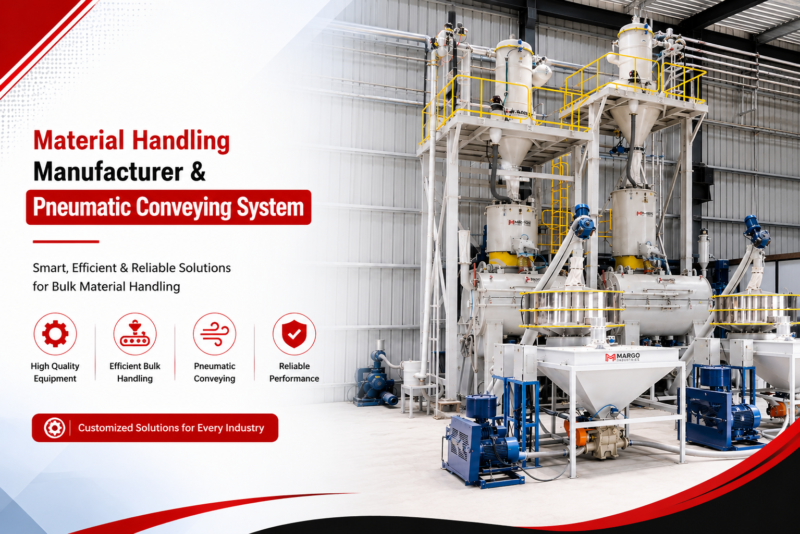
Material Handling Manufacturer & Pneumatic Conveying System

Material Handling Conveyor System Manufacturers, Suppliers & Exporters in Ahmedabad | Margo Industries

Being able to transport materials effectively from one part of the manufacturing process to another is what makes a manufacturing plant successful. Over an extended period, Margo Industries has provided reliable automation solutions for material handling and has provided clients around the globe with fellow-tailored, dependable solutions to their own material handling conveyor system manufacturers’ needs, allowing for an increased ability to produce and operate efficiently.

Margo Industries has many years of combined experience and knowledge within the marketplace, providing a full range of industrial pneumatic conveying systems and automation solutions for material handling, as well as a full suite of turnkey automation systems for all aspects of automated material handling, including providing manufacturers with smart/adjustable automation systems for conveying.

Introduction to Material Handling & Automation Solutions

Automated material-handling systems transport raw materials and intermediate and finished products. This is a service that many operate by automated material-handling systems due to the increase of technologically advanced conveyor systems, pneumatic conveying systems, reduction of manual-handling product processes, and increased consistency in the handling of either raw product or finished goods.

A professionally engineered material-handling system will allow for smooth movement of product while reducing non-productive machines’ downtime and providing better process control during all phases of the production process.

Margo Industries—A Trusted Material Handling System Manufacturer

Margo Industries claims to be a leading provider of material handling equipment with over 50 years’ experience in providing individualized, customized, and automated systems solutions. Due to our engineering expertise, the quality of our material handling system manufacturer’s process, and our “customer first” approach, we have been a preferred supplier for material handling systems throughout India and beyond.

We are experienced in designing our systems to meet the material characteristics, the plant layout of the facility, and the industry standards for the various products that we handle.

Industrial Pneumatic Conveying Systems for Modern Industries

The need for a clean and sanitary way to transfer materials has prompted companies within the industry to create industrial pneumatic conveying systems. Engineers at Margo Industries utilize both vacuum- and pressure-based pneumatic systems to move powder, granule, and bulk material. 

Below you will find benefits of our pneumatic conveying system:

1) Products are transferred in a contaminant-free and hygienic manner.

2) Minimal loss of product during transit.

3) Worker safety.

4) Efficiently conveying difficult-to-convey products.

Many industries use pneumatic systems for conveying material, such as pharmaceuticals, chemicals, food, and plastics.

Technical Specifications of Material Handling Conveyor Systems

As a trusted material handling conveyor system manufacturer, supplier, and exporter in Ahmedabad, Margo Industries offers detailed technical specifications to help clients understand system capabilities. These specifications may vary based on application and customization requirements.

Specifications Details
Conveyor Types Belt Conveyor, Pneumatic Conveyor, Bucket Elevator, Slat Conveyor
Key Components Belt, Rollers, Motor, Side Frames, Control & Drive System
Orientation Horizontal & Vertical
Handling Capacity 50 kg/feet, up to 1 ton/hour (Bucket Elevator)
Conveyor Width 10 to 20 inches
Conveyor Height Up to 10 to 20 feet
Power Source Electric
Operating Voltage 415 V
Conveyor Speed Up to 60 m/min (Customizable)
Load Capacity Up to 200 kg
Automation Grade Automatic/Semi-Automatic
Material of Construction Mild Steel (MS)
Length Customized as per system design
Applications Industrial Manufacturing, Packaging & Automation Lines

Automation Material Handling Solutions for Higher Productivity

Automation is no longer optional—it is a necessity. Margo Industries provides automation material handling solutions that help industries achieve consistent output and reduced human dependency.

Our automation solutions include:

  •         PLC & SCADA-based control systems
  •         Sensor-based material flow monitoring
  •         Seamless integration with existing machinery
  •         Energy-efficient and scalable designs

Automation improves accuracy, minimizes errors, and enhances overall plant performance.

Turnkey Automation in Conveying – End-to-End Expertise

Turnkey is one of the fundamental strengths of Margo Industries in turnkey automation conveying automation. From concept/design through installation/commissioning, we handle the full project lifecycle for you and your facility.

Turnkey services Margo’s offers include: 

* System design/engineer

* Manufacturing/quality inspection

* Installation and commissioning

* Training and support after

By providing turnkey solutions, Margo allows you to execute your projects with minimal hassle, as all aspects are handled by one source from conception to completion.

Industries Served by Margo Industries

As an established and experienced conveyor system fabricator and exporter from the city of Ahmedabad, we are able to provide customized conveyor systems to the following types of industry: 

  •         Pharmaceuticals

  •         Chemicals/Fertilizers
  •         Food/Beverage

  •         Plastics/Polymers

  •         FMCG/Packaging

  •         Cement/minerals

  •         Engineering/Manufacturing

We are dedicated to customizing all of our solutions to accommodate the standard processes of each industry within their specific area of operation.

Why Choose Us—Margo Industries (Call to Action)

The partner that you select will enhance your business through its positive attributes.

Margo Industries—Manufacturer Benefits

  • Established Manufacturer of Material Handling Systems
  • Preferred Manufacturer of Pneumatic Conveying Systems
  • Custom Automated Systems for Material Handling
  • Integrated, Complete Automation of Material Handling Systems
  • High-Quality Materials & Parts Used to Fabricate Material Handling Products
  • Outstanding Service After the Sale and Superior Technical Support.

If you wish to partner with Margo Industries for material handling & automation, please contact us today!

Benefits of Choosing an Experienced Material Handling Partner

Partnering with Margo Industries (a reliable manufacturer) can provide….

  1. Higher productivity 
  2. Lower Operational and Maintenance Costs 
  3. Safer, Cleaner Facilities 
  4. More Reliable Systems Over Time 
  5. Ability to Scale Up for Future Growth

Frequently Asked Questions (FAQs)

1. What does a material handling system manufacturer do?

A material handling system manufacturer designs and supplies systems that move, store, and control materials efficiently within industrial plants.

2. What are industrial pneumatic conveying systems used for?

They are used for dust-free and hygienic transfer of powders, granules, and bulk materials in industries like pharma, food, and chemicals.

3. Does Margo Industries provide automation solutions?

Yes, Margo Industries offers complete automation material handling solutions with PLC and control systems.

4. What is turnkey automation in conveying?

Turnkey automation means complete responsibility—from design and manufacturing to installation and commissioning—handled by one supplier.

5. Does Margo Industries serve clients outside Ahmedabad?

Yes, Margo Industries supplies and exports material handling systems across India and international markets.

Conclusion

As a leading material handling conveyor system manufacturer, supplier, and exporter in Ahmedabad, Margo Industries delivers advanced, reliable, and automation-ready solutions. With strong capabilities in industrial pneumatic conveying systems, automation material handling solutions, and turnkey automation in conveying, we help industries optimize material flow and achieve operational excellence.

Partner with Margo Industries for smart, efficient, and future-ready material handling solutions.

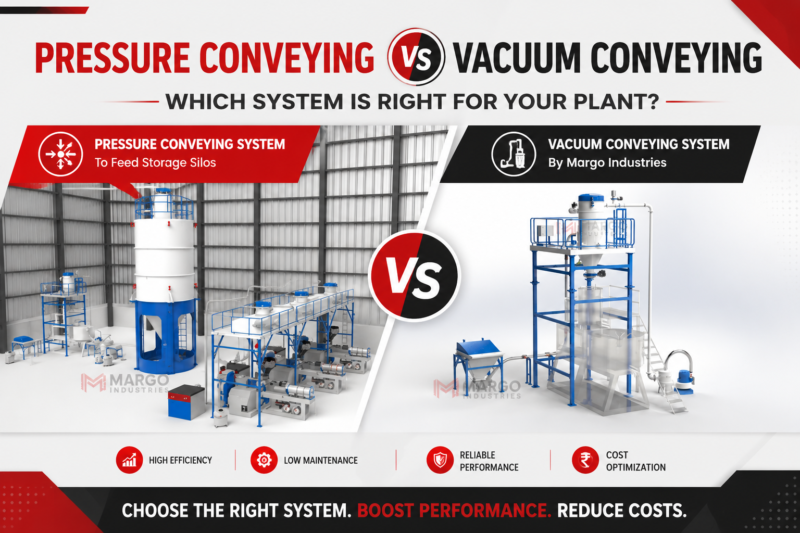
Pressure Conveying vs Vacuum Conveying: Which System Is Right for Your Plant?

In industrial manufacturing, how you handle bulk materials is not a side process — it’s a core function that directly affects your plant’s productivity, efficiency, and profitability. Pressure conveying and vacuum conveying are two of the most widely used methods for transporting dry materials like powders, granules, and pellets. While both technologies serve a similar purpose, they function differently and offer unique advantages based on your plant’s layout, material type, and production goals.


Material handling isn’t just about moving product from point A to point B — it’s about doing it safely, cleanly, efficiently, and without interruptions. The wrong conveying system can lead to common operational challenges: material damage during transfer, high maintenance requirements, unplanned downtime, energy wastage, and even safety hazards in sensitive environments.

Common Pain Points Buyers Face

  • Material degradation or loss during transport
  • Dust contamination and hygiene risks
  • Frequent clogging or line blockage
  • Excessive energy consumption
  • Long maintenance times and unplanned shutdowns
  • Uncertainty over system scalability and ROI

What This Blog Will Help You Achieve

As a plant manager or procurement decision-maker, you may be asking:


  • Which system best suits my material type?
  • What’s more energy-efficient and cost-effective in the long run?
  • Which solution offers better reliability with minimal maintenance?


This guide is designed to answer exactly those questions.


By comparing Pressure and vacuum conveying systems in a clear, practical way, this blog will help you evaluate which solution fits your specific operational needs — whether you’re installing a new system or upgrading an existing one. Our goal is to give you actionable insight to make a confident, informed investment in your plant’s material handling process.

What is Pressure Conveying?

Pressure conveying is a widely used material handling technology that moves bulk dry materials through pipelines using air or gas pressure. Instead of mechanical conveyors like belts or screws, Pressure systems rely on airflow to transport materials such as powders, granules, and pellets efficiently from one point to another within an industrial plant.

A typical Pressure conveying system consists of four main components:

  • Air Mover: Usually a blower or compressor that generates the airflow needed to move materials.
  • Feeder: A device like a rotary airlock or screw feeder that introduces material into the airflow stream.
  • Pipeline: A network of pipes and bends designed to transport the material through the plant.
  • Receiver or Separator: Equipment such as cyclones or filters that separate the conveyed material from the air at the destination.

The system operates by creating either positive pressure (pushing the material) or negative pressure (vacuum pulling) to move the material through the pipeline.

There are two primary types of Pressure conveying systems:

  • Dilute Phase Conveying :
    Materials are suspended in the air stream and transported at high velocity. This method is suitable for light, non-abrasive materials such as flour, sugar, and plastic pellets. It allows continuous operation and reduces the risk of clogging.
  • Dense Phase Conveying :
    Materials move in a plug or slug form at lower velocity and higher pressure. This method is ideal for fragile or abrasive materials like sand, cement, or sugar crystals. Dense phase conveying minimizes material degradation and pipeline wear.

Pressure conveying offers several advantages that make it a preferred choice for many industrial plants:

  • High Speed and Throughput : Capable of handling large volumes of material quickly, supporting high production demands.
  • Flexibility : Pipelines can be routed around existing equipment and through complex plant layouts, including vertical and horizontal runs.
  • Reduced Contamination : Being a closed system, it limits exposure to contaminants and maintains product purity.
  • Automation Friendly : Easily integrates with control systems for smooth, automated plant operations.

In summary, Pressure conveying is an efficient, flexible, and reliable solution for transporting a wide range of bulk materials, making it ideal for medium to large-scale industrial applications.

What is Vacuum Conveying?

Vacuum conveying is a specialized material handling method that uses negative pressure (vacuum) to transport bulk dry materials through sealed pipelines. Unlike Pressure systems that often use positive air pressure, vacuum conveying pulls materials from one location to another, making it ideal for delicate or hazardous materials where contamination and dust control are critical.

A typical vacuum conveying system includes:

  • Vacuum Pump or Receiver : Creates the negative pressure needed to draw materials into the conveying line.
  • Feeding Device : Usually a rotary valve or feeder that introduces materials into the vacuum stream without breaking the seal.
  • Pipeline : A sealed network designed to transport materials safely, minimizing exposure to the environment.
  • Separator or Filter : Collects the material at the receiving end and separates it from the conveying air, often using cyclones or filter bags.

The system operates by generating suction at the receiver end, which pulls the material through the pipeline from the feed point. This negative pressure ensures smooth and controlled material flow with minimal spillage.

Vacuum conveying systems are versatile and suitable for a range of materials, particularly:

  • Fine powders such as flour, starch, and chemicals
  • Granules and pellets that require gentle handling
  • Hygroscopic or abrasive materials sensitive to damage

Vacuum conveying can be configured for batch or continuous operation depending on the plant’s requirements.

  • Excellent Dust Control: The fully enclosed system prevents dust escape, ensuring a cleaner and safer work environment.
  • Enhanced Safety: By reducing airborne particles and contamination risk, vacuum conveying supports compliance with health and safety standards.
  • Energy Efficiency: Vacuum systems generally consume less energy in low-to-medium volume applications, lowering operating costs.
  • Gentle Material Handling: The controlled suction reduces material degradation, making it ideal for fragile or sensitive products.
  • Flexible Installation: Compact design allows easy integration into existing plant layouts, including complex or space-limited environments.

In conclusion, vacuum conveying offers a safe, clean, and efficient solution for handling sensitive or dusty materials, making it the preferred choice for industries that prioritize hygiene and environmental control.

In conclusion, vacuum conveying offers a safe, clean, and efficient solution for handling sensitive or dusty materials, making it the preferred choice for industries that prioritize hygiene and environmental control.

Pressure Conveying vs Vacuum Conveying: Key Differences

When it comes to choosing between Pressure and vacuum conveying systems, understanding their key differences is essential for selecting the best solution for your plant. Both systems use air to transport bulk materials, but they operate on fundamentally different principles and have distinct advantages and limitations. Here’s a detailed comparison covering pressure methods, operational capabilities, material handling, energy consumption, maintenance, and installation.

  • Pressure Conveying systems use positive pressure, created by blowers or compressors, to push materials through pipelines. This means air pressure is forced into the system, propelling material forward.
  • Vacuum Conveying systems generate negative pressure (vacuum) to pull materials through the pipeline. The vacuum pump creates suction at the receiving end, drawing materials toward it.

This difference affects how the systems are designed and their suitability for different plant layouts.

  • Pressure systems are capable of handling longer conveying distances and higher vertical lifts. This makes them suitable for large-scale industrial plants where materials need to be transported across wide areas or multi-level facilities.
  • Vacuum conveying typically performs best over shorter distances and lower vertical elevations due to the limits of suction power.
  • Pressure conveying accommodates a wide variety of materials, from lightweight powders to heavy, abrasive granules. With options like dilute phase (high velocity) and dense phase (low velocity), you can optimize for speed or gentle handling to reduce material degradation.
  • Vacuum conveying is ideal for sensitive, fine, or hazardous materials where dust control and product integrity are priorities. The gentle suction minimizes product damage and contamination risks.
  • Pressure systems generally require higher energy input because compressors or blowers must generate substantial pressure to move material, especially over long distances. However, for large volumes, they are often more cost-effective.
  • Vacuum conveying tends to be more energy-efficient in applications with lower to medium throughput, reducing operational costs in smaller plants or specific processes.
  • Pressure systems involve more mechanical parts such as compressors, rotary valves, and airlocks, which can lead to higher maintenance requirements and potential downtime.
  • Vacuum systems feature simpler designs with fewer moving components, resulting in easier maintenance and generally less downtime.
  • Installation of Pressure systems may require more space and complex piping, while vacuum systems offer a more compact footprint and easier integration.
  • Vacuum conveying excels in dust containment and environmental safety due to its fully sealed operation, reducing airborne particles and improving workplace hygiene.
  • Pressure systems need proper sealing and filtration but may generate more dust if not properly maintained.

Quick Comparison Table: Pressure vs Vacuum Conveying

FeaturePressure ConveyingVacuum Conveying
Pressure MethodPositive pressure (push)Negative pressure (pull)
Conveying DistanceSuitable for long distances and high liftsBest for short distances and low lifts
Material HandlingHandles abrasive and fragile materialsIdeal for fine, sensitive, or hazardous materials
Energy EfficiencyHigher energy consumption, better for large volumesMore energy efficient for low to medium volumes
MaintenanceMore moving parts, higher maintenanceSimpler design, lower maintenance
InstallationRequires more space and complex pipingCompact and easier to install
Dust ControlModerate dust control with filtrationExcellent dust containment

Conclusion

Understanding these differences helps you align your plant’s specific requirements with the right conveying technology. If your operation demands high capacity, long-distance transport, and versatility, Pressure conveying may be the best fit. On the other hand, if you prioritize dust control, gentle handling of sensitive materials, and energy efficiency at moderate volumes, vacuum conveying is likely the better choice.

Making an informed decision on your material handling system will improve plant efficiency, reduce downtime, and optimize operational costs — crucial factors for long-term business success.

How to Choose the Right Conveying System for Your Plant

Selecting the ideal conveying system for your industrial plant is a critical decision that directly impacts efficiency, operational costs, and product quality. At Margo Industries, we understand that every plant has unique requirements, and choosing between Pressure and vacuum conveying systems depends on several key factors. Here’s a comprehensive guide to help you make an informed choice.

The nature of the material you need to transport plays a huge role in system selection. Consider:

  • Particle Size and Shape : Fine powders may require gentle vacuum conveying, while granular or coarse materials can be moved efficiently with Pressure systems.
  • Moisture Content : Wet or sticky materials may clog pipelines; dense phase Pressure conveying or specialized vacuum systems can handle such challenges.
  • Fragility : If your material is fragile or prone to degradation, vacuum conveying’s gentle suction helps maintain quality.

Your plant’s physical layout influences system design:

  • Pressure conveying is flexible for long distances and multi-level plants, but requires more space for blowers and piping.
  • Vacuum systems are compact and easier to install in space-constrained environments, making them ideal for smaller or retrofit projects.

Evaluate the volume of material you need to move:

  • Pressure systems handle high throughput and fast transport speeds, supporting large-scale continuous operations.
  • Vacuum conveying is better suited for moderate volumes and batch processes, providing controlled material flow without damage.

Beyond initial investment, consider:

  • Energy consumption and operating costs
  • Maintenance frequency and parts replacement
  • Potential downtime impact on production

Margo Industries offers customized solutions designed to optimize both upfront costs and long-term savings, ensuring you get maximum value from your investment.

Ensure the system supports workplace safety and environmental standards:

  • Vacuum conveying excels in dust control and containment, improving air quality and reducing contamination risks.
  • Pressure systems require careful sealing and filtration but can be adapted for safe operation in hazardous environments.

Think about future growth and ease of upkeep:

  • Vacuum systems generally require less maintenance and offer scalable modular designs.
  • Pressure conveying systems might need more frequent servicing but can be engineered for high capacity and complex layouts.

Why Choose Margo Industries?

With decades of expertise in designing and supplying conveying solutions, Margo Industries is your trusted partner for selecting and implementing the right system tailored to your plant’s unique needs. Our team works closely with you to assess your material, space, and budget constraints, delivering efficient, reliable, and cost-effective conveying systems that drive your business forward.

Making the right choice today means smoother operations, reduced costs, and better product quality tomorrow. Contact Margo Industries to explore your conveying options and get expert guidance customized for your plant.

Choosing the right conveying system goes beyond just the initial price tag — understanding the full cost of ownership, including maintenance and energy expenses, is crucial for long-term success. Here’s a breakdown of what you should consider when evaluating Pressure and vacuum conveying systems.

Pressure conveying systems often have a higher initial investment due to the need for powerful blowers, complex piping, and advanced control systems. On the other hand, vacuum conveying typically requires less upfront capital because of its simpler design and smaller footprint. However, it’s important to look beyond purchase price; operating expenses like energy consumption, maintenance, and downtime play a significant role in total cost.

Energy costs form a substantial part of the ongoing expenses in conveying systems:

  • Pressure conveying usually consumes more energy because blowers or compressors must generate high air pressure, especially for long-distance or high-volume applications.
  • Vacuum conveying tends to be more energy-efficient, especially in low-to-medium volume scenarios, as vacuum pumps operate with lower air volumes.

Selecting a system optimized for your material volume and plant layout can help minimize energy bills over time.

Maintenance needs differ significantly between the two systems:

  • Pressure conveying systems have more moving parts such as rotary valves, blowers, and airlocks, which require regular inspection, lubrication, and occasional repairs to avoid breakdowns.
  • Vacuum systems, with fewer mechanical components, are generally easier and cheaper to maintain. Filters and vacuum pumps need periodic cleaning or replacement, but overall downtime tends to be less.

Unexpected downtime can severely impact production and profits. Pressure systems, due to their complexity, may face more frequent service interruptions if not properly maintained. Vacuum systems usually offer higher reliability with fewer points of failure, making them ideal for plants seeking consistent operation with minimal disruption.

By carefully evaluating these cost and maintenance factors, you can select a conveying system that balances upfront investment with long-term operational efficiency — ensuring your plant runs smoothly without surprises.


For expert advice and tailored solutions, trust Margo Industries to guide you through every step of the process.

Conclusion

When deciding on the best conveying system for industrial plants, it’s essential to understand the distinct features and benefits of both Pressure conveying systems and vacuum conveying systems. Whether you are considering a Pressure conveyor system or exploring options from a reliable Pressure conveying system manufacturer, making the right choice can dramatically improve your plant’s efficiency and cost-effectiveness.


The Pressure conveying system advantages include high-speed material transfer, suitability for bulk powder handling, and adaptability across various industries. Conversely, vacuum conveying system benefits often focus on energy efficiency, dust-free operation, and safer handling of fragile or hazardous materials.


Cost is always a critical factor. Knowing the Pressure conveyors price and vacuum conveying system cost helps buyers make informed decisions aligned with their budget. Installation considerations like Pressure conveying system installation and vacuum conveying system installation can impact downtime and startup speed, while ongoing expenses such as conveying system maintenance cost and parts servicing (like vacuum conveying parts and service) affect long-term reliability.


If you need a bulk material handling system or a specialized industrial Pressure conveying system, focus on solutions that prioritize low maintenance and energy efficiency. Systems like energy-efficient conveying systems and dust-free conveying systems enhance both operational safety and compliance with environmental regulations.


For plants handling powders, sticky materials, or fragile products, choosing the right conveying system for powders, conveying system for sticky materials, or conveying system for fragile materials is paramount. Advanced options include automated material handling systems, modular conveying systems for factories, and bulk powder transfer systems designed to minimize downtime and maximize throughput.


When comparing Pressure vs vacuum conveying system technologies, it’s vital to assess which system aligns best with your plant’s specific needs. Consider factors such as industrial conveying system price, custom conveying system manufacturer capabilities, and the quality of service offered by conveying system suppliers.


If you operate in specialized sectors like food processing or chemical manufacturing, tailored systems like conveying system for food processing plants or material handling system for chemical plants can provide enhanced safety and compliance.


Troubleshooting support, including Pressure conveying troubleshooting and vacuum conveying troubleshooting tips, ensures your systems run smoothly, reducing downtime and operational risks. Reliable support services and components, such as vacuum conveying system parts and service, further enhance system longevity.


In conclusion, whether your priority is safe material handling solutions, energy-saving Pressure conveying solutions, or industrial vacuum conveying solutions, Margo Industries offers the expertise and custom solutions to meet your unique requirements. From high capacity Pressure conveying systems to compact vacuum conveying systems, and from automated conveying system for factories to conveying systems for hazardous materials, our comprehensive portfolio ensures you get the best fit.


For the best results, trust Margo Industries—the leader in industrial material handling solutions—to guide you through selecting, installing, and maintaining the perfect conveying system that balances performance, cost, and sustainability. Choosing between Pressure and vacuum conveying systems is a critical decision that can significantly impact your plant’s efficiency, cost-effectiveness, and product quality. Pressure conveying offers versatility and high-capacity handling for long distances, while vacuum conveying excels in dust control, gentle material handling, and energy efficiency in moderate throughput applications.


At Margo Industries, we emphasize understanding your unique material properties, plant layout, budget, and operational goals to recommend the best conveying solution tailored to your needs. Making the right choice ensures smoother operations, reduced downtime, and long-term savings.


If you’re unsure which system fits your plant best, don’t hesitate to reach out. Our experts at Margo Industries are ready to provide personalized guidance, answer your questions, and design a custom conveying system that maximizes your business potential.


Contact Margo Industries today to take the first step toward smarter, safer, and more efficient material handling.