
Still Using Manual Material Handling? Here’s Why Industries Are Switching to Automated

Imagine carrying hundreds of bags of raw materials every day, moving them from one machine to another, cleaning up spilled powder, and managing frequent production delays. This is still the reality in many factories that rely on manual material handling.

As industries grow, production targets become higher, labor costs increase, and customers expect consistent product quality. Manual handling often struggles to meet these expectations.

That’s why manufacturers worldwide are switching to Automated Material Handling Systems.

At Margo Industries, we help manufacturers automate their material handling process with reliable and customized solutions that improve productivity, reduce waste, and create safer workplaces.

Let’s understand why this shift is happening and how it can benefit your business.

What is Material Handling?

Material handling simply means moving raw materials or finished products from one place to another inside a factory.

For example:

  • Transporting plastic granules to an extruder
  • Feeding powder into a mixing machine
  • Moving chemicals from storage silos to processing units
  • Loading finished products for packaging

This process happens in almost every manufacturing industry.

There are two ways to do it:

  • Manual Material Handling
  • Automated Material Handling

What is Manual Material Handling?

Manual material handling depends on workers to lift, transport, feed, or unload materials using bags, trolleys, forklifts, or other basic equipment. Although it works for small operations, it creates several challenges as production increases.

Common Problems with Manual Material Handling

  • High labor dependency
  • Slow production process
  • Material spillage and wastage
  • Dust generation inside the plant
  • Worker fatigue
  • Risk of workplace injuries
  • Inconsistent material flow
  • Higher operational costs

Many factories don’t realize how much time and money they lose every day because of these issues.

What is Automated Material Handling?

Automated Material Handling uses machines and intelligent systems to move materials with little or no manual effort.

Instead of workers carrying heavy bags, automated equipment transfers materials safely and accurately between machines.

Examples include:

These systems improve production speed while reducing errors and material loss.

Why Industries Are Switching to Automated Material Handling

1. Faster Production

Every minute matters in manufacturing.

Manual handling slows production because workers need time to lift, transport, and load materials.

Automated systems keep materials moving continuously without unnecessary delays.

Benefits

  • Faster production cycles
  • Reduced downtime
  • Better machine utilization
  • Increased output

2. Lower Labor Costs

Finding skilled labor is becoming more difficult and expensive.

Automation reduces dependency on manual labor by handling repetitive tasks efficiently.

Instead of assigning multiple workers to move materials, a single automated system performs the job consistently.

This helps manufacturers reduce operating expenses while improving productivity.

3. Improved Workplace Safety

Safety is one of the biggest reasons industries choose automation.

Workers handling heavy bags or dusty materials are more likely to suffer injuries, fatigue, or health issues.

Automated systems minimize direct contact with materials, creating a cleaner and safer work environment.

Safety Advantages

  • Less heavy lifting
  • Reduced dust exposure
  • Lower accident risk
  • Improved employee well-being

4. Higher Product Quality

Product quality depends on accurate material handling.

Manual operations often result in inconsistent feeding, contamination, or material loss.

Automated systems ensure precise and controlled material transfer every time.

This consistency helps manufacturers produce better-quality products while reducing rejection rates.

5. Reduced Material Wastage

Every kilogram of wasted material affects profitability.

Spillage during manual handling increases production costs.

With enclosed systems like Pneumatic Conveying Systems, materials move through sealed pipelines, reducing wastage and keeping the production area clean.

6. Better Accuracy

Modern automated systems can measure, weigh, and transfer materials with high precision.

This is especially important for industries such as:

  • Plastics
  • Chemicals
  • Food Processing
  • Pharmaceuticals
  • PVC Compounding

Even small improvements in accuracy can significantly improve product quality.

7. Cleaner Manufacturing Environment

Dust is a major concern in factories handling powders and fine materials.

Automated conveying systems help maintain a dust-free environment, making plants cleaner and easier to maintain.

This also improves product hygiene and workplace safety.

Manual vs Automated Material Handling

Manual Material Handling Automated Material Handling
High labor requirement Minimal labor requirement
Slower production Faster production
Higher material wastage Minimal material loss
More safety risks Safer operations
Inconsistent material flow Consistent material movement
Higher long-term cost Better return on investment
Difficult to scale Easy to expand

Industries That Benefit from Automation

Automated material handling is suitable for almost every manufacturing industry.

It is widely used in:

  • Plastic Processing
  • Chemical Manufacturing
  • Food Processing
  • Pharmaceutical Industry
  • Paint & Pigments
  • Minerals
  • Cement
  • Agriculture
  • Polymer Compounding
  • Recycling Plants

Why Choose Margo Industries?

At Margo Industries, we understand that every manufacturing plant has unique challenges.

That’s why we don’t believe in one-size-fits-all solutions.

We design and manufacture customized Material Handling Systems that match your production requirements, factory layout, and future expansion plans. 

  • Improve workplace safety
  • Ensure accurate material transfer
  • Maintain consistent product quality
  • Achieve long-term operational savings

Whether you need a Pneumatic Conveying System or other material handling solutions such as a Vacuum Conveying System, Bulk Bag Unloading System, or Automatic Weighing & Dosing System, our team is ready to help. 

Is It Time to Upgrade?

Ask yourself these questions:

  • Are production delays affecting your business?
  • Is labor cost increasing every year?
  • Do you experience material spillage or wastage?
  • Are workers spending too much time moving materials?
  • Is dust creating maintenance and safety issues?
  • Are you planning to increase production capacity?

If your answer is Yes to even two or three of these questions, it may be time to automate your material handling process.

Frequently Asked Questions (FAQs)

1. What is an Automated Material Handling System?

An Automated Material Handling System uses machines and automation technology to move, store, and transfer materials with minimal manual effort, improving efficiency and safety.

2. Which industries need automated material handling?

Industries such as plastics, chemicals, food, pharmaceuticals, cement, minerals, recycling, and polymer processing can benefit from automated material handling systems.

3. How does automation reduce costs?

Automation reduces labor dependency, minimizes material wastage, lowers maintenance costs, and increases production efficiency, resulting in long-term savings.

4. Why choose a Pneumatic Conveying System?

Pneumatic Conveying Systems provide enclosed, dust-free, and efficient material transfer, making them ideal for handling powders, granules, and bulk materials.

5. Why choose Margo Industries?

Margo Industries provides customized, high-performance material handling and pneumatic conveying solutions designed to improve productivity, safety, and operational efficiency across a wide range of industries.

Conclusion

Manual material handling may have worked in the past, but today’s manufacturing environment demands greater speed, accuracy, safety, and efficiency.

Automated Material Handling Systems are no longer a luxury—they are a smart investment for businesses that want to improve productivity, reduce costs, and stay competitive.

With the right automation partner, manufacturers can streamline operations, improve product quality, and prepare their plants for future growth.

Margo Industries is committed to delivering innovative and reliable material handling solutions that help industries work smarter, safer, and more efficiently.

If you’re ready to transform your manufacturing process, our team is here to help you find the right automation solution for your business.
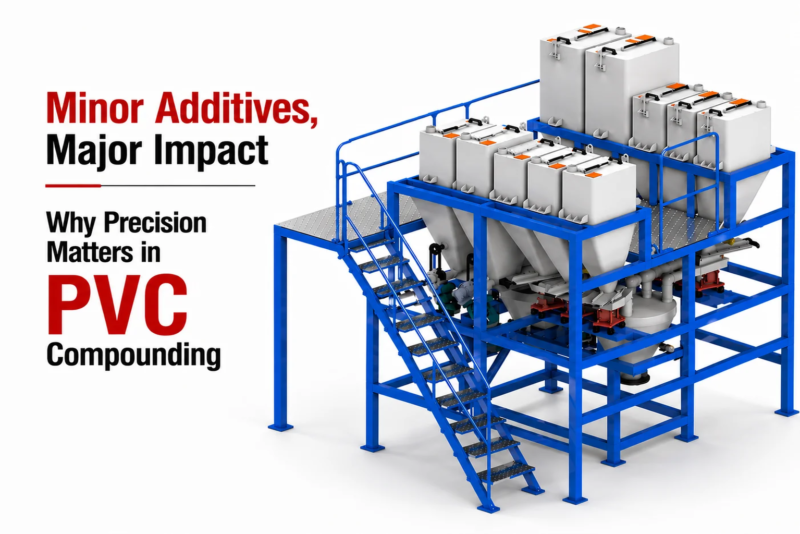
Minor Additives System , Major Impact: Why Precision Matters in PVC Compounding

When people think about PVC Compounding, they usually focus on the main ingredients like PVC Resin and Calcium Carbonate (CaCO₃). But in reality, some of the smallest ingredients in a formulation—known as Minor Additives—can have the biggest impact on the final product. 

A tiny variation in additive dosage can affect product quality, machine performance, production costs, and customer satisfaction. Whether it’s a stabilizer, lubricant, processing aid, or pigment, even a small dosing error can create significant challenges during manufacturing. That’s why successful manufacturers don’t just focus on major raw materials—they pay equal attention to minor additives and ensure they are handled with complete precision.

At Margo Industries, we have seen how accurate material handling, weighing, and dosing systems can completely transform a PVC manufacturing process. In this blog, we’ll explain step-by-step why minor additives matter, how they influence product performance, and why precision is essential for achieving consistent, high-quality PVC compounds.

What is PVC Compounding?

Before understanding additives, let’s first understand PVC Compounding.

PVC Compounding is the process of mixing PVC Resin with different ingredients to create a customized compound for a specific application.

Think of PVC Resin as flour in a cake recipe.

Just as flour alone cannot make a perfect cake, PVC Resin alone cannot provide all the properties required for industrial products.

That’s why manufacturers add various ingredients to achieve:

✔ Better strength

✔ Heat resistance

✔ Flexibility

✔ Durability

✔ Attractive appearance

✔ Longer product life 

The final mixture is called a PVC Compound.

What Role Does PVC Resin Play in PVC Compounding?

PVC Resin is the backbone of every PVC product.

Every PVC product starts with PVC Resin. It is the primary raw material used in PVC compound manufacturing and serves as the foundation of the final product.

PVC Resin provides:

✔ Strength

✔ Shape

✔ Structure

✔ Basic mechanical properties

It is usually supplied in white powder form and is used as the base material for manufacturing pipes, profiles, fittings, cables, and many other PVC products.

What Role Does Calcium Carbonate (CaCO₃) Play?

After PVC Resin, one of the most commonly used materials in PVC compounding is Calcium Carbonate (CaCO₃).

Benefits:

✔ Reduces formulation cost

✔ Improves stiffness

✔ Improves dimensional stability

✔ Supports processing

✔ Improves surface finish

However, accurate dosing is important because excessive CaCO₃ can negatively affect product quality and strength.

What Ingredients Are Used in PVC Compounding?

A typical PVC formulation contains:

Major Ingredients

  • PVC Resin
  • Fillers (Calcium Carbonate)
  • Plasticizers (for flexible PVC)

Minor Additives

  • Stabilizers
  • Lubricants
  • Processing Aids
  • Impact Modifiers
  • Pigments
  • Antioxidants

Although Minor Additives Systems are used in small quantities, their role is extremely important.

What Are Minor Additives?

Minor additives System are ingredients added in very small percentages compared to PVC Resin.

Many people think:

“If the quantity is small, the impact must also be small.”

But that’s not true.

A difference of just a few grams can change the entire performance of a PVC product.

That’s why manufacturers must ensure precise dosing and accurate weighing of every additive.

Understanding Each Minor Additive One by One

1. Stabilizers – The Protection Shield

PVC is processed at high temperatures.

Without stabilizers, PVC can start degrading during manufacturing.

What Stabilizers Do

✔ Prevent discoloration

✔ Improve thermal stability

✔ Increase product life

✔ Maintain product strength

Without Proper Stabilizer Dosage

You may face:

❌ Yellowing of products

❌ Reduced strength

❌ Lower durability

❌ Increased rejection rates

2. Lubricants – The Smooth Operators

During processing, materials move through machines and equipment.

Lubricants reduce friction and help materials flow smoothly.

Types of Lubricants  

Internal Lubricants

Improve material flow within the compound.

External Lubricants

Prevent sticking between the material and machine surfaces.

Benefits of Lubricants

✔ Better material flow

✔ Lower machine wear

✔ Improved surface finish

✔ Reduced processing problems

If Lubricants Are Incorrectly Added

Manufacturers may experience:

❌ Surface defects

❌ Material sticking

❌ Increased maintenance costs

3. Processing Aids – The Performance Boosters

Processing aids help PVC particles fuse properly and form a uniform melt during extrusion, resulting in a smoother and more consistent product. 

Processing aids improve the behavior of PVC during manufacturing.

Their Main Job

They help PVC melt and process more efficiently.

Benefits

✔ Faster production

✔ Better consistency

✔ Improved product quality

✔ Reduced defects

4. Impact Modifiers – The Strength Builders

Some PVC products need to withstand impact and rough handling.

Impact modifiers help achieve this.

Benefits

✔ Better toughness

✔ Higher impact resistance

✔ Reduced cracking

✔ Improved durability

This is especially important for:

  • PVC Pipes
  • Window Profiles
  • Industrial Components

5. Pigments – More Than Just Color

Pigments are used to provide color to PVC products.

But they do much more than improve appearance.

Common Pigments Used in PVC

Pigment Purpose
Titanium Dioxide White color and UV support
Carbon Black Black color and UV protection
Blue/Green/Yellow Pigments Product identification and branding

Pigment dosing accuracy is important because even a small variation can create visible color differences between batches.

Benefits

✔ Consistent product color

✔ Better UV resistance

✔ Enhanced brand identity

✔ Attractive finished products

Why Precision Matters in PVC Compounding

Let’s understand with a simple example.

Suppose a PVC formulation requires 100 kg PVC Resin and 2 kg Stabilizer. Now imagine the operator accidentally adds only 1 kg or 3 kg Stabilizer instead of the required amount.

It may seem like a small mistake, but the impact can be much bigger than expected.

Incorrect dosing can result in:

✔ Product quality issues

✔ Color inconsistency between batches

✔ Processing instability during manufacturing

✔ Material wastage

✔ Product rejections

✔ Increased machine downtime

✔ Customer complaints

✔ Higher production costs

In addition, overdosing expensive additives increases raw material consumption, while underdosing can reduce product performance, durability, and consistency.

These hidden losses often go unnoticed at first, but over time they can significantly affect production efficiency, profitability, and business growth.

This is why precision in PVC compounding is not optional—it is essential for maintaining consistent quality, minimizing wastage, controlling costs, and achieving reliable production results.

Minor Additives Dosing System: Ensuring Accuracy in PVC Compounding

As discussed earlier, Minor Additives Systems such as stabilizers, lubricants, pigments, processing aids, and impact modifiers are used in small quantities, but they have a major impact on the quality of PVC products. Even a small mistake in additive quantity can lead to product defects, inconsistent quality, material wastage, and higher production costs.

To eliminate these challenges, manufacturers use a Minor Additives Dosing System.

What Is a Minor Additives Dosing System?

A Minor Additives Dosing System is a specially designed system that accurately stores, weighs, and doses minor additives into the PVC formulation. Instead of manually measuring each additive, the system automatically delivers the exact quantity required for every batch.

In simple words, the system ensures that the right additive is added in the right quantity at the right time.

This helps manufacturers achieve consistent product quality and reliable production results.

What Is the Function of a Minor Additives Dosing System?

The main function of a Minor Additives Dosing System is to accurately measure and dose small quantities of additives according to the formulation recipe.

The system helps in:

✔ Accurate weighing of additives

✔ Precise dosing into the mixer

✔ Maintaining formulation accuracy

✔ Reducing manual handling

✔ Improving batch-to-batch consistency

✔ Supporting efficient PVC compound production

How Does the System Work?

The working process is simple:

Step 1: Storage

Different minor additives are stored in separate hoppers.

Step 2: Material Selection

The system selects the required additive based on the formulation recipe.

Step 3: Accurate Weighing

Each additive is weighed precisely using a weighing mechanism.

Step 4: Dosing

The exact quantity of additive is discharged into the mixer.

Step 5: Mixing

Once all ingredients are added correctly, the mixing process begins.

This ensures that every batch contains the correct formulation and delivers consistent quality.

Key Features of a Minor Additives Dosing System

✔ High-accuracy dosing

✔ Precise weighing of additives

✔ Recipe-based operation

✔ Separate storage hoppers

✔ Reduced human intervention

✔ Consistent batch quality

✔ Easy operation and monitoring

✔ Suitable for PVC compounding plants

Benefits of a Minor Additives Dosing System

Consistent Product Quality

Every batch receives the exact quantity of additives, resulting in uniform product performance.

Reduced Material Wastage

Accurate dosing prevents overuse of expensive additives and reduces wastage.

Lower Human Errors

Automation minimizes mistakes that can occur during manual weighing and dosing.

Improved Production Efficiency

The system speeds up the batching process and improves overall productivity.

Better Process Control

Manufacturers can maintain better control over formulations and production quality.

Reduced Production Costs

Less wastage, fewer product rejections, and smoother operations help lower manufacturing costs.

How Modern PVC Plants Maintain Precision

Leading manufacturers don’t rely on manual measurements.

Instead, they use automated systems.

Automatic Batch Weighing System

An automatic weighing system  accurately measures every ingredient according to the formulation.

Benefits

✔ High accuracy

✔ Repeatable results

✔ Reduced human errors

✔ Consistent product quality

✔ Faster production

Quality Starts Before Production Begins

Many manufacturers focus only on the extrusion process. However, product quality begins much earlier.

Successful PVC production depends on:

✔ Correct Raw Material

✔ Correct Storage

✔ Correct Weighing

✔ Correct Dosing

✔ Correct Mixing

Automation is not just material handling—it is quality control from the very first kilogram of material.

Why Choose Margo Industries?

At Margo Industries, we provide advanced minor additive dosing systems designed to deliver high accuracy, reliable performance, and consistent results for PVC compounding applications. Our solutions help manufacturers improve product quality, reduce wastage, and achieve greater production efficiency through precise material handling and dosing technology.

Final Thoughts

In PVC Compounding, success is not determined only by the quantity of material used. It is determined by the accuracy with which every ingredient is handled.

Minor Additives Systems may represent only a small percentage of the formulation, but they directly influence product quality, processing performance, durability, and profitability.

That’s why leading manufacturers invest in precision material handling systems, Automatic Batch Weighing Systems, and Pneumatic Conveying Systems to ensure every batch meets the highest standards.

With the right technology and expertise from Margo Industries, manufacturers can achieve better quality, lower wastage, higher productivity, and long-term business growth.

10 Costly Automation Mistakes That Reduce Factory Efficiency – And How to Avoid Them

10 Costly Automation Mistakes That Reduce Factory Efficiency – And How to Avoid Them

Automation is the backbone of modern manufacturing. It drives productivity, improves product quality, reduces human error, and lowers operational costs. However, poor automation implementation can cause more harm than good, leading to expensive downtime, low throughput, and wasted investments.

In this comprehensive guide, we explore the 10 most costly automation mistakes factories make that drastically reduce efficiency—and most importantly, how to avoid them. We will also highlight how working with experienced automation providers like Margo Industries can help you sidestep these pitfalls and maximize your ROI.

Why Automation Can Fail Without Proper Planning

Automation isn’t a “set it and forget it” solution. It requires careful planning, execution, and continuous improvement. Mistakes in design, integration, operation, or maintenance often lead to reduced equipment uptime, inconsistent product quality, and frustrated operators.

Understanding these common pitfalls before implementing automation is crucial for any factory aiming to improve efficiency sustainably.

The Mistake

Many manufacturers rush to automate without thoroughly analyzing their current processes, workflows, and pain points.

Consequences

Automating inefficient or poorly understood processes only magnifies existing problems, wastes resources, and decreases throughput.

How to Avoid It

Perform detailed process mapping and root cause analysis before automation. Identify bottlenecks, waste, quality control gaps, and safety risks. This enables you to design an automation system tailored to the specific needs of your plant.

Example: Margo Industries conducts in-depth process assessments to deliver custom solutions like their Automatic Batch Weighing System which ensures precise, efficient material handling and batching.

The Mistake

Adopting generic, “one-size-fits-all” automation solutions without considering unique product types, batch sizes, or facility layouts.

Consequences

Poorly fitting systems lead to frequent breakdowns, inefficient workflows, and increased manual interventions, reducing overall efficiency.

How to Avoid It

Opt for custom-engineered automation solutions that match your specific production parameters. Collaborate with experienced vendors who understand your industry.

For example, Margo’s Vacuum Conveying Systems are tailor-made to handle powders and granular materials cleanly and efficiently, enhancing both safety and productivity.

The Mistake

Implementing automation systems without considering how they will interface with legacy machines, control software, or upstream/downstream processes.

Consequences

Disconnected systems require manual intervention, create data silos, and cause delays due to incompatible communication protocols.

How to Avoid It

Design automation with integration in mind from day one. Use standardized communication protocols (e.g., Modbus, Profibus, OPC UA) and centralized control systems like PLC and SCADA.

Margo’s Fully Automatic Compounding Plant with PLC & SCADA exemplifies seamless integration, allowing real-time monitoring and control across all production stages.

The Mistake

Installing complex automation systems but failing to adequately train operators or involve them in the transition process.

Consequences

Operators may misuse equipment, resist change, or face difficulty troubleshooting, leading to decreased efficiency and increased downtime.

How to Avoid It

Develop comprehensive training programs and foster a culture of continuous learning. Provide user-friendly interfaces and easy-to-understand manuals.

The Mistake

Assuming automation systems are maintenance-free or require minimal upkeep.

Consequences

Neglected maintenance leads to unexpected breakdowns, costly repairs, and prolonged downtimes.

How to Avoid It

Implement preventive maintenance schedules, including regular inspections, calibration, and timely replacement of wear parts.

Margo Industries’ systems, like their durable Screw Conveyor, come with post-installation service support to keep your equipment running smoothly.

The Mistake

Not utilizing the vast amount of operational data generated by automation systems to improve processes.

Consequences

Missed opportunities to optimize throughput, reduce defects, and predict equipment failures.

How to Avoid It

Incorporate SCADA and Industrial IoT platforms to capture, analyze, and act on real-time data.

Margo’s PLC & SCADA Integrated Solutions enable data-driven decision-making that drives continuous improvement.

The Mistake

Adding unnecessary complexity or features not aligned with production needs.

Consequences

Higher costs, difficult troubleshooting, increased operator training needs, and potential for system failure.

How to Avoid It

Focus on automation systems that are simple, reliable, and scalable. Prioritize functionality over bells and whistles.

For instance, the Automatic Mixer Feeding System by Margo Industries offers

The Mistake

Deploying automation solutions directly on the production floor without thorough testing.

Consequences

Unidentified bugs and design flaws cause production disruptions, quality issues, and expensive rework.

How to Avoid It

Conduct Factory Acceptance Tests (FAT) and pilot runs in controlled environments to validate system performance before full-scale implementation.

The Mistake

Selecting vendors without assessing their technical expertise, experience, and after-sales service capabilities.

Consequences

Low-quality equipment, project delays, and inadequate technical support.

How to Avoid It

Partner with reputed vendors with proven track records. Evaluate their ability to deliver turnkey solutions, provide training, and offer reliable post-installation support.

Margo Industries stands out as a trusted automation partner with over 50 years of industry experience and a comprehensive portfolio including:

The Mistake

Selecting vendors without assessing their technical expertise, experience, and after-sales service capabilities.

Consequences

Low-quality equipment, project delays, and inadequate technical support.

How to Avoid It

Partner with reputed vendors with proven track records. Evaluate their ability to deliver turnkey solutions, provide training, and offer reliable post-installation support.

Margo Industries stands out as a trusted automation partner with over 50 years of industry experience and a comprehensive portfolio including:

Final Checklist Before Investing in Automation

Before finalizing your automation project, ensure you have:

  • Clearly defined batch sizes, process requirements, and accuracy levels.
  • Detailed material handling and feeding strategies, e.g., using
    Jumbo Bag Debagging Stations
    or Bag Dumping Stations.
  • Seamless integration plans with mixers, silos, and packaging lines.
  • Easy access for cleaning and maintenance.
  • A trusted vendor offering design, fabrication, installation, and support.

Why Choose Margo Industries for Your Automation Needs?

Margo Industries is a pioneer in process automation with decades of experience across industries including plastics, pharmaceuticals, chemicals, and food & beverage. Their turnkey solutions encompass design, fabrication, installation, PLC/SCADA integration, and post-installation support.

Automating without analyzing the existing process properly, leading to inefficiencies.

It reduces errors, speeds up production, and ensures consistent quality.

Custom systems fit your specific needs, reducing breakdowns and boosting productivity.

Work with experts like Margo Industries, who offer custom solutions, full project support, and over 50 years of automation experience.

Conclusion

Automation holds immense potential for revolutionizing factory efficiency. However, it demands careful planning, customization, integration, and continuous monitoring. Avoiding the 10 costly mistakes outlined in this guide will protect your investment and set you on a path of sustained operational excellence.

Partner with experienced automation experts like Margo Industries to leverage industry-leading solutions tailored for your production challenges. With the right approach, you can achieve faster throughput, consistent quality, lower costs, and a safer working environment.