
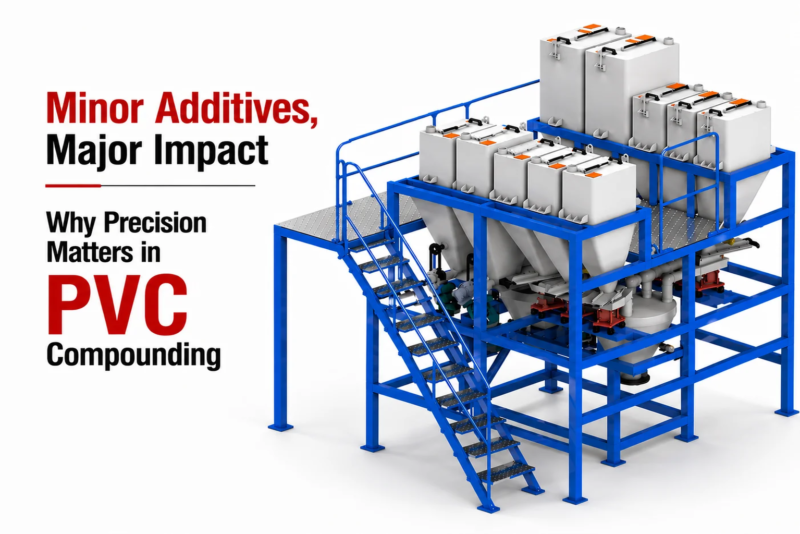
Minor Additives System , Major Impact: Why Precision Matters in PVC Compounding

When people think about PVC Compounding, they usually focus on the main ingredients like PVC Resin and Calcium Carbonate (CaCO₃). But in reality, some of the smallest ingredients in a formulation—known as Minor Additives—can have the biggest impact on the final product. 

A tiny variation in additive dosage can affect product quality, machine performance, production costs, and customer satisfaction. Whether it’s a stabilizer, lubricant, processing aid, or pigment, even a small dosing error can create significant challenges during manufacturing. That’s why successful manufacturers don’t just focus on major raw materials—they pay equal attention to minor additives and ensure they are handled with complete precision.

At Margo Industries, we have seen how accurate material handling, weighing, and dosing systems can completely transform a PVC manufacturing process. In this blog, we’ll explain step-by-step why minor additives matter, how they influence product performance, and why precision is essential for achieving consistent, high-quality PVC compounds.

What is PVC Compounding?

Before understanding additives, let’s first understand PVC Compounding.

PVC Compounding is the process of mixing PVC Resin with different ingredients to create a customized compound for a specific application.

Think of PVC Resin as flour in a cake recipe.

Just as flour alone cannot make a perfect cake, PVC Resin alone cannot provide all the properties required for industrial products.

That’s why manufacturers add various ingredients to achieve:

✔ Better strength

✔ Heat resistance

✔ Flexibility

✔ Durability

✔ Attractive appearance

✔ Longer product life 

The final mixture is called a PVC Compound.

What Role Does PVC Resin Play in PVC Compounding?

PVC Resin is the backbone of every PVC product.

Every PVC product starts with PVC Resin. It is the primary raw material used in PVC compound manufacturing and serves as the foundation of the final product.

PVC Resin provides:

✔ Strength

✔ Shape

✔ Structure

✔ Basic mechanical properties

It is usually supplied in white powder form and is used as the base material for manufacturing pipes, profiles, fittings, cables, and many other PVC products.

What Role Does Calcium Carbonate (CaCO₃) Play?

After PVC Resin, one of the most commonly used materials in PVC compounding is Calcium Carbonate (CaCO₃).

Benefits:

✔ Reduces formulation cost

✔ Improves stiffness

✔ Improves dimensional stability

✔ Supports processing

✔ Improves surface finish

However, accurate dosing is important because excessive CaCO₃ can negatively affect product quality and strength.

What Ingredients Are Used in PVC Compounding?

A typical PVC formulation contains:

Major Ingredients

  • PVC Resin
  • Fillers (Calcium Carbonate)
  • Plasticizers (for flexible PVC)

Minor Additives

  • Stabilizers
  • Lubricants
  • Processing Aids
  • Impact Modifiers
  • Pigments
  • Antioxidants

Although Minor Additives Systems are used in small quantities, their role is extremely important.

What Are Minor Additives?

Minor additives System are ingredients added in very small percentages compared to PVC Resin.

Many people think:

“If the quantity is small, the impact must also be small.”

But that’s not true.

A difference of just a few grams can change the entire performance of a PVC product.

That’s why manufacturers must ensure precise dosing and accurate weighing of every additive.

Understanding Each Minor Additive One by One

1. Stabilizers – The Protection Shield

PVC is processed at high temperatures.

Without stabilizers, PVC can start degrading during manufacturing.

What Stabilizers Do

✔ Prevent discoloration

✔ Improve thermal stability

✔ Increase product life

✔ Maintain product strength

Without Proper Stabilizer Dosage

You may face:

❌ Yellowing of products

❌ Reduced strength

❌ Lower durability

❌ Increased rejection rates

2. Lubricants – The Smooth Operators

During processing, materials move through machines and equipment.

Lubricants reduce friction and help materials flow smoothly.

Types of Lubricants  

Internal Lubricants

Improve material flow within the compound.

External Lubricants

Prevent sticking between the material and machine surfaces.

Benefits of Lubricants

✔ Better material flow

✔ Lower machine wear

✔ Improved surface finish

✔ Reduced processing problems

If Lubricants Are Incorrectly Added

Manufacturers may experience:

❌ Surface defects

❌ Material sticking

❌ Increased maintenance costs

3. Processing Aids – The Performance Boosters

Processing aids help PVC particles fuse properly and form a uniform melt during extrusion, resulting in a smoother and more consistent product. 

Processing aids improve the behavior of PVC during manufacturing.

Their Main Job

They help PVC melt and process more efficiently.

Benefits

✔ Faster production

✔ Better consistency

✔ Improved product quality

✔ Reduced defects

4. Impact Modifiers – The Strength Builders

Some PVC products need to withstand impact and rough handling.

Impact modifiers help achieve this.

Benefits

✔ Better toughness

✔ Higher impact resistance

✔ Reduced cracking

✔ Improved durability

This is especially important for:

  • PVC Pipes
  • Window Profiles
  • Industrial Components

5. Pigments – More Than Just Color

Pigments are used to provide color to PVC products.

But they do much more than improve appearance.

Common Pigments Used in PVC

Pigment Purpose
Titanium Dioxide White color and UV support
Carbon Black Black color and UV protection
Blue/Green/Yellow Pigments Product identification and branding

Pigment dosing accuracy is important because even a small variation can create visible color differences between batches.

Benefits

✔ Consistent product color

✔ Better UV resistance

✔ Enhanced brand identity

✔ Attractive finished products

Why Precision Matters in PVC Compounding

Let’s understand with a simple example.

Suppose a PVC formulation requires 100 kg PVC Resin and 2 kg Stabilizer. Now imagine the operator accidentally adds only 1 kg or 3 kg Stabilizer instead of the required amount.

It may seem like a small mistake, but the impact can be much bigger than expected.

Incorrect dosing can result in:

✔ Product quality issues

✔ Color inconsistency between batches

✔ Processing instability during manufacturing

✔ Material wastage

✔ Product rejections

✔ Increased machine downtime

✔ Customer complaints

✔ Higher production costs

In addition, overdosing expensive additives increases raw material consumption, while underdosing can reduce product performance, durability, and consistency.

These hidden losses often go unnoticed at first, but over time they can significantly affect production efficiency, profitability, and business growth.

This is why precision in PVC compounding is not optional—it is essential for maintaining consistent quality, minimizing wastage, controlling costs, and achieving reliable production results.

Minor Additives Dosing System: Ensuring Accuracy in PVC Compounding

As discussed earlier, Minor Additives Systems such as stabilizers, lubricants, pigments, processing aids, and impact modifiers are used in small quantities, but they have a major impact on the quality of PVC products. Even a small mistake in additive quantity can lead to product defects, inconsistent quality, material wastage, and higher production costs.

To eliminate these challenges, manufacturers use a Minor Additives Dosing System.

What Is a Minor Additives Dosing System?

A Minor Additives Dosing System is a specially designed system that accurately stores, weighs, and doses minor additives into the PVC formulation. Instead of manually measuring each additive, the system automatically delivers the exact quantity required for every batch.

In simple words, the system ensures that the right additive is added in the right quantity at the right time.

This helps manufacturers achieve consistent product quality and reliable production results.

What Is the Function of a Minor Additives Dosing System?

The main function of a Minor Additives Dosing System is to accurately measure and dose small quantities of additives according to the formulation recipe.

The system helps in:

✔ Accurate weighing of additives

✔ Precise dosing into the mixer

✔ Maintaining formulation accuracy

✔ Reducing manual handling

✔ Improving batch-to-batch consistency

✔ Supporting efficient PVC compound production

How Does the System Work?

The working process is simple:

Step 1: Storage

Different minor additives are stored in separate hoppers.

Step 2: Material Selection

The system selects the required additive based on the formulation recipe.

Step 3: Accurate Weighing

Each additive is weighed precisely using a weighing mechanism.

Step 4: Dosing

The exact quantity of additive is discharged into the mixer.

Step 5: Mixing

Once all ingredients are added correctly, the mixing process begins.

This ensures that every batch contains the correct formulation and delivers consistent quality.

Key Features of a Minor Additives Dosing System

✔ High-accuracy dosing

✔ Precise weighing of additives

✔ Recipe-based operation

✔ Separate storage hoppers

✔ Reduced human intervention

✔ Consistent batch quality

✔ Easy operation and monitoring

✔ Suitable for PVC compounding plants

Benefits of a Minor Additives Dosing System

Consistent Product Quality

Every batch receives the exact quantity of additives, resulting in uniform product performance.

Reduced Material Wastage

Accurate dosing prevents overuse of expensive additives and reduces wastage.

Lower Human Errors

Automation minimizes mistakes that can occur during manual weighing and dosing.

Improved Production Efficiency

The system speeds up the batching process and improves overall productivity.

Better Process Control

Manufacturers can maintain better control over formulations and production quality.

Reduced Production Costs

Less wastage, fewer product rejections, and smoother operations help lower manufacturing costs.

How Modern PVC Plants Maintain Precision

Leading manufacturers don’t rely on manual measurements.

Instead, they use automated systems.

Automatic Batch Weighing System

An automatic weighing system  accurately measures every ingredient according to the formulation.

Benefits

✔ High accuracy

✔ Repeatable results

✔ Reduced human errors

✔ Consistent product quality

✔ Faster production

Quality Starts Before Production Begins

Many manufacturers focus only on the extrusion process. However, product quality begins much earlier.

Successful PVC production depends on:

✔ Correct Raw Material

✔ Correct Storage

✔ Correct Weighing

✔ Correct Dosing

✔ Correct Mixing

Automation is not just material handling—it is quality control from the very first kilogram of material.

Why Choose Margo Industries?

At Margo Industries, we provide advanced minor additive dosing systems designed to deliver high accuracy, reliable performance, and consistent results for PVC compounding applications. Our solutions help manufacturers improve product quality, reduce wastage, and achieve greater production efficiency through precise material handling and dosing technology.

Final Thoughts

In PVC Compounding, success is not determined only by the quantity of material used. It is determined by the accuracy with which every ingredient is handled.

Minor Additives Systems may represent only a small percentage of the formulation, but they directly influence product quality, processing performance, durability, and profitability.

That’s why leading manufacturers invest in precision material handling systems, Automatic Batch Weighing Systems, and Pneumatic Conveying Systems to ensure every batch meets the highest standards.

With the right technology and expertise from Margo Industries, manufacturers can achieve better quality, lower wastage, higher productivity, and long-term business growth.
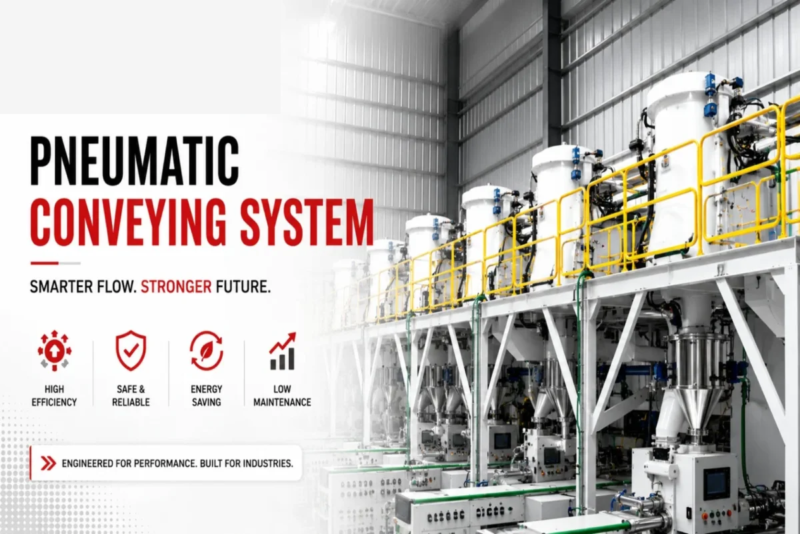
The Future of Bulk Material Handling: Why Pneumatic Conveying System is a Game Changer in Modern Industries

Material handling is typically a behind-the-scenes activity in most industries. However, when this process is not running smoothly, it can have serious repercussions throughout all other processes within an organization.

When there is inefficiency in material handling, issues such as dust contamination and product loss during transfer, as well as frequent need for maintenance, are common. This leads to higher costs and reduced productivity over time.

Pneumatic conveying  systems  provide an effective solution to these problems by allowing for cleaner and more controlled transfer of bulk materials throughout your facility.

Margo Industries delivers reliable, industry-specific solutions that enhance material handling efficiency and convert routine operations into high-performance, cost-effective processes.

What is a Pneumatic Conveying System?

Pneumatic Conveying system moves bulk materials (ex. powder, granules, dry solids) along pipes via the use of air pressure or vacuum.

Airflow moves materials through these pipes; this way, there is less dust, loss of material, and manual labor.

In other words, material is moved within pipes using moving air.

How Do Pneumatic Conveying Systems Work?

The way that the system operates is straightforward and effective, using material supplied by means of a hopper as input for the system. By generating air pressure/vacuum, the material is moved along a closed pipe system from point A to point B, where the material can then be separated/collected.

The system’s enclosed nature helps to preserve the cleanliness of the material being transferred and reduces waste during transportation.

Vacuum vs Pressure Conveying System  

Aspect    

Vacuum Conveying System 

Pressure Conveying System 

Introduction A vacuum conveying system is used to safely and cleanly transfer materials by pulling them through pipelines using suction. It is ideal where hygiene and dust control are important.  A pressure conveying system is used to move large quantities of materials quickly by pushing them through pipelines using air pressure. It is ideal for bulk handling over longer distances. 
How It Works Uses suction (negative pressure) to pull material from one point to another  Uses air pressure (positive pressure) to push material through pipes 
Where It Is Used Food industry (flour, sugar, spices), Pharma, Chemical powders Cement industry, Chemicals, Plastics, Bulk material handling
Why It Is Used For clean, dust-free, and contamination-free transfer For fast, long-distance, and bulk material transfer
Distance Best for short to medium distances Suitable for long distances
Material Type Fragile, lightweight, fine powders and hygiene-sensitive materials Heavy, abrasive, dense and high-volume bulk materials
Cleanliness Fully enclosed dust-free conveying with high hygiene standards  Good dust control but comparatively less hygienic than vacuum systems 
Main Benefit Clean, safe, and controlled handling High speed and efficient bulk transfer

Key Advantages

  • Workplace is cleaner and free of debris
  •  Material waste is minimized
  • Lower overall cost for maintenance
  • Increased productivity and efficiency
  • Flexible options in system design
  • Minimal Manpower depandcy

Where Is Pneumatic Conveying System Utilized?

Pneumatic conveying systems are utilized in multiple industries including:

  • Plastic and packaging Industries
  • Cement manufacturing
  • Food processing
  • Pharmaceutical manufacturing
  • Chemical manufacturing

Does Your Plant’s System Restrict Your Working Performance?

Should your factory encounter any dust issues, leakages of material  during machine stoppages, then the material handling system could be the cause of those issues.

Implementing an upgrade from a mechanical conveying mechanism to a pneumatic conveying mechanism could assist in the resolution of these operational challenges and will improve efficiency and productivity.

Why Choose Margo Industries?

At Margo Industries, we specialize in delivering customized material handling and automation solutions designed to meet your specific process requirements and industry standards.

With decades of expertise in pneumatic conveying and bulk material handling, we provide reliable, energy-efficient, and high-performance systems that help improve operational productivity, reduce material loss, and ensure smooth plant operations.

Our Solutions Include:
• Vacuum Conveying Systems
• Pressure Conveying Systems

Our goal is to deliver dependable and efficient conveying solutions that enhance your plant performance, optimize workflow, and support long-term operational excellence.

Need to Talk About Your Needs?

Whether you are working on a new project or upgrading an existing conveyance system, making the proper choice from the beginning will ensure you have the best solution available. Choosing the right pneumatic conveying systems will help improve efficiency and long-term performance.

Provide your request to Margo Industries, so that we can create a custom solution for your requirements and maximize your plant’s performance.

Frequently Asked Questions

  1. What is a pneumatic conveying system?

A pneumatic conveying system uses air pressure or vacuum to move bulk materials through pipes, providing an efficient and clean process for handling bulk material.

  1. What is the difference between vacuum conveying and pressure conveying?

Vacuum conveying uses suction to pull material and is suitable for applications requiring a high degree of cleanliness and contamination-free handling.

Pressure conveying uses compressed air to push material through pipelines and is suitable for transporting materials over long distances and for high-capacity bulk material handling applications

  1. What are some of the advantages of pneumatic conveying systems?

Pneumatic conveying systems have many advantages including the reduction of airborne dust, low material loss, reduced maintenance costs, reduced dependency on manual labour, and improved overall operational efficiency. 

  1. What industries use these systems?

Pneumatic conveying systems are typically found in the food, pharmaceuticals, chemicals, and plastics industries.

  1. Is it possible to customize the Pneumatic Conveying Systems?

Yes, the systems can be made according to your type of material, size, and layout. Margo Industries provides customized solutions.

  1. Are Pneumatic Conveying Systems exported?

Yes, Margo Industries exports pneumatic conveying systems across Africa and the Middle East, as well as to various other countries, delivering reliable solutions to clients worldwide.

  1. What is the process for getting a quote on Pneumatic Conveying Systems?

Share with us your type of material, required capacity, and distance to determine the proper solution for you and receive a quote.

In summary

In today’s competitive industrial environment, efficient material handling is no longer optional—it is essential for smooth operations and long-term growth. Pneumatic conveying systems offer a smarter, cleaner, and more reliable way to handle bulk materials while reducing dust, waste, and manual effort.

By upgrading to a modern pneumatic conveying solution, industries can improve productivity, maintain product quality, and lower operational costs. Whether you are setting up a new plant or upgrading an existing system, choosing the right conveying solution can make a significant difference in your overall performance.

At Margo Industries, we understand that every application is different. That’s why we provide customized Pressure conveying systems and vacuum conveying systems designed to meet your exact requirements. With our experience and global expertise, we help businesses achieve efficient, reliable, and future-ready material handling solutions.

If you are looking to improve your plant performance and reduce handling challenges, now is the right time to switch to advanced pneumatic conveying systems.

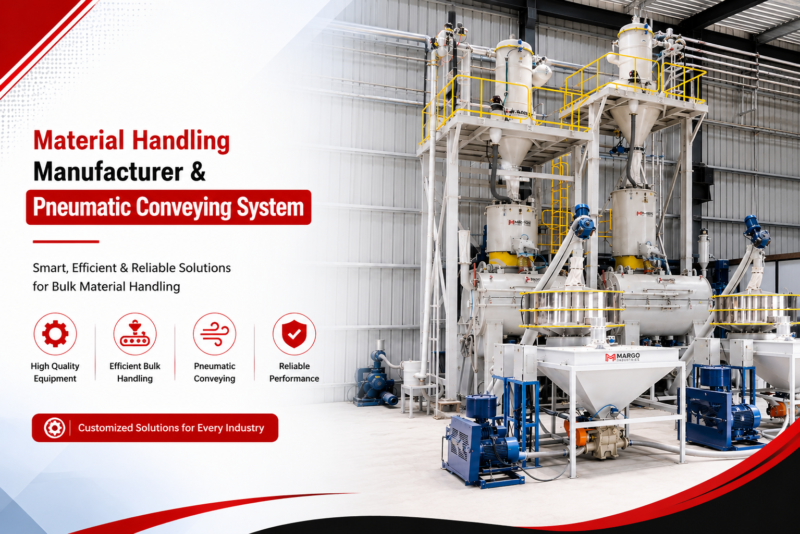
Material Handling Manufacturer & Pneumatic Conveying System

Material Handling Conveyor System Manufacturers, Suppliers & Exporters in Ahmedabad | Margo Industries

Being able to transport materials effectively from one part of the manufacturing process to another is what makes a manufacturing plant successful. Over an extended period, Margo Industries has provided reliable automation solutions for material handling and has provided clients around the globe with fellow-tailored, dependable solutions to their own material handling conveyor system manufacturers’ needs, allowing for an increased ability to produce and operate efficiently.

Margo Industries has many years of combined experience and knowledge within the marketplace, providing a full range of industrial pneumatic conveying systems and automation solutions for material handling, as well as a full suite of turnkey automation systems for all aspects of automated material handling, including providing manufacturers with smart/adjustable automation systems for conveying.

Introduction to Material Handling & Automation Solutions

Automated material-handling systems transport raw materials and intermediate and finished products. This is a service that many operate by automated material-handling systems due to the increase of technologically advanced conveyor systems, pneumatic conveying systems, reduction of manual-handling product processes, and increased consistency in the handling of either raw product or finished goods.

A professionally engineered material-handling system will allow for smooth movement of product while reducing non-productive machines’ downtime and providing better process control during all phases of the production process.

Margo Industries—A Trusted Material Handling System Manufacturer

Margo Industries claims to be a leading provider of material handling equipment with over 50 years’ experience in providing individualized, customized, and automated systems solutions. Due to our engineering expertise, the quality of our material handling system manufacturer’s process, and our “customer first” approach, we have been a preferred supplier for material handling systems throughout India and beyond.

We are experienced in designing our systems to meet the material characteristics, the plant layout of the facility, and the industry standards for the various products that we handle.

Industrial Pneumatic Conveying Systems for Modern Industries

The need for a clean and sanitary way to transfer materials has prompted companies within the industry to create industrial pneumatic conveying systems. Engineers at Margo Industries utilize both vacuum- and pressure-based pneumatic systems to move powder, granule, and bulk material. 

Below you will find benefits of our pneumatic conveying system:

1) Products are transferred in a contaminant-free and hygienic manner.

2) Minimal loss of product during transit.

3) Worker safety.

4) Efficiently conveying difficult-to-convey products.

Many industries use pneumatic systems for conveying material, such as pharmaceuticals, chemicals, food, and plastics.

Technical Specifications of Material Handling Conveyor Systems

As a trusted material handling conveyor system manufacturer, supplier, and exporter in Ahmedabad, Margo Industries offers detailed technical specifications to help clients understand system capabilities. These specifications may vary based on application and customization requirements.

Specifications Details
Conveyor Types Belt Conveyor, Pneumatic Conveyor, Bucket Elevator, Slat Conveyor
Key Components Belt, Rollers, Motor, Side Frames, Control & Drive System
Orientation Horizontal & Vertical
Handling Capacity 50 kg/feet, up to 1 ton/hour (Bucket Elevator)
Conveyor Width 10 to 20 inches
Conveyor Height Up to 10 to 20 feet
Power Source Electric
Operating Voltage 415 V
Conveyor Speed Up to 60 m/min (Customizable)
Load Capacity Up to 200 kg
Automation Grade Automatic/Semi-Automatic
Material of Construction Mild Steel (MS)
Length Customized as per system design
Applications Industrial Manufacturing, Packaging & Automation Lines

Automation Material Handling Solutions for Higher Productivity

Automation is no longer optional—it is a necessity. Margo Industries provides automation material handling solutions that help industries achieve consistent output and reduced human dependency.

Our automation solutions include:

  •         PLC & SCADA-based control systems
  •         Sensor-based material flow monitoring
  •         Seamless integration with existing machinery
  •         Energy-efficient and scalable designs

Automation improves accuracy, minimizes errors, and enhances overall plant performance.

Turnkey Automation in Conveying – End-to-End Expertise

Turnkey is one of the fundamental strengths of Margo Industries in turnkey automation conveying automation. From concept/design through installation/commissioning, we handle the full project lifecycle for you and your facility.

Turnkey services Margo’s offers include: 

* System design/engineer

* Manufacturing/quality inspection

* Installation and commissioning

* Training and support after

By providing turnkey solutions, Margo allows you to execute your projects with minimal hassle, as all aspects are handled by one source from conception to completion.

Industries Served by Margo Industries

As an established and experienced conveyor system fabricator and exporter from the city of Ahmedabad, we are able to provide customized conveyor systems to the following types of industry: 

  •         Pharmaceuticals

  •         Chemicals/Fertilizers
  •         Food/Beverage

  •         Plastics/Polymers

  •         FMCG/Packaging

  •         Cement/minerals

  •         Engineering/Manufacturing

We are dedicated to customizing all of our solutions to accommodate the standard processes of each industry within their specific area of operation.

Why Choose Us—Margo Industries (Call to Action)

The partner that you select will enhance your business through its positive attributes.

Margo Industries—Manufacturer Benefits

  • Established Manufacturer of Material Handling Systems
  • Preferred Manufacturer of Pneumatic Conveying Systems
  • Custom Automated Systems for Material Handling
  • Integrated, Complete Automation of Material Handling Systems
  • High-Quality Materials & Parts Used to Fabricate Material Handling Products
  • Outstanding Service After the Sale and Superior Technical Support.

If you wish to partner with Margo Industries for material handling & automation, please contact us today!

Benefits of Choosing an Experienced Material Handling Partner

Partnering with Margo Industries (a reliable manufacturer) can provide….

  1. Higher productivity 
  2. Lower Operational and Maintenance Costs 
  3. Safer, Cleaner Facilities 
  4. More Reliable Systems Over Time 
  5. Ability to Scale Up for Future Growth

Frequently Asked Questions (FAQs)

1. What does a material handling system manufacturer do?

A material handling system manufacturer designs and supplies systems that move, store, and control materials efficiently within industrial plants.

2. What are industrial pneumatic conveying systems used for?

They are used for dust-free and hygienic transfer of powders, granules, and bulk materials in industries like pharma, food, and chemicals.

3. Does Margo Industries provide automation solutions?

Yes, Margo Industries offers complete automation material handling solutions with PLC and control systems.

4. What is turnkey automation in conveying?

Turnkey automation means complete responsibility—from design and manufacturing to installation and commissioning—handled by one supplier.

5. Does Margo Industries serve clients outside Ahmedabad?

Yes, Margo Industries supplies and exports material handling systems across India and international markets.

Conclusion

As a leading material handling conveyor system manufacturer, supplier, and exporter in Ahmedabad, Margo Industries delivers advanced, reliable, and automation-ready solutions. With strong capabilities in industrial pneumatic conveying systems, automation material handling solutions, and turnkey automation in conveying, we help industries optimize material flow and achieve operational excellence.

Partner with Margo Industries for smart, efficient, and future-ready material handling solutions.