
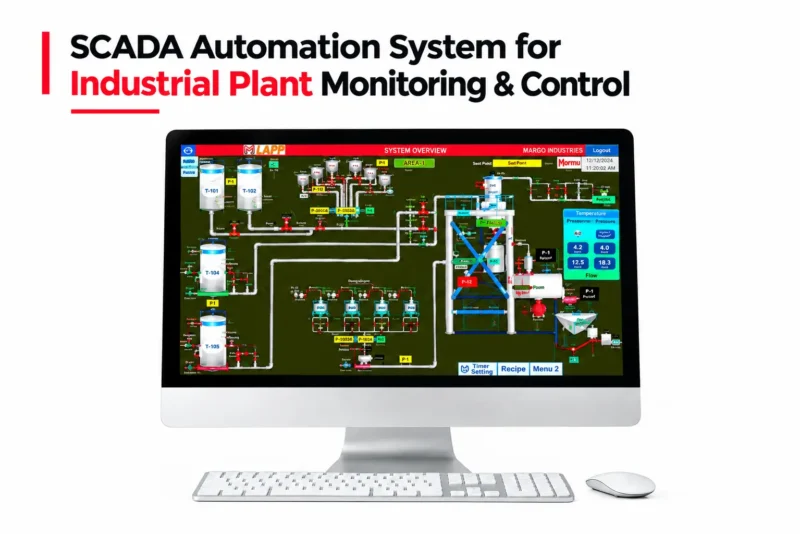
Margo Industries provides customized SCADA Automation Systems for industrial plant monitoring, process control, material handling, batching, weighing, dosing, conveying and storage applications. Our PLC and SCADA-based automation solutions provide centralized process visualization, real-time monitoring, alarm management and operational data visibility.
From individual equipment automation to complete plant automation, our SCADA solutions are designed around your process requirements and can integrate with conveyors, silos, weighing systems, dosing systems, mixers, valves, sensors and other industrial equipment.
What is a SCADA Automation System?
SCADA (Supervisory Control and Data Acquisition) is an industrial automation system used to monitor, visualize and supervise manufacturing and process operations from a centralized interface.
A SCADA Automation System collects information from sensors, instruments, machines and PLCs and presents the relevant process information through graphical screens.
Operators can use the SCADA interface to monitor:
- Equipment status
- Material flow
- Pressure
- Temperature
- Weight
- Silo levels
- Dosing quantities
- Batch status
- Motor and valve status
- Process alarms
- Historical trends
- Production information
In simple terms, PLC controls the equipment, while SCADA gives operators centralized visibility and supervisory control of the process.
Margo already uses PLC and SCADA integration across applications such as material handling, batching, dosing and compounding automation.
How Does SCADA Automation Work?
A typical SCADA automation system connects field devices, PLCs, communication networks and SCADA software.
1. Sensors Collect Process Data
Sensors and instruments collect information from the plant.
Examples include:
- Pressure sensors
- Level sensors
- Temperature sensors
- Load cells
- Flow instruments
- Proximity sensors
- Equipment feedback signals
2. PLC Processes the Signals
The signals are transferred to the PLC (Programmable Logic Controller).
The PLC processes the input signals according to the programmed automation logic and controls the connected equipment.
3. Data is Communicated to SCADA
The PLC communicates relevant process information to the SCADA system through the plant’s industrial communication architecture.
4. SCADA Displays the Process
SCADA converts the information into graphical screens that allow operators to see the process in real time.
5. Operators Monitor & Supervise
Operators can monitor equipment status, process parameters, alarms and selected control functions from the centralized SCADA interface.
SCADA Automation System Architecture
A typical industrial SCADA system can be understood as:
Sensors & Instruments
↓
PLC / Control System
↓
Industrial Communication Network
↓
SCADA Software
↓
Operator / Control Room
Each level performs a different function.
Field Level
Sensors, transmitters, motors, valves, drives and other equipment interact with the physical process.
Control Level
PLCs process signals and execute the programmed automation logic.
Communication Level
Industrial communication connects the control system with SCADA and other integrated devices.
Supervisory Level
SCADA provides visualization, alarms, trends, data monitoring and supervisory functions.
PLC and SCADA Integration
A PLC SCADA Automation System combines machine-level control with centralized supervisory monitoring.
The PLC handles real-time control logic, while SCADA provides a graphical interface for monitoring and managing the overall process.
For example, in an automated material handling plant:
Material Storage → Conveying → Weighing → Dosing → Mixing → Production
can be monitored through a centralized SCADA interface.
This type of integration is particularly useful where several machines or process stages need to operate in a coordinated sequence.
SCADA Automation for Material Handling
For Margo Industries, this is an important section because SCADA should connect directly with your core business instead of looking like a generic IT/software page.
SCADA can be integrated with automated material handling systems to provide centralized monitoring and control of:
1. Pneumatic Conveying Systems
Monitor conveying sequences, equipment status, pressure-related parameters, valves and process alarms.
2. Vacuum Conveying Systems
Monitor vacuum conveying cycles, equipment operation, material transfer and system status.
3. Pressure Conveying Systems
Monitor conveying parameters, valves, pressure conditions and equipment operation.
4. Automatic Batch Weighing Systems
Monitor material feeding, weighing values, batch sequences and recipe-related operations.
5. Liquid Dosing & Weighing Systems
Monitor dosing quantities, process parameters, equipment status and alarms.
6. Raw Material & Recipe Silos
Monitor material levels, silo status, feeding operations and connected equipment.
7. Automatic Mixer Feeding Systems
Monitor material feeding sequences, weighing information and mixer-related operations.
Margo’s existing automation portfolio includes these types of systems, including conveying, weighing, dosing, silo and PLC-SCADA-based compounding solutions.
Key Features of SCADA Automation
1. Real-Time Process Monitoring
View important plant parameters and equipment status through a centralized interface.
2. Graphical Process Visualization
Represent machines and processes through intuitive graphical screens so operators can understand plant conditions quickly.
3. Alarm Management
Configured alarms can notify operators when selected process conditions, equipment faults or abnormal events occur.
4. Historical Data & Trends
Selected process values can be recorded and displayed as historical trends for process analysis.
5. Batch & Recipe Monitoring
For suitable applications, batch and recipe information can be integrated into the automation interface.
6. Equipment Status Monitoring
Monitor motors, valves, conveyors, pumps and other connected equipment.
7. Centralized Control
Multiple automated process sections can be brought together within a centralized supervisory system.
8. Data Visibility
Relevant operational data can be made available for monitoring, reporting and process analysis.
9. Batch Report Generation
SCADA Automation Systems enable batch report generation by recording batch details, process parameters, material consumption, and production data. These reports help maintain production records, improve traceability, and support quality control and process analysis.
Benefits of SCADA Automation System
1. Better Process Visibility
SCADA provides a centralized view of connected plant operations.
2. Reduced Manual Monitoring
Operators can monitor multiple process parameters from a centralized interface instead of manually checking each equipment point.
3. Faster Identification of Abnormal Conditions
Alarm and status information helps operators identify configured faults and process deviations.
4. Improved Process Control
PLC and SCADA integration enables coordinated automation and supervisory monitoring.
5. Better Production Data
Historical process information can support production review and process analysis.
6. Improved Batch Consistency
For automated batching and dosing applications, SCADA can provide visibility into weighing, dosing and recipe-related operations.
7. Scalable Automation
The system can be designed around the required plant equipment and expanded as automation requirements change.
SCADA Automation Applications
Margo’s SCADA-based automation solutions can be applied to:
- Plastic & PVC Industries
- Polymer Compounding Plants
- Chemical Industries
- Pharmaceutical Industries
- Food Processing Industries
- Pigment Industries
- Powder Processing Plants
- Bulk Material Handling Plants
- Batching & Weighing Applications
- Dosing Applications
- Silo & Storage Systems
- Pneumatic Conveying Systems
- Complete Plant Automation
Margo currently positions PLC/SCADA automation across industries including plastics, chemicals, pharmaceuticals and food processing.
Full Plant Automation with SCADA
For plants with multiple interconnected processes, SCADA can act as the supervisory layer for complete plant automation.
A typical automated plant may include:
Raw Material Storage
↓
Material Conveying
↓
Weighing & Dosing
↓
Batch Preparation
↓
Mixing / Processing
SCADA can provide a centralized view of these operations, while PLC-based automation manages the required control sequences.
Margo describes its full-plant SCADA solutions as integrating material handling, mixing, weighing, batching, conveying and storage into a unified monitoring and control system.
Why Choose Margo Industries for SCADA Automation?
50+ Years of Industrial Engineering Experience
Margo Industries has been working in industrial engineering, material handling and automation since 1969.
Material Handling + Automation Expertise
Instead of treating SCADA as a standalone software solution, Margo can connect automation with actual industrial equipment and material handling processes.
Customized Automation
SCADA screens, monitoring requirements, control logic and system integration can be designed around the project requirements.
Integrated Solutions
SCADA can be integrated with conveying, weighing, dosing, storage, feeding and other automation systems.
-
Turnkey Approach
Margo provides end-to-end industrial automation capabilities from engineering and manufacturing through installation and commissioning.
SCADA Automation System FAQs
1. What is SCADA Automation?
SCADA Automation is an industrial supervisory system used to monitor, visualize, collect data from and supervise automated processes.
2. What is the difference between PLC and SCADA?
A PLC primarily executes control logic and controls connected equipment, while SCADA provides centralized visualization, monitoring, alarms and supervisory functions.
3. Can SCADA be integrated with material handling systems?
Yes. SCADA can be integrated with pneumatic conveying, vacuum conveying, pressure conveying, batching, weighing, dosing, feeding and silo systems.
4. What can be monitored through SCADA?
Depending on the application, SCADA can monitor equipment status, pressure, temperature, weight, level, flow, alarms, batch information and other process parameters.
5. Can SCADA be customized for an industrial plant?
Yes. SCADA architecture, screens, parameters, alarms, data logging and integration can be configured according to the plant’s requirements.
6. Does Margo Industries provide SCADA Automation Solutions?
Yes. Margo Industries provides customized PLC and SCADA-based automation solutions for material handling, process automation, batching, dosing, weighing, conveying and complete plant automation.
Ready to Automate Your Plant?
Improve plant visibility with a customized SCADA Automation System from Margo Industries.
Whether you need SCADA for material handling, PLC-SCADA integration, batch automation, dosing automation, conveying control or complete plant automation, our team can develop a solution around your process requirements.
Request a Quote →
Talk to Our Automation Experts →