Pressure Conveying System: How It Works, Benefits & Industrial Applications
Moving powders, granules, pellets, and other bulk materials from one point to another is a common requirement in modern manufacturing. Traditionally, industries relied on mechanical conveyors, manual handling, or open transfer methods. However, these methods can take up more space, require frequent maintenance, and may increase the risk of material contamination.
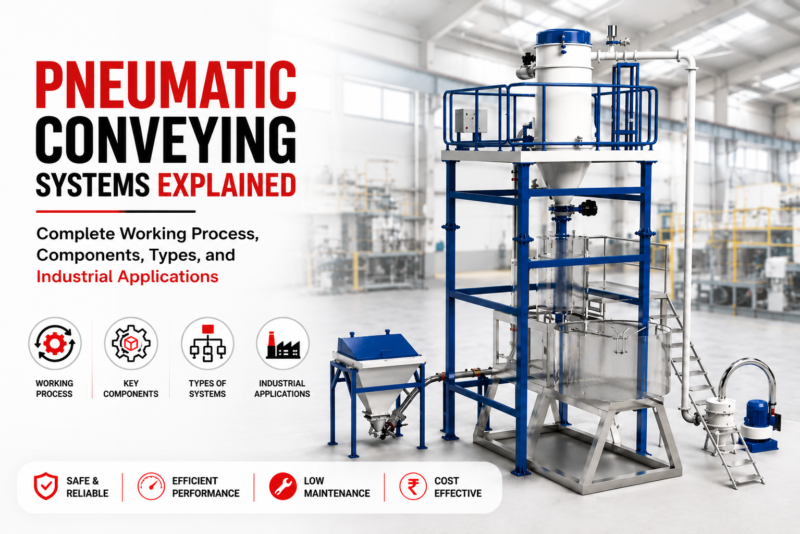
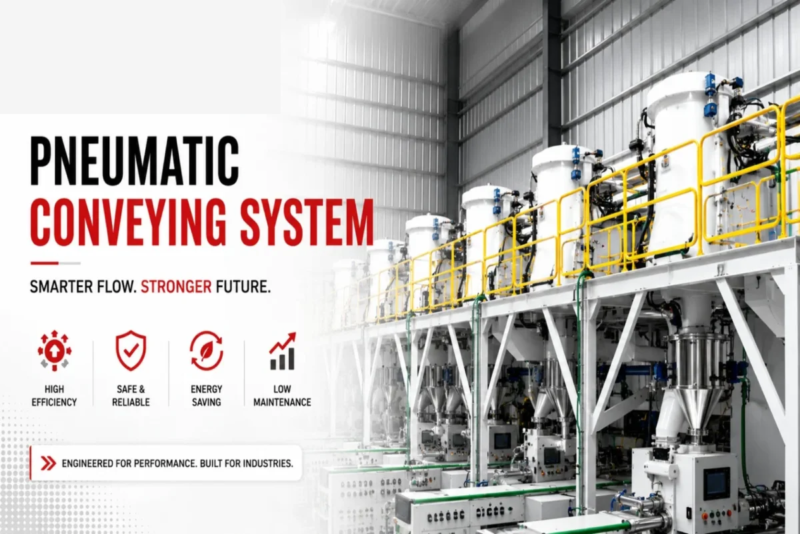
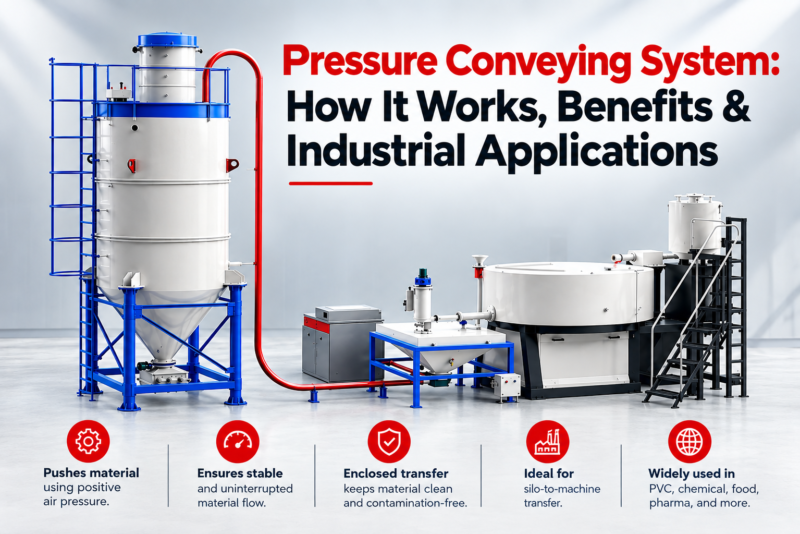
A Pressure Conveying System is a type of Pneumatic Conveying System that uses positive air pressure to transport bulk materials through enclosed pipelines. It offers a cleaner, enclosed, and efficient way to move materials and is widely used in industries such as plastics, chemicals, pharmaceuticals, food processing, minerals, and general manufacturing.
In this guide, we will explain what a Pressure Conveying System is, how it works, its complete process, major components, types, benefits, limitations, applications, and how to choose the right system for your industry.
What Is a Pressure Conveying System?
A Pressure Conveying System is a pneumatic material handling system that transports dry bulk materials through a closed pipeline using positive air pressure.
In simple words, imagine you need to move plastic granules from a storage hopper to a processing machine located some distance away. Instead of using a belt or manually carrying the material, the system uses compressed or pressurized air to push the material through a pipeline until it reaches the required destination.
The basic concept is:
Material + Pressurized Air → Pipeline → Destination
Because the material travels through an enclosed pipeline, the system can reduce dust generation, material exposure, and manual handling.
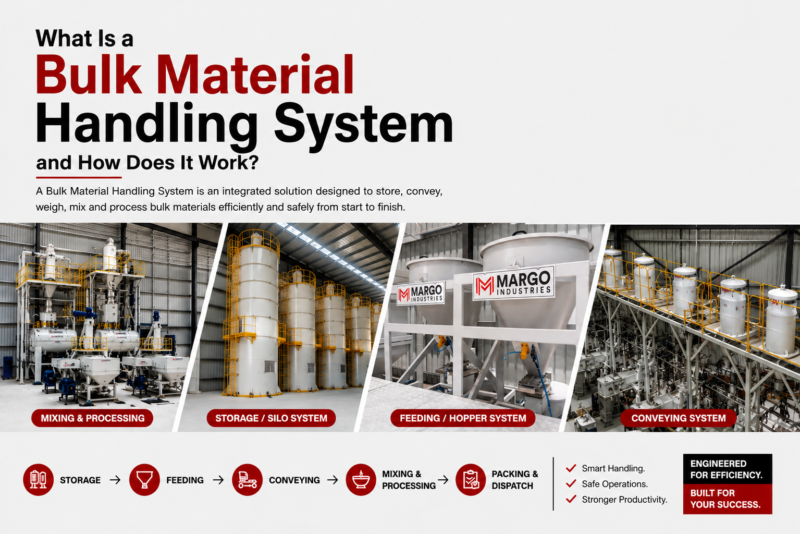
Margo Industries provides pneumatic conveying and bulk material handling solutions designed around different material characteristics, conveying distances, capacities, and industrial requirements.
How Does a Pressure Conveying System Work?
The working principle of a pressure conveying system is relatively straightforward, although the actual system design can become highly customized depending on the application.
Here is the complete process:
1. Material Feeding
The process begins when the bulk material is supplied from a source such as:
- Silo
- Hopper
- Storage bin
- Bag dumping station
- Bulk bag unloading system
- Process equipment
A suitable feeding device controls how much material enters the conveying pipeline.
2. Air Is Generated
A blower, compressor, or other air-moving equipment generates the required pressure.
The air source must be selected according to factors such as:
- Conveying distance
- Material characteristics
- Required capacity
- Pipeline diameter
- Pressure requirement
3. Material Enters the Pipeline
The material is introduced into the conveying line through a controlled feeding arrangement.
At this stage, the system must maintain the correct balance between material flow and air flow. Too much material can cause blockages, while excessive air velocity can damage sensitive products or increase energy consumption.
4. Pressurized Air Pushes the Material
This is the main working stage.
The pressurized air moves through the pipeline and carries or pushes the bulk material toward the destination.
Depending on the system design, the material can travel:
Horizontally → Vertically → Around bends → To elevated equipment
This flexibility is one of the major reasons industries use pneumatic conveying systems.
5. Material Reaches the Destination
The material eventually reaches the receiving equipment, such as:
- Processing machine
- Silo
- Hopper
- Packaging machine
6. Air and Material Are Separated
At the receiving point, a filter, cyclone, receiver, or suitable separation equipment separates the conveyed material from the conveying air.
The material moves into the receiving equipment, while the air is filtered and released or recirculated depending on the system design.
7. Material Is Ready for the Next Process
Once the material has reached its destination, it can be automatically transferred into the next production stage.
This creates a continuous and automated material handling process with less manual intervention.
Pressure Conveying System Working Process at a Glance
The complete process can be understood as:
Material Storage → Feeding → Air Generation → Pressure Conveying → Pipeline Transportation → Material-Air Separation → Receiving Equipment → Next Process
This automated flow makes pressure conveying particularly useful where materials need to be moved frequently between different stages of production.
Main Components of a Pressure Conveying System
A pressure conveying system consists of several components working together.
1. Air Blower or Compressor
The blower or compressor generates the air pressure required to move the material.
The correct air source depends on the conveying pressure, distance, capacity, and material.
2. Feeding Equipment
The feeder controls the quantity of material entering the pipeline.
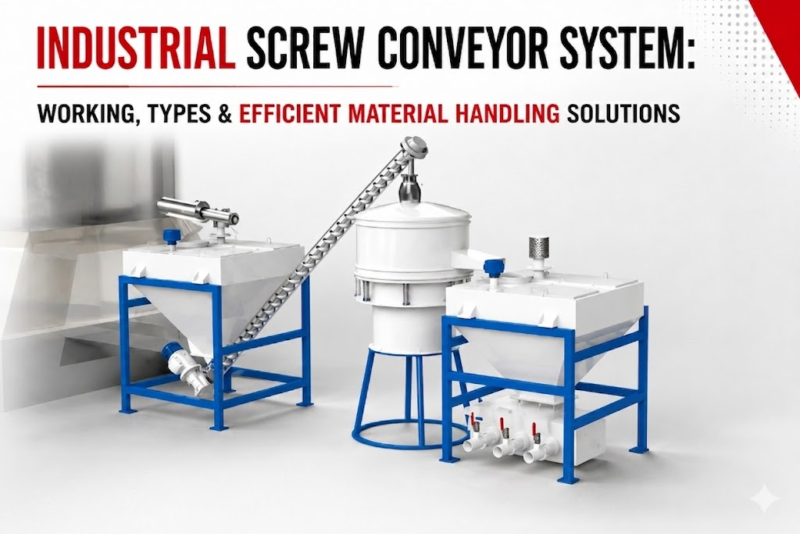
Common feeding arrangements include rotary valves, screw feeders, pressure vessels, and other specialized feeding systems.
3. Conveying Pipeline
The pipeline provides the enclosed route through which the material travels.
Pipeline diameter, length, bends, layout, and material selection can significantly influence system performance.
4. Diverter Valves
Diverter valves can direct material toward different destinations when a plant has multiple receiving points.
5. Filters
Filters help separate material particles from conveying air and minimize dust emissions.
6. Receiver or Separator
The receiver collects the conveyed material at the destination while separating it from the air stream.
7. Control System
Modern pneumatic conveying systems can be integrated with automation and control systems to monitor and manage:
- Air pressure
- Material flow
- Feeding rate
- Valves
- Alarms
- Equipment operation
- Level Sensors
- Weighing
Types of Pressure Conveying Systems
Pressure conveying systems can generally be categorized according to how the material travels through the conveying pipeline.
1. Dilute Phase Pressure Conveying System
In a Dilute Phase Conveying System, material is transported at relatively high air velocity with the particles suspended in the air stream.
It is suitable for materials that can tolerate higher conveying velocities.
Advantages
- High conveying capacity
- Suitable for longer conveying routes
- Relatively simple system design
- Suitable for many lightweight materials
- Continuous material transfer
Typical Applications
Dilute phase pressure conveying is commonly used for:
- Plastic pellets
- Granules
- Powders
- Food ingredients
- Chemical materials
2. Dense Phase Pressure Conveying System
In Dense Phase Conveying, material moves at a lower velocity and generally at a higher solids concentration compared with dilute phase conveying.
Instead of keeping all particles continuously suspended, the material can move in plugs, slugs, or dense pockets depending on the system design.
Advantages
- Lower conveying velocity
- Reduced particle degradation
- Lower risk of product damage for suitable materials
- Reduced pipeline wear for some applications
- Suitable for fragile or abrasive materials when properly designed
Dense phase conveying is often considered when material quality and controlled conveying are important.
Pressure Conveying vs Vacuum Conveying
One common question is: Should I choose pressure conveying or vacuum conveying?
The main difference is where the air pressure is applied.
| Feature | Pressure Conveying | Vacuum Conveying |
| Principle | Pushes material | Pulls material |
| Air pressure | Positive pressure | Negative pressure |
| Suitable for | Multiple destinations | Multiple pickup points |
| Enclosed transfer | Yes | Yes |
| Applicable when? | Suitable for longer-distance transfer and multiple destination points | Suitable for multiple pickup points and flexible material collection |
| System selection | Depends on layout and material | Depends on layout and material |
Neither system is automatically better for every application. The right choice depends on the material, plant layout, conveying distance, required capacity, and process requirements.
Key Benefits of a Pressure Conveying System
1. Enclosed Material Transfer
Because the material moves inside a pipeline, exposure to the surrounding environment is minimized.
This can be particularly valuable when handling powders, chemicals, food ingredients, or materials that require controlled transfer conditions.
2. Reduced Manual Handling
Automation reduces the need for workers to manually transport materials between different production stages.
This can improve operational efficiency and reduce repetitive handling activities.
3. Saves Floor Space
Unlike long belt or mechanical conveyor arrangements, pipelines can be routed above equipment and through relatively compact plant layouts.
4. Flexible Plant Layout
Pipelines can be designed to move materials across:
- Different floors
- Long distances
- Vertical elevations
- Multiple process areas
5. Reduced Material Contamination
The enclosed conveying route can help protect material from external contamination compared with open transfer methods.
6. Easy Integration With Automation
Pressure conveying systems can be integrated with automated production lines, PLC systems, sensors, and material management systems.
7. Suitable for Different Materials
With proper engineering, pneumatic conveying can handle various dry bulk materials, including powders, granules, pellets, and other free-flowing materials.
8. Improved Production Efficiency
Automated transfer helps maintain a consistent flow of material to processing equipment, which can support smoother production operations.
Industrial Applications of Pressure Conveying Systems
Pressure conveying is used across a wide range of industries.
Plastics Industry
Plastic manufacturers commonly use pneumatic conveying to transfer:
- Plastic granules
- Polymer pellets
- PVC compounds
- Masterbatch
- Regrind materials
Materials can be transferred from silos or storage systems to other processing equipment.
Chemical Industry
Pressure conveying can be used for transporting suitable dry chemical powders and granular materials between storage and processing areas.
Food Processing
Food-grade pneumatic conveying systems can transport ingredients such as powders and granules in enclosed pipelines.
The system design should meet the hygiene and material-handling requirements of the application.
Pharmaceutical Industry
Controlled pneumatic conveying can be used for suitable pharmaceutical powders and ingredients where enclosed material transfer is required.
Cement and Mineral Industries
Pneumatic systems can also be used for suitable powders and fine materials in cement, minerals, and related processing industries.
General Manufacturing
Manufacturing plants can use pneumatic conveying to connect storage, processing, mixing, weighing, and packaging operations.
How to Choose the Right Pressure Conveying System?
Choosing a system only by looking at the required conveying distance is not enough.
Several factors should be evaluated.
1. Material Characteristics
Consider:
- Particle size
- Bulk density
- Moisture
- Flowability
- Abrasiveness
- Fragility
- Temperature
- Dust characteristics
2. Required Capacity
Determine how much material needs to be transferred per hour.
For example:
kg/hour or tons/hour
The required capacity directly affects feeder, pipeline, blower, and system sizing.
3. Conveying Distance
The total pipeline length, number of bends, vertical lift, and routing should be considered.
4. Material Sensitivity
If the product is fragile, the conveying velocity and system type should be selected carefully to minimize degradation.
5. Destination Points
A single-destination system and a multi-destination system may require completely different layouts and valve arrangements.
6. Energy Efficiency
An efficient system should provide the required conveying performance without unnecessarily increasing air consumption or pressure requirements.
Why Proper System Design Matters
A pressure conveying system may look simple from the outside—just a pipeline carrying material from one point to another. But behind that pipeline is a combination of engineering calculations and equipment selection.
A properly designed system considers:
Material Properties + Capacity + Distance + Air Velocity + Pressure + Pipeline Size + Feeding Method + Receiving Equipment
When these factors are correctly matched, the system can provide reliable and consistent material transfer.
Pressure Conveying System for Modern Material Handling
Industries are increasingly looking for automated solutions that reduce manual handling while improving productivity and process control. This is where pneumatic conveying becomes valuable.
A well-designed Pressure Conveying System can connect different stages of a production facility—from raw material storage to processing and packaging—while keeping material movement enclosed and automated.
For companies handling plastic granules, powders, chemicals, food ingredients, pharmaceutical materials, or other dry bulk products, selecting the right conveying technology can make a significant difference to production efficiency.
Margo Industries offers customized material handling and pneumatic conveying solutions based on the specific requirements of the application, including material characteristics, capacity, conveying distance, and plant layout.
Frequently Asked Questions About Pressure Conveying Systems
1. What is a Pressure Conveying System?
A Pressure Conveying System is a pneumatic material handling system that uses positive air pressure to transport dry bulk materials through an enclosed pipeline from one point to another.
2. How does a pressure conveying system work?
The system feeds material into a pipeline, generates pressurized air using a blower or compressor, and uses that air to push the material through the pipeline to the receiving point.
3. What materials can be transported using pressure conveying?
Depending on the system design, it can transport powders, pellets, granules, plastic materials, food ingredients, chemicals, pharmaceutical materials, minerals, and other suitable dry bulk materials.
4. What is the difference between pressure and vacuum conveying?
Pressure conveying pushes material through the pipeline using positive air pressure, while vacuum conveying pulls material toward the receiving point using negative pressure.
5. What are the main types of pressure conveying?
The two commonly discussed types are dilute phase pressure conveying and dense phase pressure conveying. The appropriate type depends on material characteristics, capacity, distance, and process requirements.
6. Does pressure conveying reduce manual material handling?
Yes. Since material transfer can be automated through enclosed pipelines, it can significantly reduce the need for manual movement between process stages.
7. How do I select the right pressure conveying system?
Start by. evaluating the material, required capacity, conveying distance, elevation, number of destinations, material sensitivity, and plant layout. A professional system design can then determine the appropriate conveying method and equipment.
Conclusion
A Pressure Conveying System is more than just a method of moving material through a pipe. It is an automated bulk material handling solution that can help industries achieve cleaner, safer, more efficient, and more flexible material transfer.
From plastic granules and powders to food ingredients, chemicals, pharmaceuticals, and industrial materials, pressure conveying can be adapted to many production environments.
The key to successful operation is choosing the correct conveying type, air velocity, pipeline size, feeding equipment, and control system according to the material and application.
If your industry requires reliable and customized bulk material transportation, a properly engineered Pressure Conveying System can be an important part of an efficient automated material handling setup.